







Siah Duzi weaves Sistan’s history into contemporary fashion
In Sistan and Baluchestan Province, an ancient land, traditional arts have emerged from people’s everyday lives and been passed down from one generation to the next, becoming an integral part of the region’s cultural identity. These crafts are more than decorative forms; they tell stories of the history, culture, nature and lifestyle of the people of Sistan.
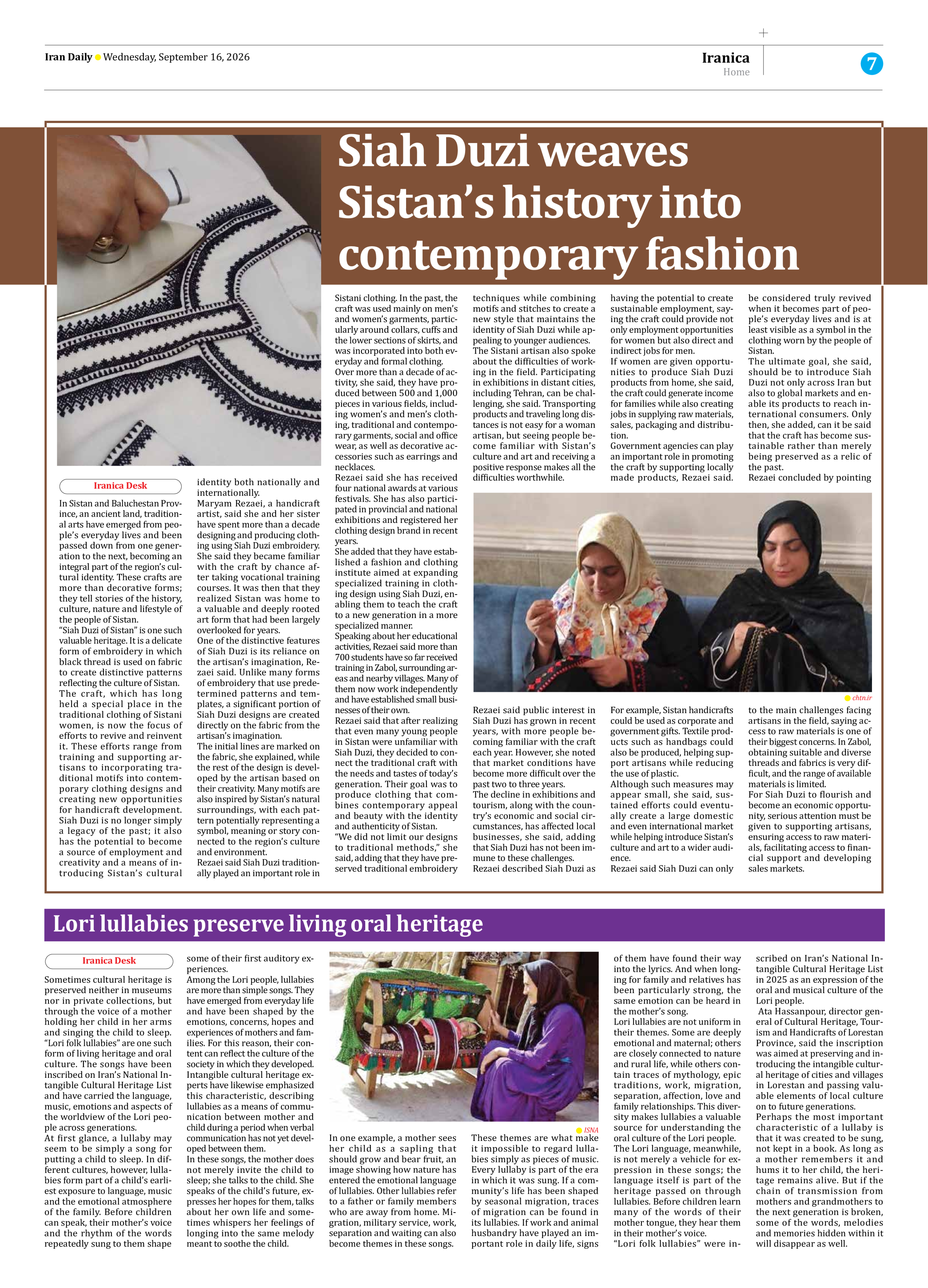
“Siah Duzi of Sistan” is one such valuable heritage. It is a delicate form of embroidery in which black thread is used on fabric to create distinctive patterns reflecting the culture of Sistan.
The craft, which has long held a special place in the traditional clothing of Sistani women, is now the focus of efforts to revive and reinvent it. These efforts range from training and supporting artisans to incorporating traditional motifs into contemporary clothing designs and creating new opportunities for handicraft development. Siah Duzi is no longer simply a legacy of the past; it also has the potential to become a source of employment and creativity and a means of introducing Sistan’s cultural identity both nationally and internationally.
Maryam Rezaei, a handicraft artist, said she and her sister have spent more than a decade designing and producing clothing using Siah Duzi embroidery.
She said they became familiar with the craft by chance after taking vocational training courses. It was then that they realized Sistan was home to a valuable and deeply rooted art form that had been largely overlooked for years.
One of the distinctive features of Siah Duzi is its reliance on the artisan’s imagination, Rezaei said. Unlike many forms of embroidery that use predetermined patterns and templates, a significant portion of Siah Duzi designs are created directly on the fabric from the artisan’s imagination.
The initial lines are marked on the fabric, she explained, while the rest of the design is developed by the artisan based on their creativity. Many motifs are also inspired by Sistan’s natural surroundings, with each pattern potentially representing a symbol, meaning or story connected to the region’s culture and environment.
Rezaei said Siah Duzi traditionally played an important role in Sistani clothing. In the past, the craft was used mainly on men’s and women’s garments, particularly around collars, cuffs and the lower sections of skirts, and was incorporated into both everyday and formal clothing.
Over more than a decade of activity, she said, they have produced between 500 and 1,000 pieces in various fields, including women’s and men’s clothing, traditional and contemporary garments, social and office wear, as well as decorative accessories such as earrings and necklaces.
Rezaei said she has received four national awards at various festivals. She has also participated in provincial and national exhibitions and registered her clothing design brand in recent years.
She added that they have established a fashion and clothing institute aimed at expanding specialized training in clothing design using Siah Duzi, enabling them to teach the craft to a new generation in a more specialized manner.
Speaking about her educational activities, Rezaei said more than 700 students have so far received training in Zabol, surrounding areas and nearby villages. Many of them now work independently and have established small businesses of their own.
Rezaei said that after realizing that even many young people in Sistan were unfamiliar with Siah Duzi, they decided to connect the traditional craft with the needs and tastes of today’s generation. Their goal was to produce clothing that combines contemporary appeal and beauty with the identity and authenticity of Sistan.
“We did not limit our designs to traditional methods,” she said, adding that they have preserved traditional embroidery techniques while combining motifs and stitches to create a new style that maintains the identity of Siah Duzi while appealing to younger audiences.
The Sistani artisan also spoke about the difficulties of working in the field. Participating in exhibitions in distant cities, including Tehran, can be challenging, she said. Transporting products and traveling long distances is not easy for a woman artisan, but seeing people become familiar with Sistan’s culture and art and receiving a positive response makes all the difficulties worthwhile.
Rezaei said public interest in Siah Duzi has grown in recent years, with more people becoming familiar with the craft each year. However, she noted that market conditions have become more difficult over the past two to three years.
The decline in exhibitions and tourism, along with the country’s economic and social circumstances, has affected local businesses, she said, adding that Siah Duzi has not been immune to these challenges.
Rezaei described Siah Duzi as having the potential to create sustainable employment, saying the craft could provide not only employment opportunities for women but also direct and indirect jobs for men.
If women are given opportunities to produce Siah Duzi products from home, she said, the craft could generate income for families while also creating jobs in supplying raw materials, sales, packaging and distribution.
Government agencies can play an important role in promoting the craft by supporting locally made products, Rezaei said. For example, Sistan handicrafts could be used as corporate and government gifts. Textile products such as handbags could also be produced, helping support artisans while reducing the use of plastic.
Although such measures may appear small, she said, sustained efforts could eventually create a large domestic and even international market while helping introduce Sistan’s culture and art to a wider audience.
Rezaei said Siah Duzi can only be considered truly revived when it becomes part of people’s everyday lives and is at least visible as a symbol in the clothing worn by the people of Sistan.
The ultimate goal, she said, should be to introduce Siah Duzi not only across Iran but also to global markets and enable its products to reach international consumers. Only then, she added, can it be said that the craft has become sustainable rather than merely being preserved as a relic of the past.
Rezaei concluded by pointing to the main challenges facing artisans in the field, saying access to raw materials is one of their biggest concerns. In Zabol, obtaining suitable and diverse threads and fabrics is very difficult, and the range of available materials is limited.
For Siah Duzi to flourish and become an economic opportunity, serious attention must be given to supporting artisans, ensuring access to raw materials, facilitating access to financial support and developing sales markets.