







Copy in clipboard...
Ayatollah Taleqani linked faith, freedom and political activism
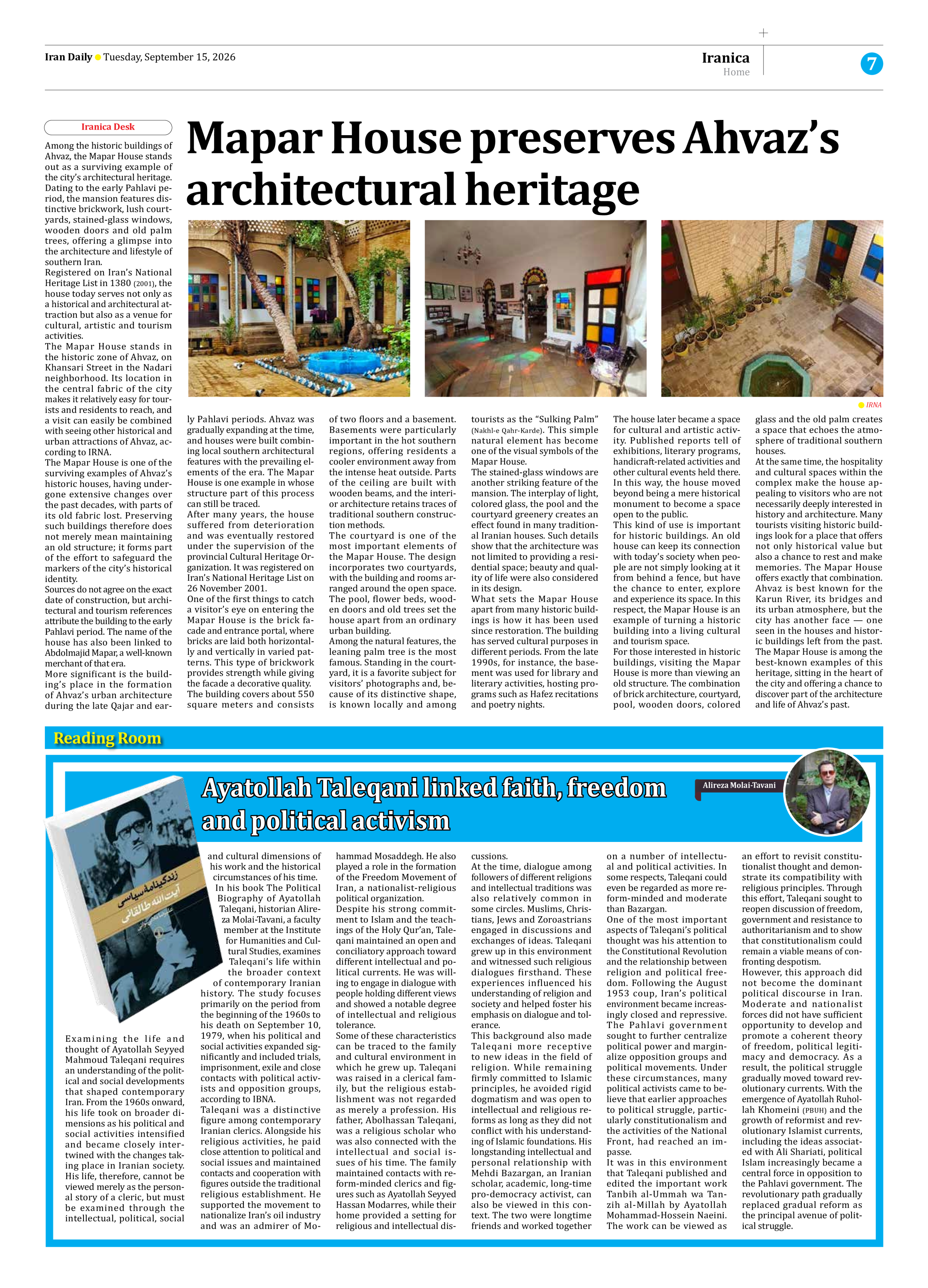
In his book The Political Biography of Ayatollah Taleqani, historian Alireza Molai-Tavani, a faculty member at the Institute for Humanities and Cultural Studies, examines Taleqani’s life within the broader context of contemporary Iranian history. The study focuses primarily on the period from the beginning of the 1960s to his death on September 10, 1979, when his political and social activities expanded significantly and included trials, imprisonment, exile and close contacts with political activists and opposition groups, according to IBNA.
Taleqani was a distinctive figure among contemporary Iranian clerics. Alongside his religious activities, he paid close attention to political and social issues and maintained contacts and cooperation with figures outside the traditional religious establishment. He supported the movement to nationalize Iran’s oil industry and was an admirer of Mohammad Mosaddegh. He also played a role in the formation of the Freedom Movement of Iran, a nationalist-religious political organization.
Despite his strong commitment to Islam and the teachings of the Holy Qur’an, Taleqani maintained an open and conciliatory approach toward different intellectual and political currents. He was willing to engage in dialogue with people holding different views and showed a notable degree of intellectual and religious tolerance.
Some of these characteristics can be traced to the family and cultural environment in which he grew up. Taleqani was raised in a clerical family, but the religious establishment was not regarded as merely a profession. His father, Abolhassan Taleqani, was a religious scholar who was also connected with the intellectual and social issues of his time. The family maintained contacts with reform-minded clerics and figures such as Ayatollah Seyyed Hassan Modarres, while their home provided a setting for religious and intellectual discussions.
At the time, dialogue among followers of different religions and intellectual traditions was also relatively common in some circles. Muslims, Christians, Jews and Zoroastrians engaged in discussions and exchanges of ideas. Taleqani grew up in this environment and witnessed such religious dialogues firsthand. These experiences influenced his understanding of religion and society and helped foster his emphasis on dialogue and tolerance.
This background also made Taleqani more receptive to new ideas in the field of religion. While remaining firmly committed to Islamic principles, he avoided rigid dogmatism and was open to intellectual and religious reforms as long as they did not conflict with his understanding of Islamic foundations. His longstanding intellectual and personal relationship with Mehdi Bazargan, an Iranian scholar, academic, long-time pro-democracy activist, can also be viewed in this context. The two were longtime friends and worked together on a number of intellectual and political activities. In some respects, Taleqani could even be regarded as more reform-minded and moderate than Bazargan.
One of the most important aspects of Taleqani’s political thought was his attention to the Constitutional Revolution and the relationship between religion and political freedom. Following the August 1953 coup, Iran’s political environment became increasingly closed and repressive. The Pahlavi government sought to further centralize political power and marginalize opposition groups and political movements. Under these circumstances, many political activists came to believe that earlier approaches to political struggle, particularly constitutionalism and the activities of the National Front, had reached an impasse.
It was in this environment that Taleqani published and edited the important work Tanbih al-Ummah wa Tanzih al-Millah by Ayatollah Mohammad-Hossein Naeini. The work can be viewed as an effort to revisit constitutionalist thought and demonstrate its compatibility with religious principles. Through this effort, Taleqani sought to reopen discussion of freedom, government and resistance to authoritarianism and to show that constitutionalism could remain a viable means of confronting despotism.
However, this approach did not become the dominant political discourse in Iran. Moderate and nationalist forces did not have sufficient opportunity to develop and promote a coherent theory of freedom, political legitimacy and democracy. As a result, the political struggle gradually moved toward revolutionary currents. With the emergence of Ayatollah Ruhollah Khomeini (PBUH) and the growth of reformist and revolutionary Islamist currents, including the ideas associated with Ali Shariati, political Islam increasingly became a central force in opposition to the Pahlavi government. The revolutionary path gradually replaced gradual reform as the principal avenue of political struggle.