







Vietnam eyes new chapter in cooperation with Iran
Vietnam’s ambassador to Iran said Saturday that the Southeast Asian nation is pursuing a new growth model centered on technology, innovation and strategic self-reliance while seeking to expand economic, scientific and cultural cooperation with Iran.
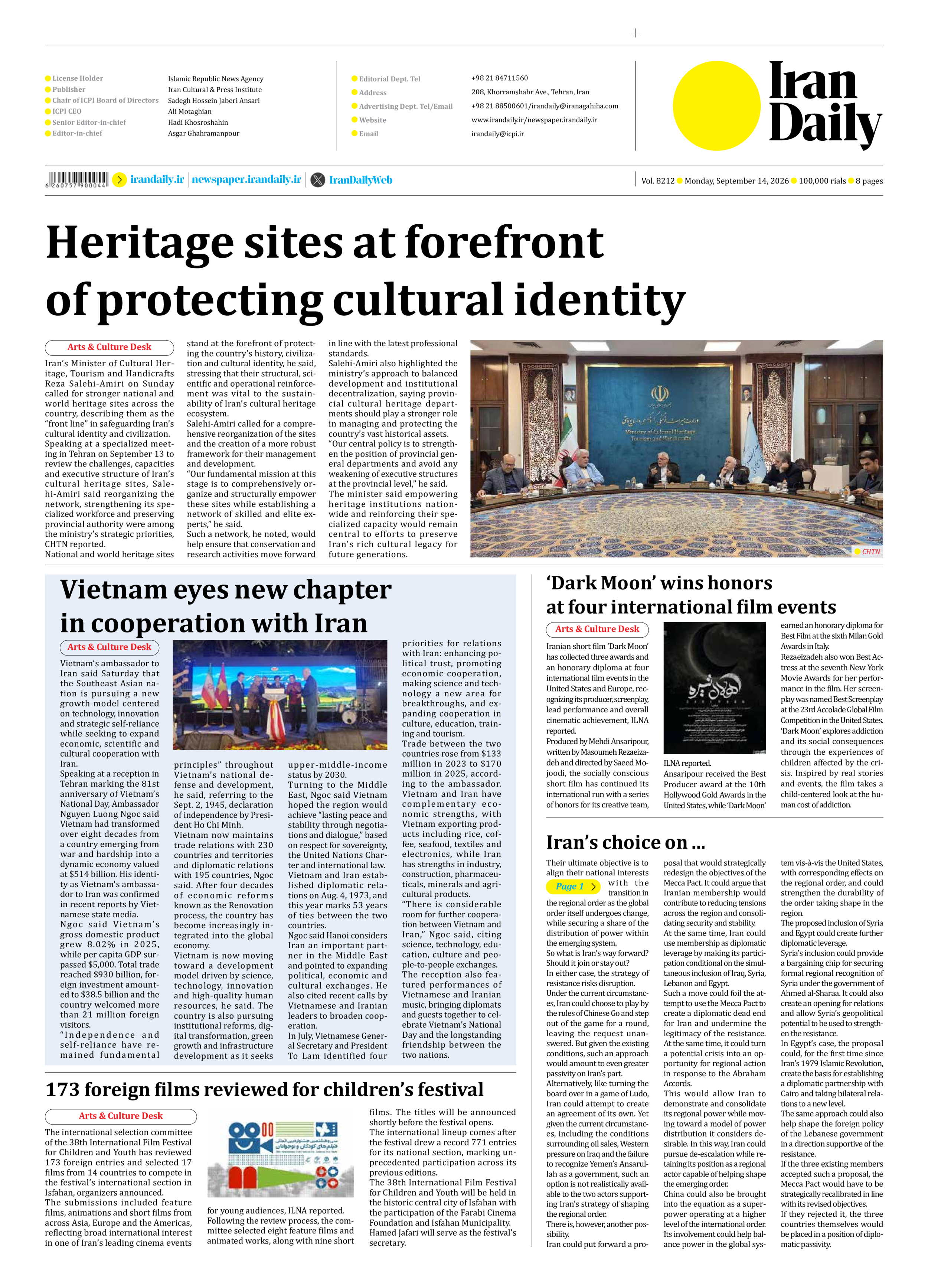
Speaking at a reception in Tehran marking the 81st anniversary of Vietnam’s National Day, Ambassador Nguyen Luong Ngoc said Vietnam had transformed over eight decades from a country emerging from war and hardship into a dynamic economy valued at $514 billion. His identity as Vietnam's ambassador to Iran was confirmed in recent reports by Vietnamese state media.
Ngoc said Vietnam’s gross domestic product grew 8.02% in 2025, while per capita GDP surpassed $5,000. Total trade reached $930 billion, foreign investment amounted to $38.5 billion and the country welcomed more than 21 million foreign visitors.
“Independence and self-reliance have remained fundamental principles” throughout Vietnam’s national defense and development, he said, referring to the Sept. 2, 1945, declaration of independence by President Ho Chi Minh.
Vietnam now maintains trade relations with 230 countries and territories and diplomatic relations with 195 countries, Ngoc said. After four decades of economic reforms known as the Renovation process, the country has become increasingly integrated into the global economy.
Vietnam is now moving toward a development model driven by science, technology, innovation and high-quality human resources, he said. The country is also pursuing institutional reforms, digital transformation, green growth and infrastructure development as it seeks upper-middle-income status by 2030.
Turning to the Middle East, Ngoc said Vietnam hoped the region would achieve “lasting peace and stability through negotiations and dialogue,” based on respect for sovereignty, the United Nations Charter and international law.
Vietnam and Iran established diplomatic relations on Aug. 4, 1973, and this year marks 53 years of ties between the two countries.
Ngoc said Hanoi considers Iran an important partner in the Middle East and pointed to expanding political, economic and cultural exchanges. He also cited recent calls by Vietnamese and Iranian leaders to broaden cooperation.
In July, Vietnamese General Secretary and President To Lam identified four priorities for relations with Iran: enhancing political trust, promoting economic cooperation, making science and technology a new area for breakthroughs, and expanding cooperation in culture, education, training and tourism.
Trade between the two countries rose from $133 million in 2023 to $170 million in 2025, according to the ambassador. Vietnam and Iran have complementary economic strengths, with Vietnam exporting products including rice, coffee, seafood, textiles and electronics, while Iran has strengths in industry, construction, pharmaceuticals, minerals and agricultural products.
“There is considerable room for further cooperation between Vietnam and Iran,” Ngoc said, citing science, technology, education, culture and people-to-people exchanges.
The reception also featured performances of Vietnamese and Iranian music, bringing diplomats and guests together to celebrate Vietnam’s National Day and the longstanding friendship between the two nations.