







Hashjin promotes diverse attractions for tourism development
Hashjin, a city in Khalkhal, has a variety of attractions to draw tourists, thanks to its pleasant climate and spectacular mountainous landscape. Located among the provinces of Gilan, Ardabil, Zanjan and East Azarbaijan, the city has also seen tourism projects implemented and others underway with private-sector investment.
Hashjin is the center of Khoresh-e Rostam District in Khalkhal, in southern Ardabil Province. The city has a history of settlement dating back more than 6,000 years. It was established as a district in 1944 and remained part of East Azarbaijan Province until 1993, when it was incorporated into Ardabil Province.
According to inscriptions, Sargon, king of Assyria, encountered a food-storage center called “Panizish” during his military campaign into the land of Urartu. He then moved his army toward the southern borders of Urartu in an attempt to capture it.
Hashjin, located at an elevation of 650 meters along the banks of the rushing Qezel Ozan River and near Mount Aqdagh, which rises to 3,322 meters and is designated as a protected and no-hunting area, presents a remarkable panorama of natural, wildlife and mountainous attractions.
Flower-covered slopes and summer highlands filled with fragrant thyme, pristine natural landscapes and refreshing springs, as well as the beautiful forests around the villages of Now Deh, Ak-Suu and Chenarlaq, are among the colorful pages of Hashjin’s scenic album.
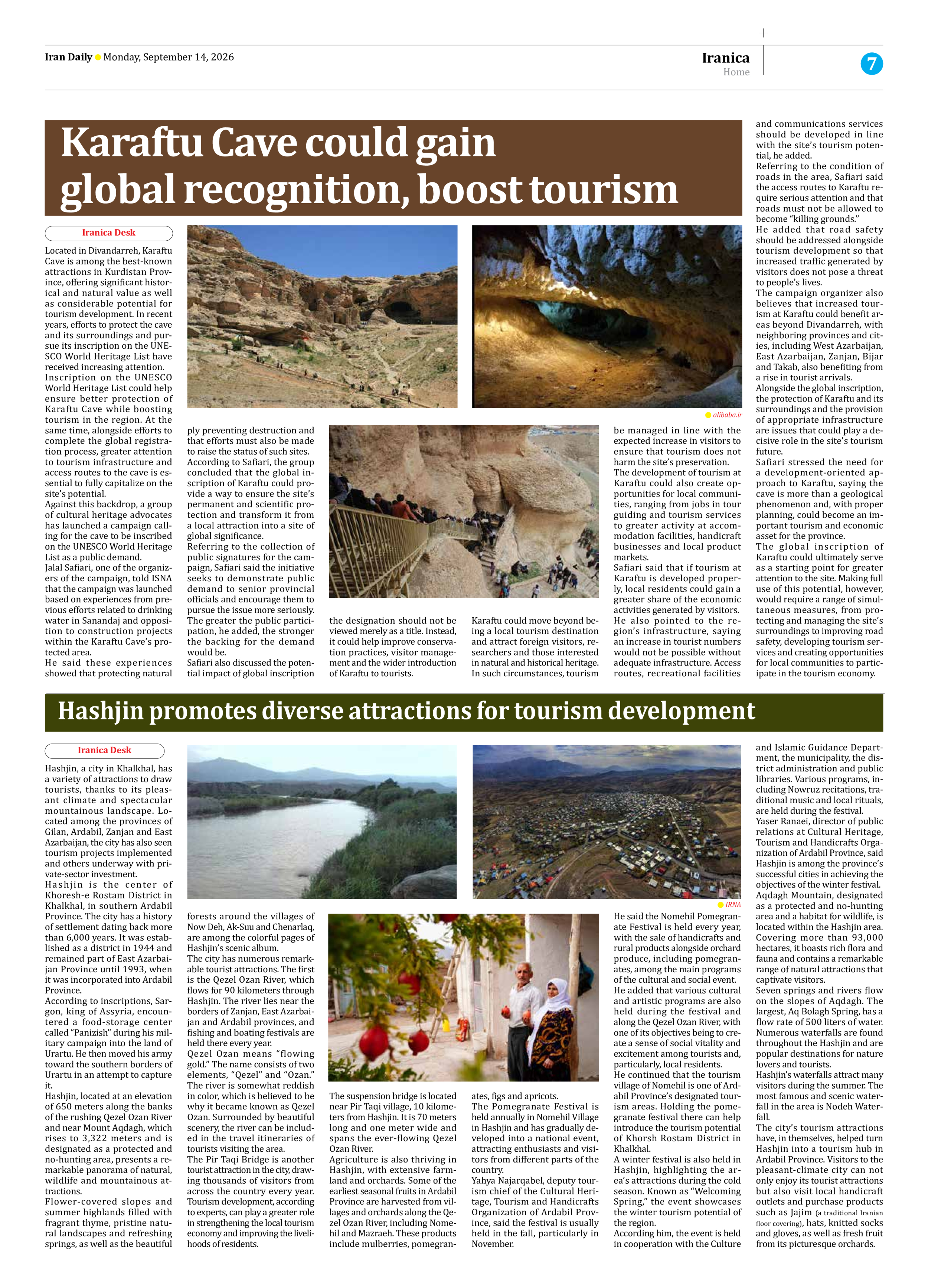
The city has numerous remarkable tourist attractions. The first is the Qezel Ozan River, which flows for 90 kilometers through Hashjin. The river lies near the borders of Zanjan, East Azarbaijan and Ardabil provinces, and fishing and boating festivals are held there every year.
Qezel Ozan means “flowing gold.” The name consists of two elements, “Qezel” and “Ozan.” The river is somewhat reddish in color, which is believed to be why it became known as Qezel Ozan. Surrounded by beautiful scenery, the river can be included in the travel itineraries of tourists visiting the area.
The Pir Taqi Bridge is another tourist attraction in the city, drawing thousands of visitors from across the country every year. Tourism development, according to experts, can play a greater role in strengthening the local tourism economy and improving the livelihoods of residents.
The suspension bridge is located near Pir Taqi village, 10 kilometers from Hashjin. It is 70 meters long and one meter wide and spans the ever-flowing Qezel Ozan River.
Agriculture is also thriving in Hashjin, with extensive farmland and orchards. Some of the earliest seasonal fruits in Ardabil Province are harvested from villages and orchards along the Qezel Ozan River, including Nomehil and Mazraeh. These products include mulberries, pomegranates, figs and apricots.
The Pomegranate Festival is held annually in Nomehil Village in Hashjin and has gradually developed into a national event, attracting enthusiasts and visitors from different parts of the country.
Yahya Najarqabel, deputy tourism chief of the Cultural Heritage, Tourism and Handicrafts Organization of Ardabil Province, said the festival is usually held in the fall, particularly in November.
He said the Nomehil Pomegranate Festival is held every year, with the sale of handicrafts and rural products alongside orchard produce, including pomegranates, among the main programs of the cultural and social event.
He added that various cultural and artistic programs are also held during the festival and along the Qezel Ozan River, with one of its objectives being to create a sense of social vitality and excitement among tourists and, particularly, local residents.
He continued that the tourism village of Nomehil is one of Ardabil Province’s designated tourism areas. Holding the pomegranate festival there can help introduce the tourism potential of Khorsh Rostam District in Khalkhal.
A winter festival is also held in Hashjin, highlighting the area’s attractions during the cold season. Known as “Welcoming Spring,” the event showcases the winter tourism potential of the region.
According him, the event is held in cooperation with the Culture and Islamic Guidance Department, the municipality, the district administration and public libraries. Various programs, including Nowruz recitations, traditional music and local rituals, are held during the festival.
Yaser Ranaei, director of public relations at Cultural Heritage, Tourism and Handicrafts Organization of Ardabil Province, said Hashjin is among the province’s successful cities in achieving the objectives of the winter festival.
Aqdagh Mountain, designated as a protected and no-hunting area and a habitat for wildlife, is located within the Hashjin area. Covering more than 93,000 hectares, it boasts rich flora and fauna and contains a remarkable range of natural attractions that captivate visitors.
Seven springs and rivers flow on the slopes of Aqdagh. The largest, Aq Bolagh Spring, has a flow rate of 500 liters of water. Numerous waterfalls are found throughout the Hashjin and are popular destinations for nature lovers and tourists.
Hashjin’s waterfalls attract many visitors during the summer. The most famous and scenic waterfall in the area is Nodeh Waterfall.
The city’s tourism attractions have, in themselves, helped turn Hashjin into a tourism hub in Ardabil Province. Visitors to the pleasant-climate city can not only enjoy its tourist attractions but also visit local handicraft outlets and purchase products such as Jajim (a traditional Iranian floor covering), hats, knitted socks and gloves, as well as fresh fruit from its picturesque orchards.