







Karaftu Cave could gain global recognition, boost tourism
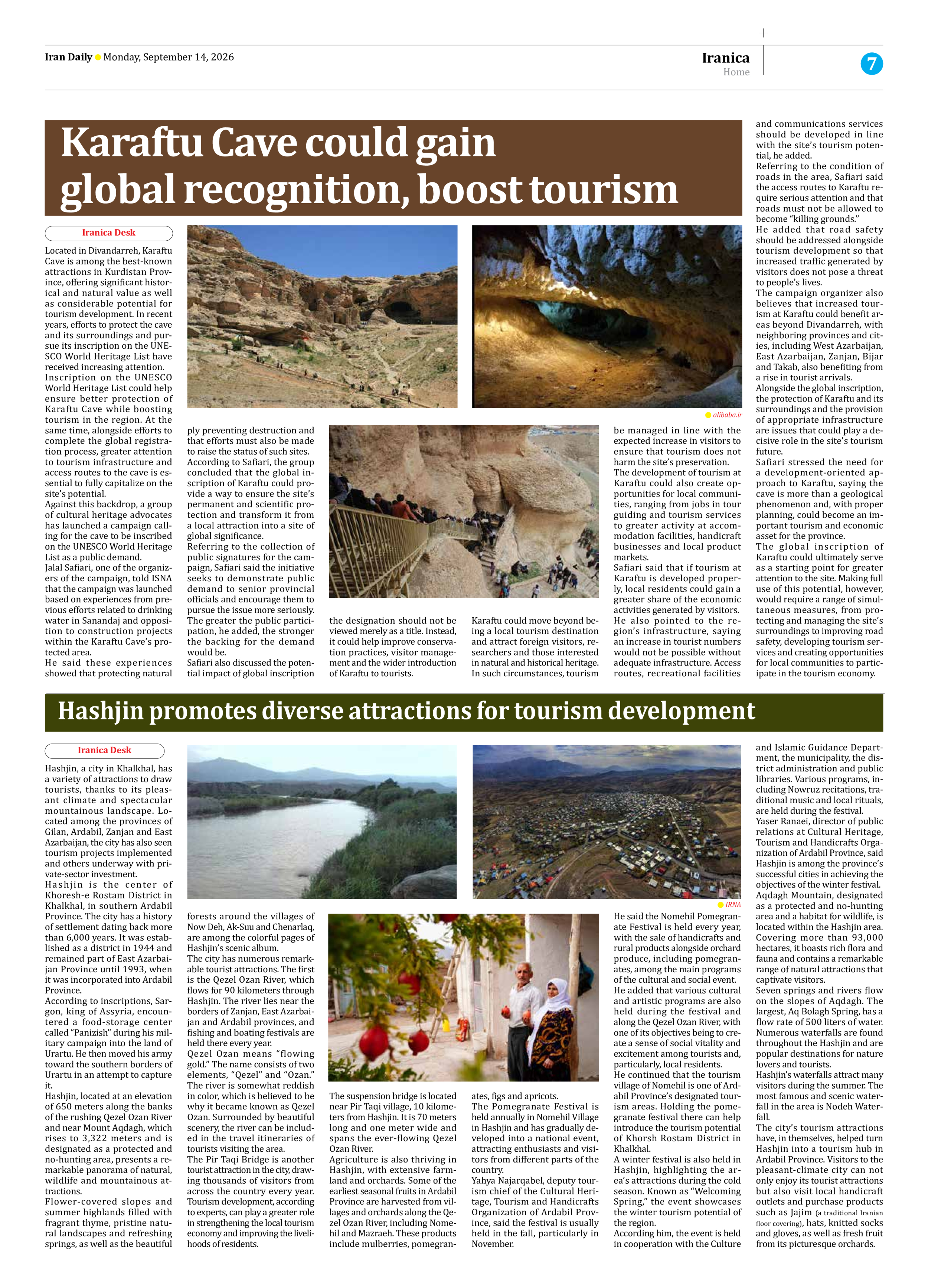
Located in Divandarreh, Karaftu Cave is among the best-known attractions in Kurdistan Province, offering significant historical and natural value as well as considerable potential for tourism development. In recent years, efforts to protect the cave and its surroundings and pursue its inscription on the UNESCO World Heritage List have received increasing attention.
Inscription on the UNESCO World Heritage List could help ensure better protection of Karaftu Cave while boosting tourism in the region. At the same time, alongside efforts to complete the global registration process, greater attention to tourism infrastructure and access routes to the cave is essential to fully capitalize on the site’s potential.
Against this backdrop, a group of cultural heritage advocates has launched a campaign calling for the cave to be inscribed on the UNESCO World Heritage List as a public demand.
Jalal Safiari, one of the organizers of the campaign, told ISNA that the campaign was launched based on experiences from previous efforts related to drinking water in Sanandaj and opposition to construction projects within the Karaftu Cave’s protected area.
He said these experiences showed that protecting natural heritage requires more than simply preventing destruction and that efforts must also be made to raise the status of such sites.
According to Safiari, the group concluded that the global inscription of Karaftu could provide a way to ensure the site’s permanent and scientific protection and transform it from a local attraction into a site of global significance.
Referring to the collection of public signatures for the campaign, Safiari said the initiative seeks to demonstrate public demand to senior provincial officials and encourage them to pursue the issue more seriously. The greater the public participation, he added, the stronger the backing for the demand would be.
Safiari also discussed the potential impact of global inscription on tourism at Karaftu, saying the designation should not be viewed merely as a title. Instead, it could help improve conservation practices, visitor management and the wider introduction of Karaftu to tourists.
He added that once inscribed, Karaftu could move beyond being a local tourism destination and attract foreign visitors, researchers and those interested in natural and historical heritage.
In such circumstances, tourism at Karaftu would also need to be managed in line with the expected increase in visitors to ensure that tourism does not harm the site’s preservation.
The development of tourism at Karaftu could also create opportunities for local communities, ranging from jobs in tour guiding and tourism services to greater activity at accommodation facilities, handicraft businesses and local product markets.
Safiari said that if tourism at Karaftu is developed properly, local residents could gain a greater share of the economic activities generated by visitors.
He also pointed to the region’s infrastructure, saying an increase in tourist numbers would not be possible without adequate infrastructure. Access routes, recreational facilities and communications services should be developed in line with the site’s tourism potential, he added.
Referring to the condition of roads in the area, Safiari said the access routes to Karaftu require serious attention and that roads must not be allowed to become “killing grounds.”
He added that road safety should be addressed alongside tourism development so that increased traffic generated by visitors does not pose a threat to people’s lives.
The campaign organizer also believes that increased tourism at Karaftu could benefit areas beyond Divandarreh, with neighboring provinces and cities, including West Azarbaijan, East Azarbaijan, Zanjan, Bijar and Takab, also benefiting from a rise in tourist arrivals.
Alongside the global inscription, the protection of Karaftu and its surroundings and the provision of appropriate infrastructure are issues that could play a decisive role in the site’s tourism future.
Safiari stressed the need for a development-oriented approach to Karaftu, saying the cave is more than a geological phenomenon and, with proper planning, could become an important tourism and economic asset for the province.
The global inscription of Karaftu could ultimately serve as a starting point for greater attention to the site. Making full use of this potential, however, would require a range of simultaneous measures, from protecting and managing the site’s surroundings to improving road safety, developing tourism services and creating opportunities for local communities to participate in the tourism economy.