





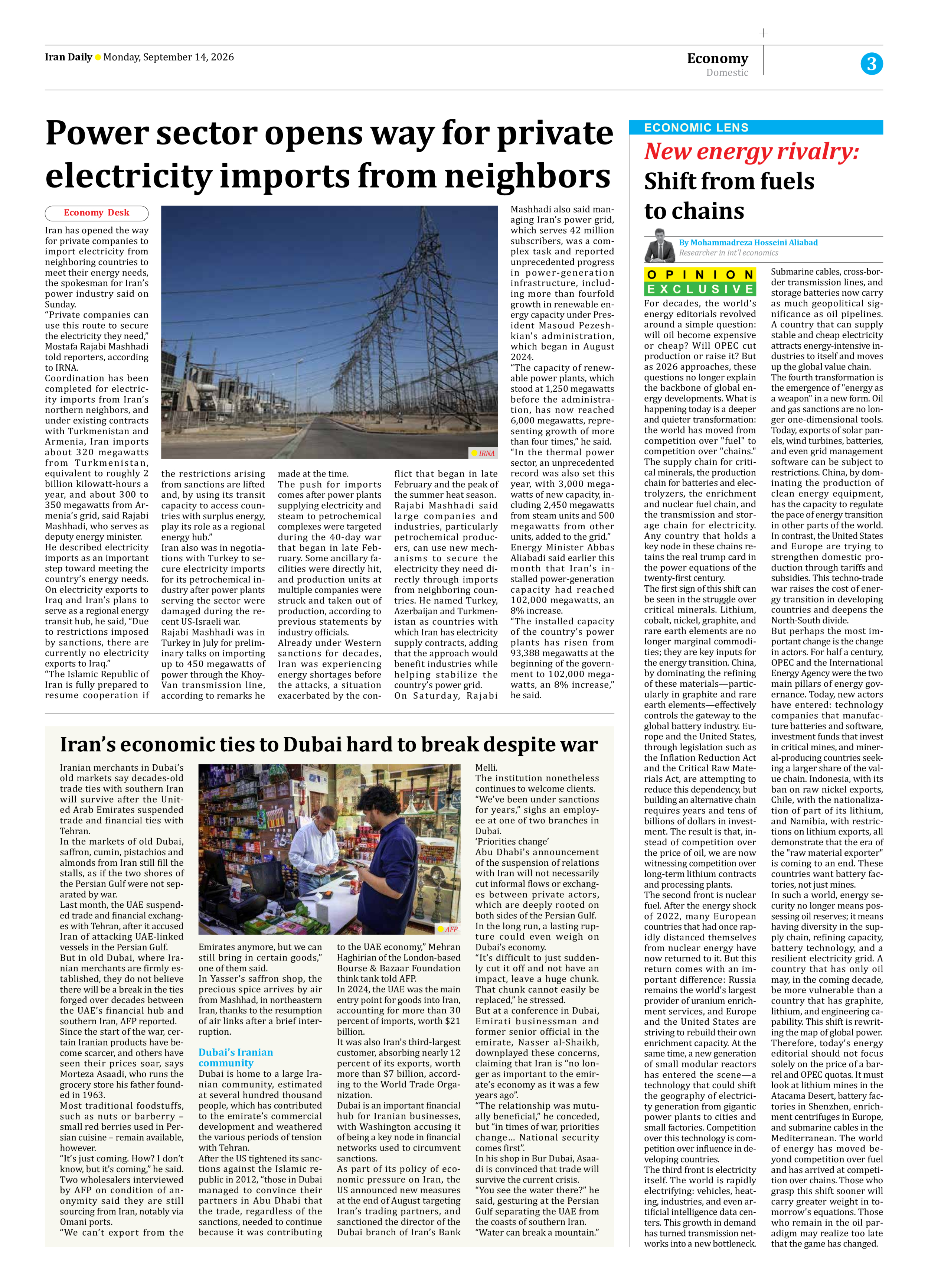


Power sector opens way for private electricity imports from neighbors
Iran has opened the way for private companies to import electricity from neighboring countries to meet their energy needs, the spokesman for Iran’s power industry said on Sunday.
“Private companies can use this route to secure the electricity they need,” Mostafa Rajabi Mashhadi told reporters, according to IRNA.
Coordination has been completed for electricity imports from Iran’s northern neighbors, and under existing contracts with Turkmenistan and Armenia, Iran imports about 320 megawatts from Turkmenistan, equivalent to roughly 2 billion kilowatt-hours a year, and about 300 to 350 megawatts from Armenia’s grid, said Rajabi Mashhadi, who serves as deputy energy minister.
He described electricity imports as an important step toward meeting the country’s energy needs. On electricity exports to Iraq and Iran’s plans to serve as a regional energy transit hub, he said, “Due to restrictions imposed by sanctions, there are currently no electricity exports to Iraq.”
“The Islamic Republic of Iran is fully prepared to resume cooperation if the restrictions arising from sanctions are lifted and, by using its transit capacity to access countries with surplus energy, play its role as a regional energy hub.”
Iran also was in negotiations with Turkey to secure electricity imports for its petrochemical industry after power plants serving the sector were damaged during the recent US-Israeli war.
Rajabi Mashhadi was in Turkey in July for preliminary talks on importing up to 450 megawatts of power through the Khoy-Van transmission line, according to remarks he made at the time.
The push for imports comes after power plants supplying electricity and steam to petrochemical complexes were targeted during the 40-day war that began in late February. Some ancillary facilities were directly hit, and production units at multiple companies were struck and taken out of production, according to previous statements by industry officials.
Already under Western sanctions for decades, Iran was experiencing energy shortages before the attacks, a situation exacerbated by the conflict that began in late February and the peak of the summer heat season.
Rajabi Mashhadi said large companies and industries, particularly petrochemical producers, can use new mechanisms to secure the electricity they need directly through imports from neighboring countries. He named Turkey, Azerbaijan and Turkmenistan as countries with which Iran has electricity supply contracts, adding that the approach would benefit industries while helping stabilize the country’s power grid.
On Saturday, Rajabi Mashhadi also said managing Iran’s power grid, which serves 42 million subscribers, was a complex task and reported unprecedented progress in power-generation infrastructure, including more than fourfold growth in renewable energy capacity under President Masoud Pezeshkian’s administration, which began in August 2024.
“The capacity of renewable power plants, which stood at 1,250 megawatts before the administration, has now reached 6,000 megawatts, representing growth of more than four times,” he said.
“In the thermal power sector, an unprecedented record was also set this year, with 3,000 megawatts of new capacity, including 2,450 megawatts from steam units and 500 megawatts from other units, added to the grid.”
Energy Minister Abbas Aliabadi said earlier this month that Iran’s installed power-generation capacity had reached 102,000 megawatts, an 8% increase.
“The installed capacity of the country’s power plants has risen from 93,388 megawatts at the beginning of the government to 102,000 megawatts, an 8% increase,” he said.