







Semnan looks to water heritage to expand cultural tourism
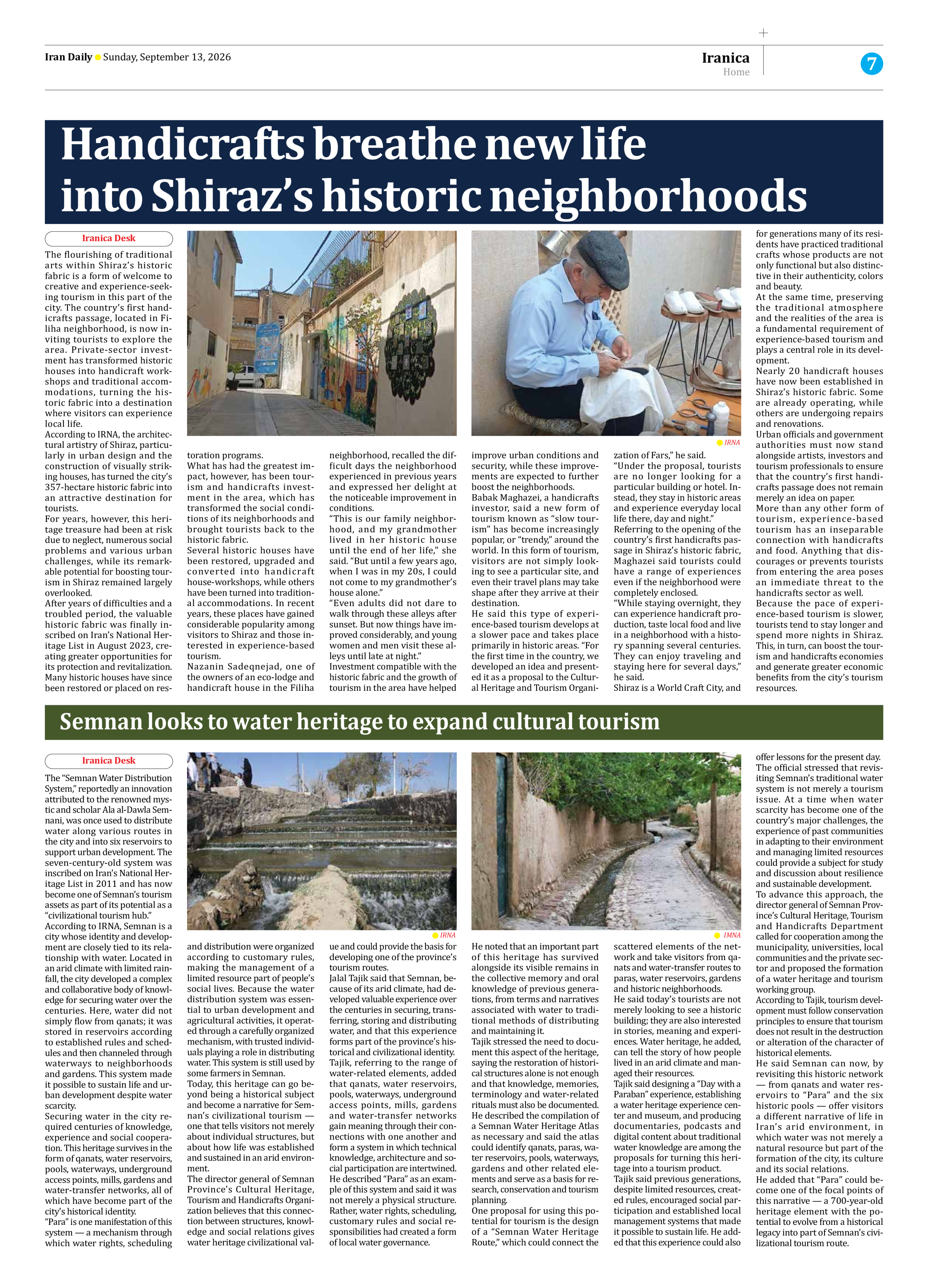
The “Semnan Water Distribution System,” reportedly an innovation attributed to the renowned mystic and scholar Ala al-Dawla Semnani, was once used to distribute water along various routes in the city and into six reservoirs to support urban development. The seven-century-old system was inscribed on Iran’s National Heritage List in 2011 and has now become one of Semnan’s tourism assets as part of its potential as a “civilizational tourism hub.”
According to IRNA, Semnan is a city whose identity and development are closely tied to its relationship with water. Located in an arid climate with limited rainfall, the city developed a complex and collaborative body of knowledge for securing water over the centuries. Here, water did not simply flow from qanats; it was stored in reservoirs according to established rules and schedules and then channeled through waterways to neighborhoods and gardens. This system made it possible to sustain life and urban development despite water scarcity.
Securing water in the city required centuries of knowledge, experience and social cooperation. This heritage survives in the form of qanats, water reservoirs, pools, waterways, underground access points, mills, gardens and water-transfer networks, all of which have become part of the city’s historical identity.
“Para” is one manifestation of this system — a mechanism through which water rights, scheduling and distribution were organized according to customary rules, making the management of a limited resource part of people’s social lives. Because the water distribution system was essential to urban development and agricultural activities, it operated through a carefully organized mechanism, with trusted individuals playing a role in distributing water. This system is still used by some farmers in Semnan.
Today, this heritage can go beyond being a historical subject and become a narrative for Semnan’s civilizational tourism — one that tells visitors not merely about individual structures, but about how life was established and sustained in an arid environment.
The director general of Semnan Province’s Cultural Heritage, Tourism and Handicrafts Organization believes that this connection between structures, knowledge and social relations gives water heritage civilizational value and could provide the basis for developing one of the province’s tourism routes.
Jalal Tajik said that Semnan, because of its arid climate, had developed valuable experience over the centuries in securing, transferring, storing and distributing water, and that this experience forms part of the province’s historical and civilizational identity.
Tajik, referring to the range of water-related elements, added that qanats, water reservoirs, pools, waterways, underground access points, mills, gardens and water-transfer networks gain meaning through their connections with one another and form a system in which technical knowledge, architecture and social participation are intertwined.
He described “Para” as an example of this system and said it was not merely a physical structure. Rather, water rights, scheduling, customary rules and social responsibilities had created a form of local water governance.
He noted that an important part of this heritage has survived alongside its visible remains in the collective memory and oral knowledge of previous generations, from terms and narratives associated with water to traditional methods of distributing and maintaining it.
Tajik stressed the need to document this aspect of the heritage, saying the restoration of historical structures alone is not enough and that knowledge, memories, terminology and water-related rituals must also be documented.
He described the compilation of a Semnan Water Heritage Atlas as necessary and said the atlas could identify qanats, paras, water reservoirs, pools, waterways, gardens and other related elements and serve as a basis for research, conservation and tourism planning.
One proposal for using this potential for tourism is the design of a “Semnan Water Heritage Route,” which could connect the scattered elements of the network and take visitors from qanats and water-transfer routes to paras, water reservoirs, gardens and historic neighborhoods.
He said today’s tourists are not merely looking to see a historic building; they are also interested in stories, meaning and experiences. Water heritage, he added, can tell the story of how people lived in an arid climate and managed their resources.
Tajik said designing a “Day with a Paraban” experience, establishing a water heritage experience center and museum, and producing documentaries, podcasts and digital content about traditional water knowledge are among the proposals for turning this heritage into a tourism product.
Tajik said previous generations, despite limited resources, created rules, encouraged social participation and established local management systems that made it possible to sustain life. He added that this experience could also offer lessons for the present day.
The official stressed that revisiting Semnan’s traditional water system is not merely a tourism issue. At a time when water scarcity has become one of the country’s major challenges, the experience of past communities in adapting to their environment and managing limited resources could provide a subject for study and discussion about resilience and sustainable development.
To advance this approach, the director general of Semnan Province’s Cultural Heritage, Tourism and Handicrafts Department called for cooperation among the municipality, universities, local communities and the private sector and proposed the formation of a water heritage and tourism working group.
According to Tajik, tourism development must follow conservation principles to ensure that tourism does not result in the destruction or alteration of the character of historical elements.
He said Semnan can now, by revisiting this historic network — from qanats and water reservoirs to “Para” and the six historic pools — offer visitors a different narrative of life in Iran’s arid environment, in which water was not merely a natural resource but part of the formation of the city, its culture and its social relations.
He added that “Para” could become one of the focal points of this narrative — a 700-year-old heritage element with the potential to evolve from a historical legacy into part of Semnan’s civilizational tourism route.