







National Museum of Iran offers journey through history
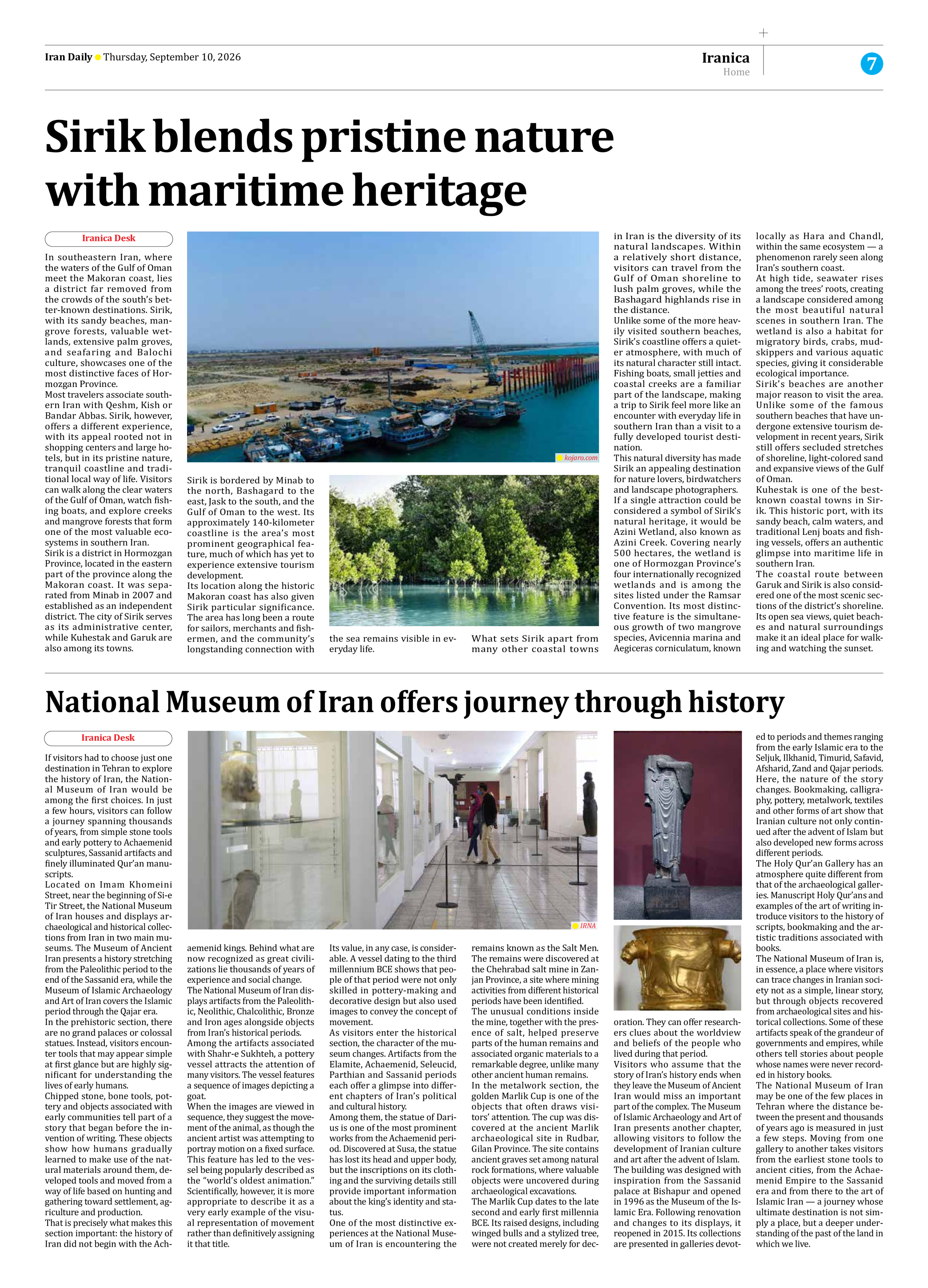
If visitors had to choose just one destination in Tehran to explore the history of Iran, the National Museum of Iran would be among the first choices. In just a few hours, visitors can follow a journey spanning thousands of years, from simple stone tools and early pottery to Achaemenid sculptures, Sassanid artifacts and finely illuminated Qur’an manuscripts.
Located on Imam Khomeini Street, near the beginning of Si-e Tir Street, the National Museum of Iran houses and displays archaeological and historical collections from Iran in two main museums. The Museum of Ancient Iran presents a history stretching from the Paleolithic period to the end of the Sassanid era, while the Museum of Islamic Archaeology and Art of Iran covers the Islamic period through the Qajar era.
In the prehistoric section, there are no grand palaces or colossal statues. Instead, visitors encounter tools that may appear simple at first glance but are highly significant for understanding the lives of early humans.
Chipped stone, bone tools, pottery and objects associated with early communities tell part of a story that began before the invention of writing. These objects show how humans gradually learned to make use of the natural materials around them, developed tools and moved from a way of life based on hunting and gathering toward settlement, agriculture and production.
That is precisely what makes this section important: the history of Iran did not begin with the Achaemenid kings. Behind what are now recognized as great civilizations lie thousands of years of experience and social change.
The National Museum of Iran displays artifacts from the Paleolithic, Neolithic, Chalcolithic, Bronze and Iron ages alongside objects from Iran’s historical periods.
Among the artifacts associated with Shahr-e Sukhteh, a pottery vessel attracts the attention of many visitors. The vessel features a sequence of images depicting a goat.
When the images are viewed in sequence, they suggest the movement of the animal, as though the ancient artist was attempting to portray motion on a fixed surface.
This feature has led to the vessel being popularly described as the “world’s oldest animation.” Scientifically, however, it is more appropriate to describe it as a very early example of the visual representation of movement rather than definitively assigning it that title.
Its value, in any case, is considerable. A vessel dating to the third millennium BCE shows that people of that period were not only skilled in pottery-making and decorative design but also used images to convey the concept of movement.
As visitors enter the historical section, the character of the museum changes. Artifacts from the Elamite, Achaemenid, Seleucid, Parthian and Sassanid periods each offer a glimpse into different chapters of Iran’s political and cultural history.
Among them, the statue of Darius is one of the most prominent works from the Achaemenid period. Discovered at Susa, the statue has lost its head and upper body, but the inscriptions on its clothing and the surviving details still provide important information about the king’s identity and status.
One of the most distinctive experiences at the National Museum of Iran is encountering the remains known as the Salt Men. The remains were discovered at the Chehrabad salt mine in Zanjan Province, a site where mining activities from different historical periods have been identified.
The unusual conditions inside the mine, together with the presence of salt, helped preserve parts of the human remains and associated organic materials to a remarkable degree, unlike many other ancient human remains.
In the metalwork section, the golden Marlik Cup is one of the objects that often draws visitors’ attention. The cup was discovered at the ancient Marlik archaeological site in Rudbar, Gilan Province. The site contains ancient graves set among natural rock formations, where valuable objects were uncovered during archaeological excavations.
The Marlik Cup dates to the late second and early first millennia BCE. Its raised designs, including winged bulls and a stylized tree, were not created merely for decoration. They can offer researchers clues about the worldview and beliefs of the people who lived during that period.
Visitors who assume that the story of Iran’s history ends when they leave the Museum of Ancient Iran would miss an important part of the complex. The Museum of Islamic Archaeology and Art of Iran presents another chapter, allowing visitors to follow the development of Iranian culture and art after the advent of Islam.
The building was designed with inspiration from the Sassanid palace at Bishapur and opened in 1996 as the Museum of the Islamic Era. Following renovation and changes to its displays, it reopened in 2015. Its collections are presented in galleries devoted to periods and themes ranging from the early Islamic era to the Seljuk, Ilkhanid, Timurid, Safavid, Afsharid, Zand and Qajar periods.
Here, the nature of the story changes. Bookmaking, calligraphy, pottery, metalwork, textiles and other forms of art show that Iranian culture not only continued after the advent of Islam but also developed new forms across different periods.
The Holy Qur’an Gallery has an atmosphere quite different from that of the archaeological galleries. Manuscript Holy Qur’ans and examples of the art of writing introduce visitors to the history of scripts, bookmaking and the artistic traditions associated with books.
The National Museum of Iran is, in essence, a place where visitors can trace changes in Iranian society not as a simple, linear story, but through objects recovered from archaeological sites and historical collections. Some of these artifacts speak of the grandeur of governments and empires, while others tell stories about people whose names were never recorded in history books.
The National Museum of Iran may be one of the few places in Tehran where the distance between the present and thousands of years ago is measured in just a few steps. Moving from one gallery to another takes visitors from the earliest stone tools to ancient cities, from the Achaemenid Empire to the Sassanid era and from there to the art of Islamic Iran — a journey whose ultimate destination is not simply a place, but a deeper understanding of the past of the land in which we live.