







Iran launches retaliatory attacks on US military bases, vessels
US submarine drone captured by IRGC
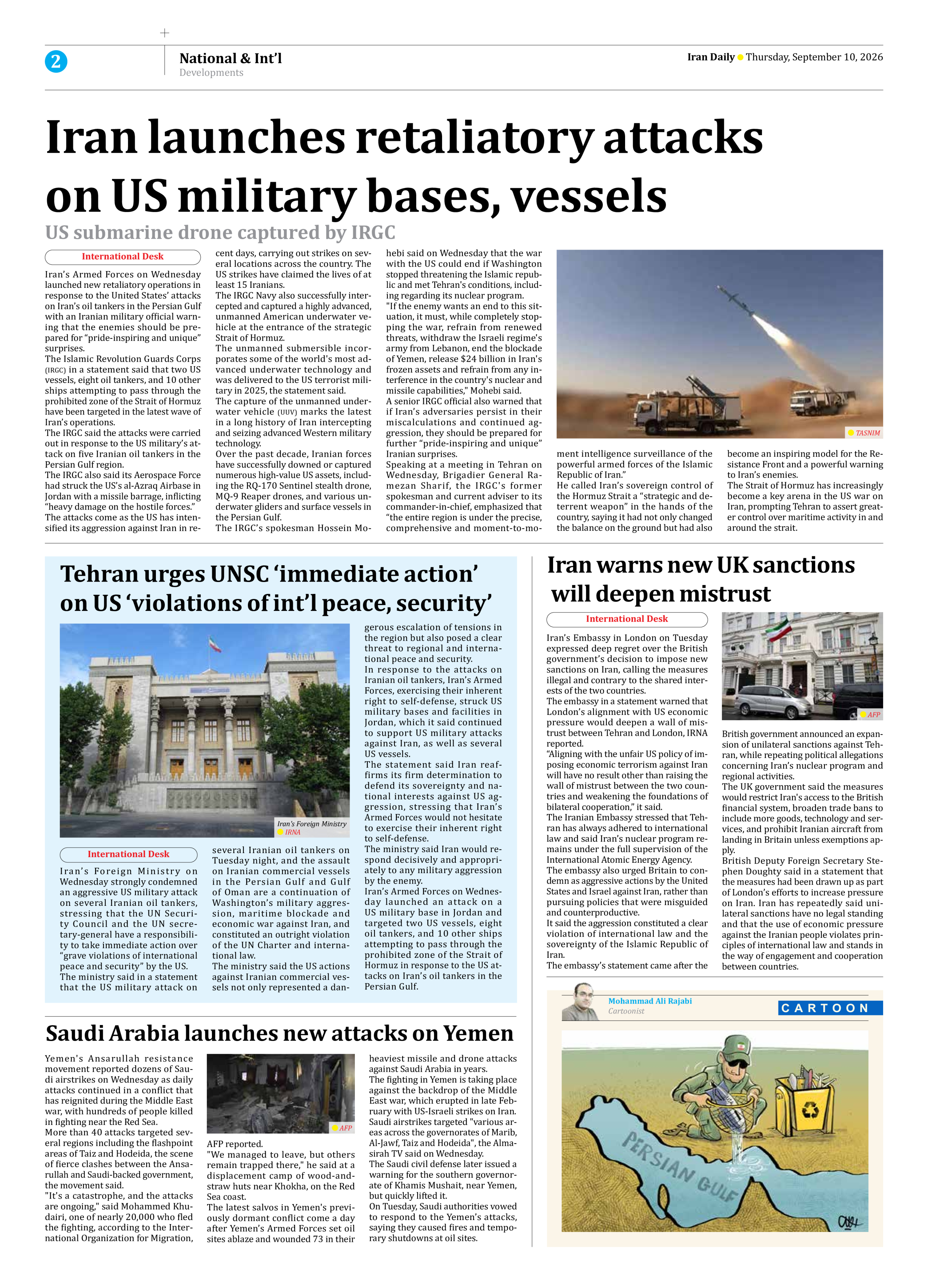
Iran’s Armed Forces on Wednesday launched new retaliatory operations in response to the United States’ attacks on Iran’s oil tankers in the Persian Gulf with an Iranian military official warning that the enemies should be prepared for “pride-inspiring and unique” surprises.
The Islamic Revolution Guards Corps (IRGC) in a statement said that two US vessels, eight oil tankers, and 10 other ships attempting to pass through the prohibited zone of the Strait of Hormuz have been targeted in the latest wave of Iran’s operations.
The IRGC said the attacks were carried out in response to the US military’s attack on five Iranian oil tankers in the Persian Gulf region.
The IRGC also said its Aerospace Force had struck the US’s al-Azraq Airbase in Jordan with a missile barrage, inflicting “heavy damage on the hostile forces.”
The attacks come as the US has intensified its aggression against Iran in recent days, carrying out strikes on several locations across the country. The US strikes have claimed the lives of at least 15 Iranians.
The IRGC Navy also successfully intercepted and captured a highly advanced, unmanned American underwater vehicle at the entrance of the strategic Strait of Hormuz.
The unmanned submersible incorporates some of the world's most advanced underwater technology and was delivered to the US terrorist military in 2025, the statement said.
The capture of the unmanned underwater vehicle (UUV) marks the latest in a long history of Iran intercepting and seizing advanced Western military technology.
Over the past decade, Iranian forces have successfully downed or captured numerous high-value US assets, including the RQ-170 Sentinel stealth drone, MQ-9 Reaper drones, and various underwater gliders and surface vessels in the Persian Gulf.
The IRGC’s spokesman Hossein Mohebi said on Wednesday that the war with the US could end if Washington stopped threatening the Islamic republic and met Tehran's conditions, including regarding its nuclear program.
"If the enemy wants an end to this situation, it must, while completely stopping the war, refrain from renewed threats, withdraw the Israeli regime's army from Lebanon, end the blockade of Yemen, release $24 billion in Iran's frozen assets and refrain from any interference in the country's nuclear and missile capabilities," Mohebi said.
A senior IRGC official also warned that if Iran’s adversaries persist in their miscalculations and continued aggression, they should be prepared for further “pride-inspiring and unique” Iranian surprises.
Speaking at a meeting in Tehran on Wednesday, Brigadier General Ramezan Sharif, the IRGC's former spokesman and current adviser to its commander-in-chief, emphasized that “the entire region is under the precise, comprehensive and moment-to-moment intelligence surveillance of the powerful armed forces of the Islamic Republic of Iran.”
He called Iran’s sovereign control of the Hormuz Strait a “strategic and deterrent weapon” in the hands of the country, saying it had not only changed the balance on the ground but had also become an inspiring model for the Resistance Front and a powerful warning to Iran’s enemies.
The Strait of Hormuz has increasingly become a key arena in the US war on Iran, prompting Tehran to assert greater control over maritime activity in and around the strait.