







Khorashad nurtures talent, tradition in eastern Iran
South Khorasan Province, located in eastern Iran, is one of the country’s historically rich yet less industrialized regions, where handicrafts have long played a central role in local livelihoods and cultural expression. Shaped by desert geography, cross-regional trade routes, and deeply rooted traditions, the province is known for a wide range of indigenous crafts, including handwoven textiles, embroidery, carpet weaving, pottery, stone carving, and traditional woodwork. In many rural areas, these crafts continue to function not only as cultural symbols but also as essential sources of income, particularly for women and small family-based workshops.
Handicrafts in South Khorasan Province reflect the province’s cultural diversity and long-standing adaptation to its natural environment. Traditional skills such as handwoven textiles, embroidery, pottery, felt-making, stone carving, and woodcraft have been passed down through generations, often within family-based or community workshops. These crafts not only preserve local aesthetics and techniques but also play a practical role in sustaining rural economies and reinforcing social ties.
Across different cities and villages of the province, variations in materials, patterns, and production methods highlight the close relationship between handicrafts and local lifestyles. From textile and embroidery traditions in Birjand and Qaen to pottery and stone-based crafts in other parts of the province, South Khorasan’s handicrafts continue to represent a living heritage that remains closely connected to everyday life
The experience of provinces such as South Khorasan highlights the broader significance of handicrafts within Iran’s cultural and creative economy, as well as the structural challenges faced by producers across different regions.
Khorashad is a small village in eastern Iran, located in South Khorasan Province. Nestled in Nasr Abad Valley, its unique name — meaning “The Place of Sunrise” in the Pahlavi language — derives from the breathtaking natural scenery that greets the dawn.
Dating back to a period even before Islam, Khorashad is a rare example of a village that attracts people rather than losing them to migration. One of its most remarkable characteristics is the production of numerous successful and elite individuals in scientific, cultural, and economic fields — an achievement extraordinary for a village with a population of just around 1,000. Due to these distinctions, the region has been officially recognized as an elite village in Iran, according to visitiran.ir.
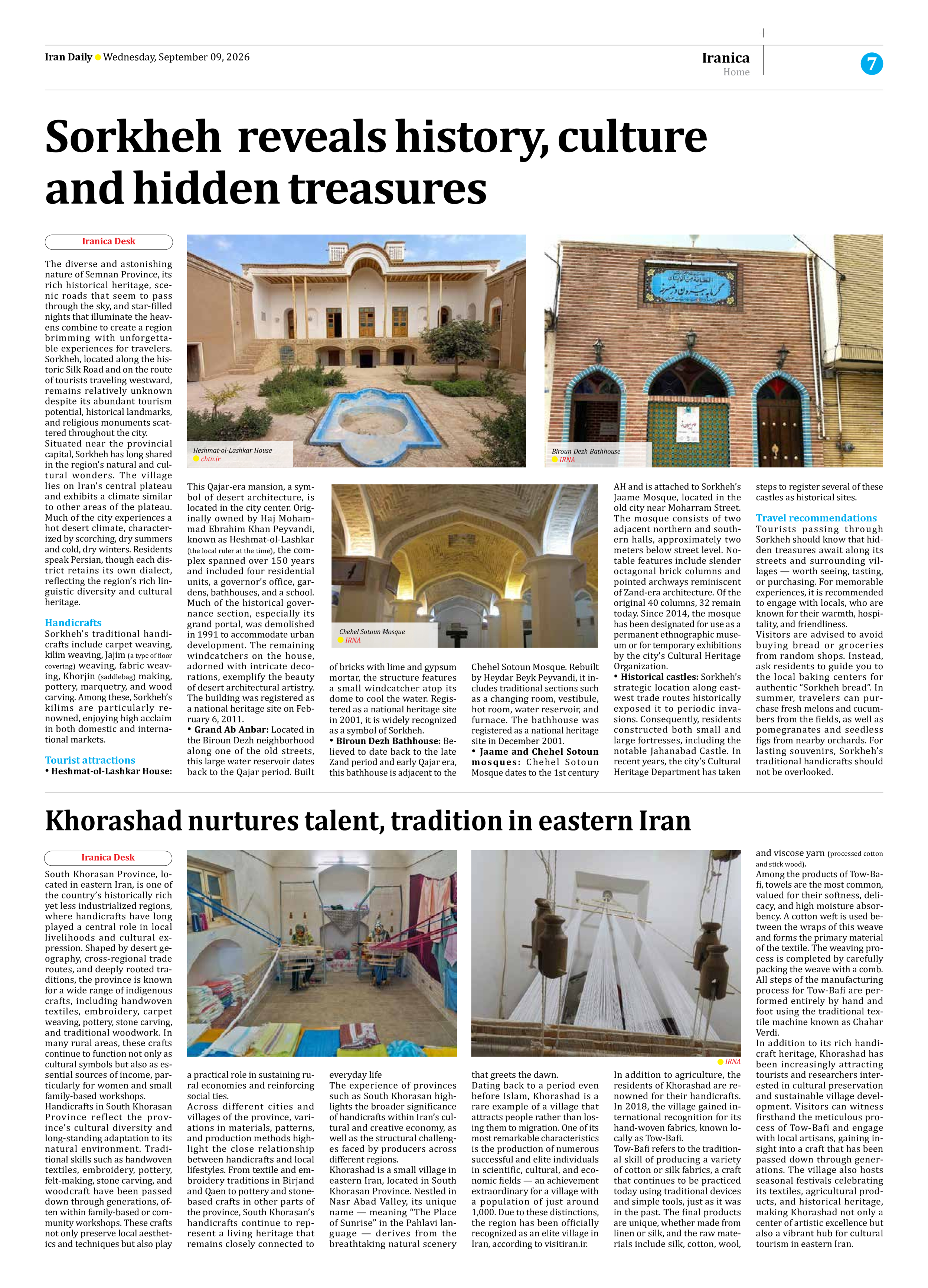
In addition to agriculture, the residents of Khorashad are renowned for their handicrafts. In 2018, the village gained international recognition for its hand-woven fabrics, known locally as Tow-Bafi.
Tow-Bafi refers to the traditional skill of producing a variety of cotton or silk fabrics, a craft that continues to be practiced today using traditional devices and simple tools, just as it was in the past. The final products are unique, whether made from linen or silk, and the raw materials include silk, cotton, wool, and viscose yarn (processed cotton and stick wood).
Among the products of Tow-Bafi, towels are the most common, valued for their softness, delicacy, and high moisture absorbency. A cotton weft is used between the wraps of this weave and forms the primary material of the textile. The weaving process is completed by carefully packing the weave with a comb. All steps of the manufacturing process for Tow-Bafi are performed entirely by hand and foot using the traditional textile machine known as Chahar Verdi.
In addition to its rich handicraft heritage, Khorashad has been increasingly attracting tourists and researchers interested in cultural preservation and sustainable village development. Visitors can witness firsthand the meticulous process of Tow-Bafi and engage with local artisans, gaining insight into a craft that has been passed down through generations. The village also hosts seasonal festivals celebrating its textiles, agricultural products, and historical heritage, making Khorashad not only a center of artistic excellence but also a vibrant hub for cultural tourism in eastern Iran.