







Sorkheh reveals history, culture and hidden treasures
The diverse and astonishing nature of Semnan Province, its rich historical heritage, scenic roads that seem to pass through the sky, and star-filled nights that illuminate the heavens combine to create a region brimming with unforgettable experiences for travelers. Sorkheh, located along the historic Silk Road and on the route of tourists traveling westward, remains relatively unknown despite its abundant tourism potential, historical landmarks, and religious monuments scattered throughout the city.
Situated near the provincial capital, Sorkheh has long shared in the region’s natural and cultural wonders. The village lies on Iran’s central plateau and exhibits a climate similar to other areas of the plateau. Much of the city experiences a hot desert climate, characterized by scorching, dry summers and cold, dry winters. Residents speak Persian, though each district retains its own dialect, reflecting the region’s rich linguistic diversity and cultural heritage.
Handicrafts
Sorkheh’s traditional handicrafts include carpet weaving, kilim weaving, Jajim (a type of floor covering) weaving, fabric weaving, Khorjin (saddlebag) making, pottery, marquetry, and wood carving. Among these, Sorkheh’s kilims are particularly renowned, enjoying high acclaim in both domestic and international markets.
Tourist attractions
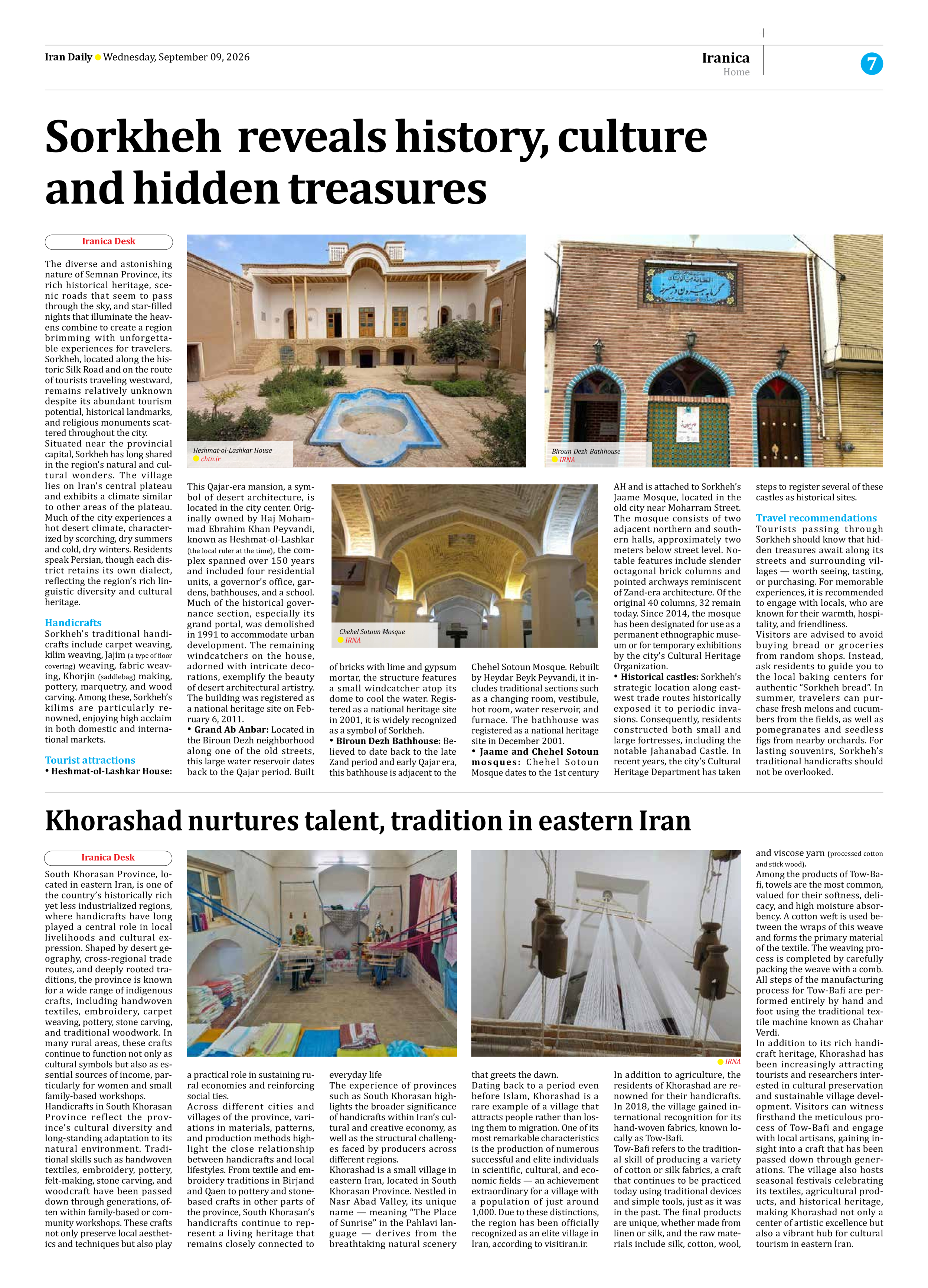
• Heshmat-ol-Lashkar House: This Qajar-era mansion, a symbol of desert architecture, is located in the city center. Originally owned by Haj Mohammad Ebrahim Khan Peyvandi, known as Heshmat-ol-Lashkar (the local ruler at the time), the complex spanned over 150 years and included four residential units, a governor’s office, gardens, bathhouses, and a school. Much of the historical governance section, especially its grand portal, was demolished in 1991 to accommodate urban development. The remaining windcatchers on the house, adorned with intricate decorations, exemplify the beauty of desert architectural artistry. The building was registered as a national heritage site on February 6, 2011.
• Grand Ab Anbar: Located in the Biroun Dezh neighborhood along one of the old streets, this large water reservoir dates back to the Qajar period. Built of bricks with lime and gypsum mortar, the structure features a small windcatcher atop its dome to cool the water. Registered as a national heritage site in 2001, it is widely recognized as a symbol of Sorkheh.
• Biroun Dezh Bathhouse: Believed to date back to the late Zand period and early Qajar era, this bathhouse is adjacent to the Chehel Sotoun Mosque. Rebuilt by Heydar Beyk Peyvandi, it includes traditional sections such as a changing room, vestibule, hot room, water reservoir, and furnace. The bathhouse was registered as a national heritage site in December 2001.
• Jaame and Chehel Sotoun mosques: Chehel Sotoun Mosque dates to the 1st century AH and is attached to Sorkheh’s Jaame Mosque, located in the old city near Moharram Street. The mosque consists of two adjacent northern and southern halls, approximately two meters below street level. Notable features include slender octagonal brick columns and pointed archways reminiscent of Zand-era architecture. Of the original 40 columns, 32 remain today. Since 2014, the mosque has been designated for use as a permanent ethnographic museum or for temporary exhibitions by the city’s Cultural Heritage Organization.
• Historical castles: Sorkheh’s strategic location along east-west trade routes historically exposed it to periodic invasions. Consequently, residents constructed both small and large fortresses, including the notable Jahanabad Castle. In recent years, the city’s Cultural Heritage Department has taken steps to register several of these castles as historical sites.
Travel recommendations
Tourists passing through Sorkheh should know that hidden treasures await along its streets and surrounding villages — worth seeing, tasting, or purchasing. For memorable experiences, it is recommended to engage with locals, who are known for their warmth, hospitality, and friendliness.
Visitors are advised to avoid buying bread or groceries from random shops. Instead, ask residents to guide you to the local baking centers for authentic “Sorkheh bread”. In summer, travelers can purchase fresh melons and cucumbers from the fields, as well as pomegranates and seedless figs from nearby orchards. For lasting souvenirs, Sorkheh’s traditional handicrafts should not be overlooked.