







Pezeshkian calls for greater support for nation’s scientists, innovators
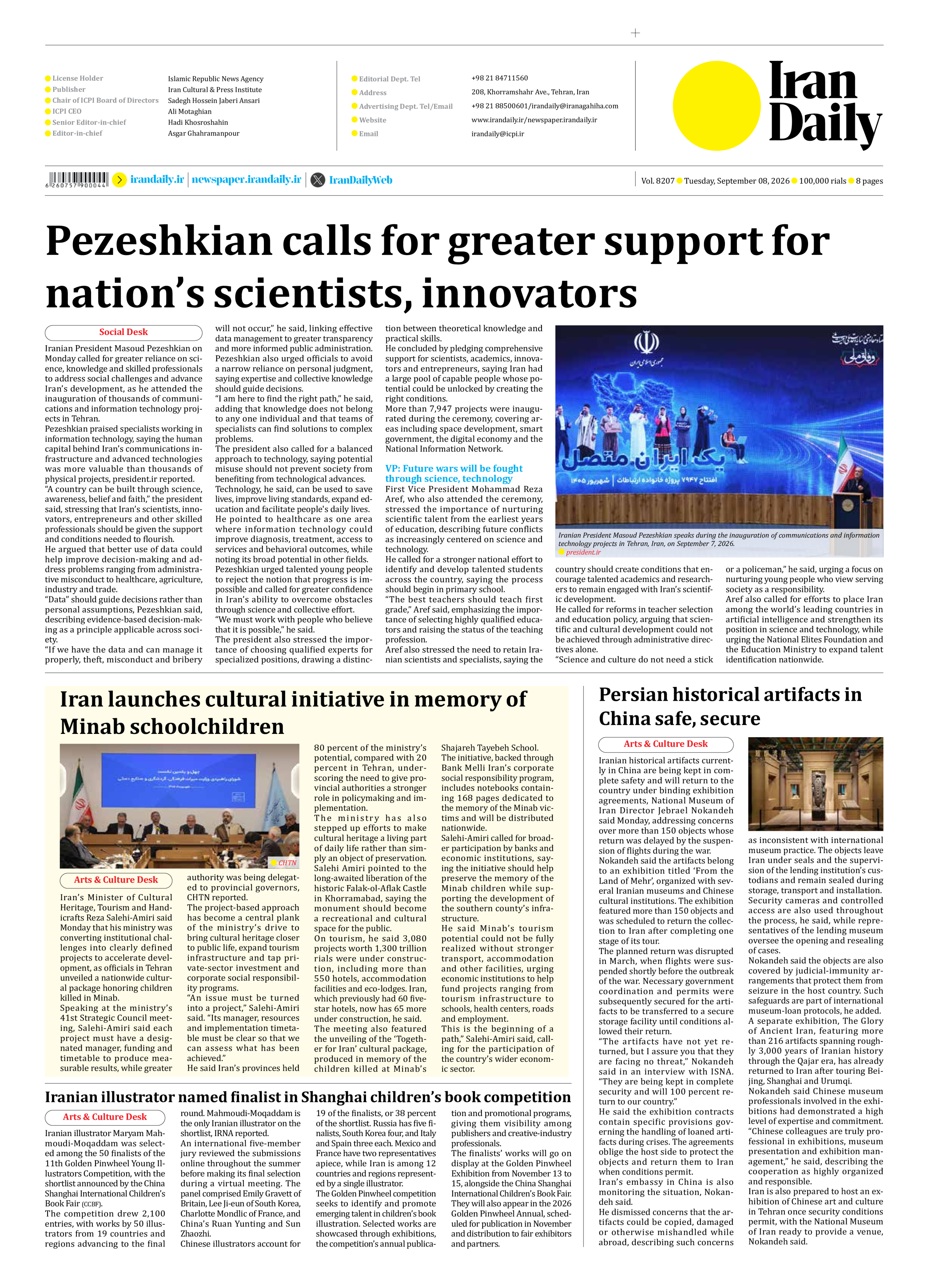
Iranian President Masoud Pezeshkian on Monday called for greater reliance on science, knowledge and skilled professionals to address social challenges and advance Iran’s development, as he attended the inauguration of thousands of communications and information technology projects in Tehran.
Pezeshkian praised specialists working in information technology, saying the human capital behind Iran’s communications infrastructure and advanced technologies was more valuable than thousands of physical projects, president.ir reported.
“A country can be built through science, awareness, belief and faith,” the president said, stressing that Iran’s scientists, innovators, entrepreneurs and other skilled professionals should be given the support and conditions needed to flourish.
He argued that better use of data could help improve decision-making and address problems ranging from administrative misconduct to healthcare, agriculture, industry and trade.
“Data” should guide decisions rather than personal assumptions, Pezeshkian said, describing evidence-based decision-making as a principle applicable across society.
“If we have the data and can manage it properly, theft, misconduct and bribery will not occur,” he said, linking effective data management to greater transparency and more informed public administration.
Pezeshkian also urged officials to avoid a narrow reliance on personal judgment, saying expertise and collective knowledge should guide decisions.
“I am here to find the right path,” he said, adding that knowledge does not belong to any one individual and that teams of specialists can find solutions to complex problems.
The president also called for a balanced approach to technology, saying potential misuse should not prevent society from benefiting from technological advances.
Technology, he said, can be used to save lives, improve living standards, expand education and facilitate people's daily lives.
He pointed to healthcare as one area where information technology could improve diagnosis, treatment, access to services and behavioral outcomes, while noting its broad potential in other fields.
Pezeshkian urged talented young people to reject the notion that progress is impossible and called for greater confidence in Iran’s ability to overcome obstacles through science and collective effort.
“We must work with people who believe that it is possible,” he said.
The president also stressed the importance of choosing qualified experts for specialized positions, drawing a distinction between theoretical knowledge and practical skills.
He concluded by pledging comprehensive support for scientists, academics, innovators and entrepreneurs, saying Iran had a large pool of capable people whose potential could be unlocked by creating the right conditions.
More than 7,947 projects were inaugurated during the ceremony, covering areas including space development, smart government, the digital economy and the National Information Network.
VP: Future wars will be fought through science, technology
First Vice President Mohammad Reza Aref, who also attended the ceremony, stressed the importance of nurturing scientific talent from the earliest years of education, describing future conflicts as increasingly centered on science and technology.
He called for a stronger national effort to identify and develop talented students across the country, saying the process should begin in primary school.
“The best teachers should teach first grade,” Aref said, emphasizing the importance of selecting highly qualified educators and raising the status of the teaching profession.
Aref also stressed the need to retain Iranian scientists and specialists, saying the country should create conditions that encourage talented academics and researchers to remain engaged with Iran’s scientific development.
He called for reforms in teacher selection and education policy, arguing that scientific and cultural development could not be achieved through administrative directives alone.
“Science and culture do not need a stick or a policeman,” he said, urging a focus on nurturing young people who view serving society as a responsibility.
Aref also called for efforts to place Iran among the world’s leading countries in artificial intelligence and strengthen its position in science and technology, while urging the National Elites Foundation and the Education Ministry to expand talent identification nationwide.