







Chega Sofla sheds new light on life before rise of cities
In southwestern Iran, on the Zaydon Plain near the Zohreh River, Khuzestan Province, an archaeological site is offering new insights into how human societies developed in the millennia before the emergence of cities.
Known as Chega Sofla, the site has evolved in recent years from a relatively little-known location in Iran’s archaeological landscape into an important focus of research into the social, ritual and cultural complexity of prehistoric communities, according to chtn.ir.
The significance of Chega Sofla lies not only in its antiquity but also in the diversity of evidence uncovered there. Dating to around 6,000 years ago, the site suggests that life in southwestern Iran before urbanization was far more complex than a simple picture of small rural communities focused primarily on subsistence.
Archaeological evidence points to a society with dedicated spaces for ritual activities and burial, as well as systems of production, exchange and symbolic expression.
These discoveries have attracted growing international attention. Archaeology Magazine featured Chega Sofla in an article titled “Ahead of Their Time,” examining the unexpected complexity of Chalcolithic society in the Zohreh Valley. Smithsonian Magazine and Live Science have also highlighted discoveries from the site, particularly human remains showing evidence of intentional cranial modification and severe trauma.
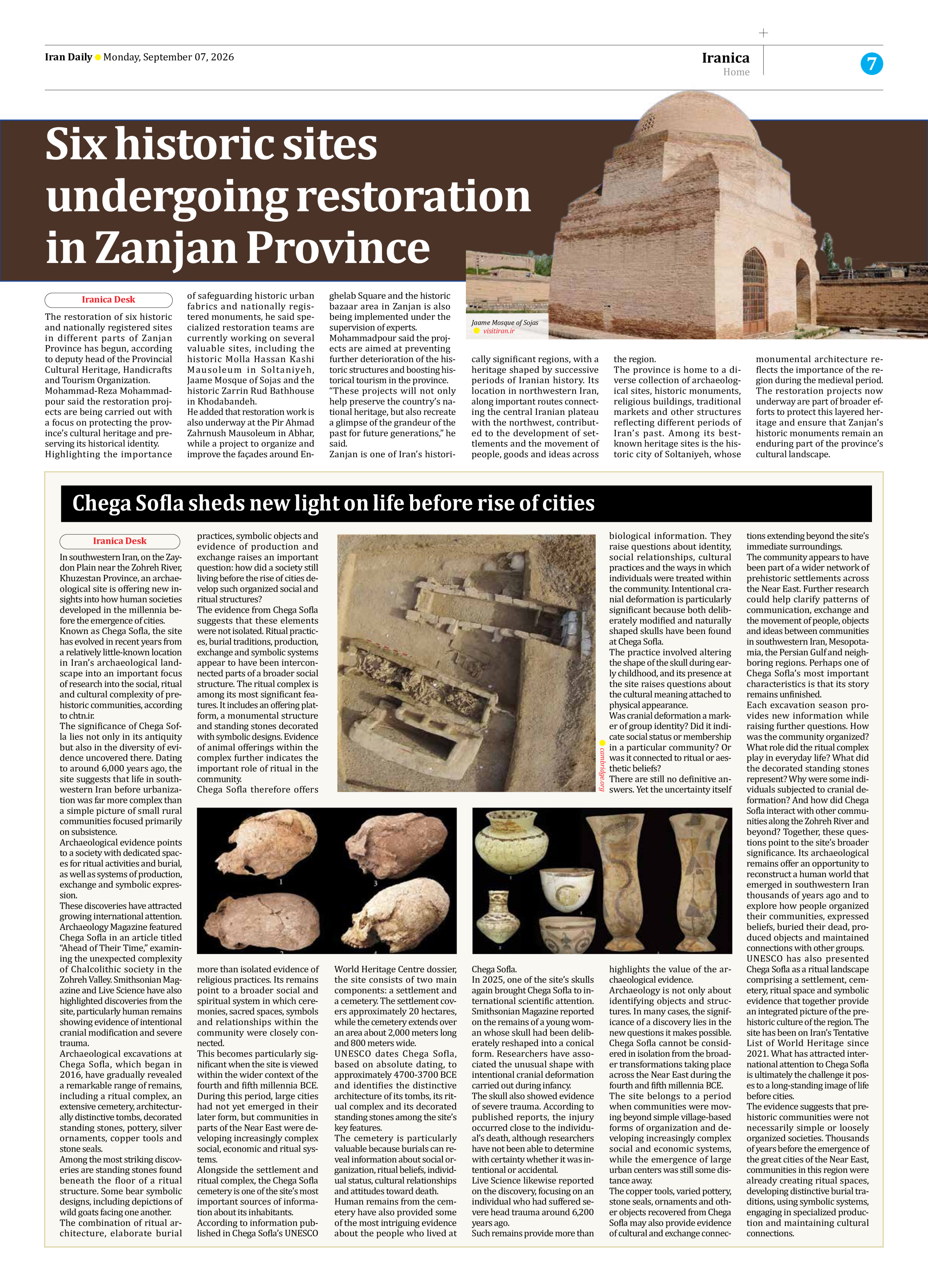
Archaeological excavations at Chega Sofla, which began in 2016, have gradually revealed a remarkable range of remains, including a ritual complex, an extensive cemetery, architecturally distinctive tombs, decorated standing stones, pottery, silver ornaments, copper tools and stone seals.
Among the most striking discoveries are standing stones found beneath the floor of a ritual structure. Some bear symbolic designs, including depictions of wild goats facing one another.
The combination of ritual architecture, elaborate burial practices, symbolic objects and evidence of production and exchange raises an important question: how did a society still living before the rise of cities develop such organized social and ritual structures?
The evidence from Chega Sofla suggests that these elements were not isolated. Ritual practices, burial traditions, production, exchange and symbolic systems appear to have been interconnected parts of a broader social structure. The ritual complex is among its most significant features. It includes an offering platform, a monumental structure and standing stones decorated with symbolic designs. Evidence of animal offerings within the complex further indicates the important role of ritual in the community.
Chega Sofla therefore offers more than isolated evidence of religious practices. Its remains point to a broader social and spiritual system in which ceremonies, sacred spaces, symbols and relationships within the community were closely connected.
This becomes particularly significant when the site is viewed within the wider context of the fourth and fifth millennia BCE. During this period, large cities had not yet emerged in their later form, but communities in parts of the Near East were developing increasingly complex social, economic and ritual systems.
Alongside the settlement and ritual complex, the Chega Sofla cemetery is one of the site’s most important sources of information about its inhabitants.
According to information published in Chega Sofla’s UNESCO World Heritage Centre dossier, the site consists of two main components: a settlement and a cemetery. The settlement covers approximately 20 hectares, while the cemetery extends over an area about 2,000 meters long and 800 meters wide.
UNESCO dates Chega Sofla, based on absolute dating, to approximately 4700-3700 BCE and identifies the distinctive architecture of its tombs, its ritual complex and its decorated standing stones among the site’s key features.
The cemetery is particularly valuable because burials can reveal information about social organization, ritual beliefs, individual status, cultural relationships and attitudes toward death.
Human remains from the cemetery have also provided some of the most intriguing evidence about the people who lived at Chega Sofla.
In 2025, one of the site’s skulls again brought Chega Sofla to international scientific attention. Smithsonian Magazine reported on the remains of a young woman whose skull had been deliberately reshaped into a conical form. Researchers have associated the unusual shape with intentional cranial deformation carried out during infancy.
The skull also showed evidence of severe trauma. According to published reports, the injury occurred close to the individual’s death, although researchers have not been able to determine with certainty whether it was intentional or accidental.
Live Science likewise reported on the discovery, focusing on an individual who had suffered severe head trauma around 6,200 years ago.
Such remains provide more than biological information. They raise questions about identity, social relationships, cultural practices and the ways in which individuals were treated within the community. Intentional cranial deformation is particularly significant because both deliberately modified and naturally shaped skulls have been found at Chega Sofla.
The practice involved altering the shape of the skull during early childhood, and its presence at the site raises questions about the cultural meaning attached to physical appearance.
Was cranial deformation a marker of group identity? Did it indicate social status or membership in a particular community? Or was it connected to ritual or aesthetic beliefs?
There are still no definitive answers. Yet the uncertainty itself highlights the value of the archaeological evidence.
Archaeology is not only about identifying objects and structures. In many cases, the significance of a discovery lies in the new questions it makes possible.
Chega Sofla cannot be considered in isolation from the broader transformations taking place across the Near East during the fourth and fifth millennia BCE.
The site belongs to a period when communities were moving beyond simple village-based forms of organization and developing increasingly complex social and economic systems, while the emergence of large urban centers was still some distance away.
The copper tools, varied pottery, stone seals, ornaments and other objects recovered from Chega Sofla may also provide evidence of cultural and exchange connections extending beyond the site’s immediate surroundings.
The community appears to have been part of a wider network of prehistoric settlements across the Near East. Further research could help clarify patterns of communication, exchange and the movement of people, objects and ideas between communities in southwestern Iran, Mesopotamia, the Persian Gulf and neighboring regions. Perhaps one of Chega Sofla’s most important characteristics is that its story remains unfinished.
Each excavation season provides new information while raising further questions. How was the community organized? What role did the ritual complex play in everyday life? What did the decorated standing stones represent? Why were some individuals subjected to cranial deformation? And how did Chega Sofla interact with other communities along the Zohreh River and beyond? Together, these questions point to the site’s broader significance. Its archaeological remains offer an opportunity to reconstruct a human world that emerged in southwestern Iran thousands of years ago and to explore how people organized their communities, expressed beliefs, buried their dead, produced objects and maintained connections with other groups.
UNESCO has also presented Chega Sofla as a ritual landscape comprising a settlement, cemetery, ritual space and symbolic evidence that together provide an integrated picture of the prehistoric culture of the region. The site has been on Iran’s Tentative List of World Heritage since 2021. What has attracted international attention to Chega Sofla is ultimately the challenge it poses to a long-standing image of life before cities.
The evidence suggests that prehistoric communities were not necessarily simple or loosely organized societies. Thousands of years before the emergence of the great cities of the Near East, communities in this region were already creating ritual spaces, developing distinctive burial traditions, using symbolic systems, engaging in specialized production and maintaining cultural connections.