







Copy in clipboard...
Anbaran seeks global recognition for its distinctive kilim tradition
Most of Anbaran’s residents are Sunni Muslims of the Shafi’i school. The city’s neighborhoods developed from three former villages: Upper Anbaran, Lower Anbaran and Amin Jan.
Kilim weaving remains a thriving activity in Anbaran, with many families engaged in the craft. The city has gained considerable recognition as Iran’s National City of Kilim and is considered to have strong potential for international recognition.
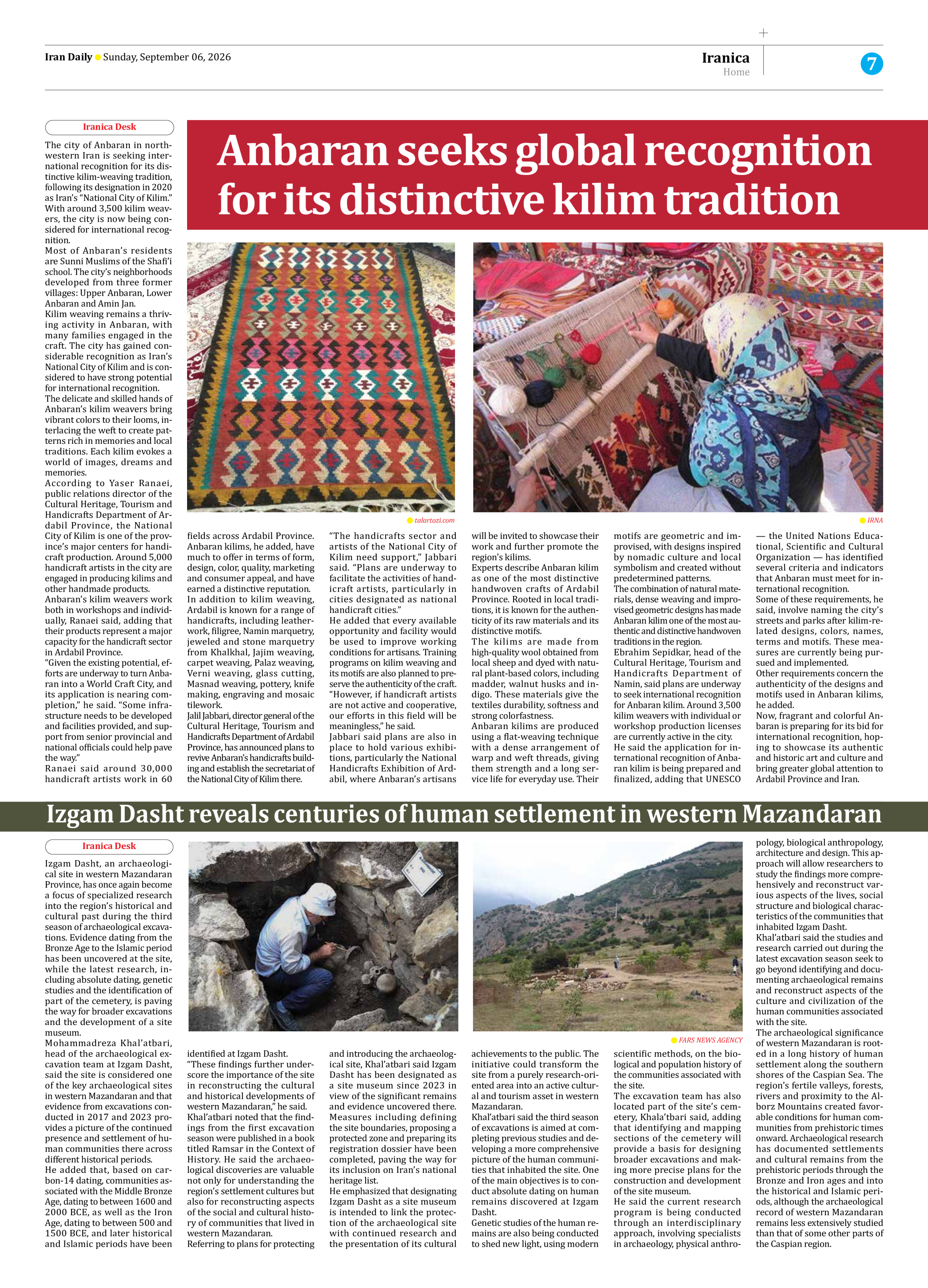
The delicate and skilled hands of Anbaran’s kilim weavers bring vibrant colors to their looms, interlacing the weft to create patterns rich in memories and local traditions. Each kilim evokes a world of images, dreams and memories.
According to Yaser Ranaei, public relations director of the Cultural Heritage, Tourism and Handicrafts Department of Ardabil Province, the National City of Kilim is one of the province’s major centers for handicraft production. Around 5,000 handicraft artists in the city are engaged in producing kilims and other handmade products.
Anbaran’s kilim weavers work both in workshops and individually, Ranaei said, adding that their products represent a major capacity for the handicraft sector in Ardabil Province.
“Given the existing potential, efforts are underway to turn Anbaran into a World Craft City, and its application is nearing completion,” he said. “Some infrastructure needs to be developed and facilities provided, and support from senior provincial and national officials could help pave the way.”
Ranaei said around 30,000 handicraft artists work in 60 fields across Ardabil Province. Anbaran kilims, he added, have much to offer in terms of form, design, color, quality, marketing and consumer appeal, and have earned a distinctive reputation.
In addition to kilim weaving, Ardabil is known for a range of handicrafts, including leatherwork, filigree, Namin marquetry, jeweled and stone marquetry from Khalkhal, Jajim weaving, carpet weaving, Palaz weaving, Verni weaving, glass cutting, Masnad weaving, pottery, knife making, engraving and mosaic tilework.
Jalil Jabbari, director general of the Cultural Heritage, Tourism and Handicrafts Department of Ardabil Province, has announced plans to revive Anbaran’s handicrafts building and establish the secretariat of the National City of Kilim there.
“The handicrafts sector and artists of the National City of Kilim need support,” Jabbari said. “Plans are underway to facilitate the activities of handicraft artists, particularly in cities designated as national handicraft cities.”
He added that every available opportunity and facility would be used to improve working conditions for artisans. Training programs on kilim weaving and its motifs are also planned to preserve the authenticity of the craft.
“However, if handicraft artists are not active and cooperative, our efforts in this field will be meaningless,” he said.
Jabbari said plans are also in place to hold various exhibitions, particularly the National Handicrafts Exhibition of Ardabil, where Anbaran’s artisans will be invited to showcase their work and further promote the region’s kilims.
Experts describe Anbaran kilim as one of the most distinctive handwoven crafts of Ardabil Province. Rooted in local traditions, it is known for the authenticity of its raw materials and its distinctive motifs.
The kilims are made from high-quality wool obtained from local sheep and dyed with natural plant-based colors, including madder, walnut husks and indigo. These materials give the textiles durability, softness and strong colorfastness.
Anbaran kilims are produced using a flat-weaving technique with a dense arrangement of warp and weft threads, giving them strength and a long service life for everyday use. Their motifs are geometric and improvised, with designs inspired by nomadic culture and local symbolism and created without predetermined patterns.
The combination of natural materials, dense weaving and improvised geometric designs has made Anbaran kilim one of the most authentic and distinctive handwoven traditions in the region.
Ebrahim Sepidkar, head of the Cultural Heritage, Tourism and Handicrafts Department of Namin, said plans are underway to seek international recognition for Anbaran kilim. Around 3,500 kilim weavers with individual or workshop production licenses are currently active in the city.
He said the application for international recognition of Anbaran kilim is being prepared and finalized, adding that UNESCO — the United Nations Educational, Scientific and Cultural Organization — has identified several criteria and indicators that Anbaran must meet for international recognition.
Some of these requirements, he said, involve naming the city’s streets and parks after kilim-related designs, colors, names, terms and motifs. These measures are currently being pursued and implemented.
Other requirements concern the authenticity of the designs and motifs used in Anbaran kilims, he added.
Now, fragrant and colorful Anbaran is preparing for its bid for international recognition, hoping to showcase its authentic and historic art and culture and bring greater global attention to Ardabil Province and Iran.