







Mesr village on track to join UN Best Tourism Villages list
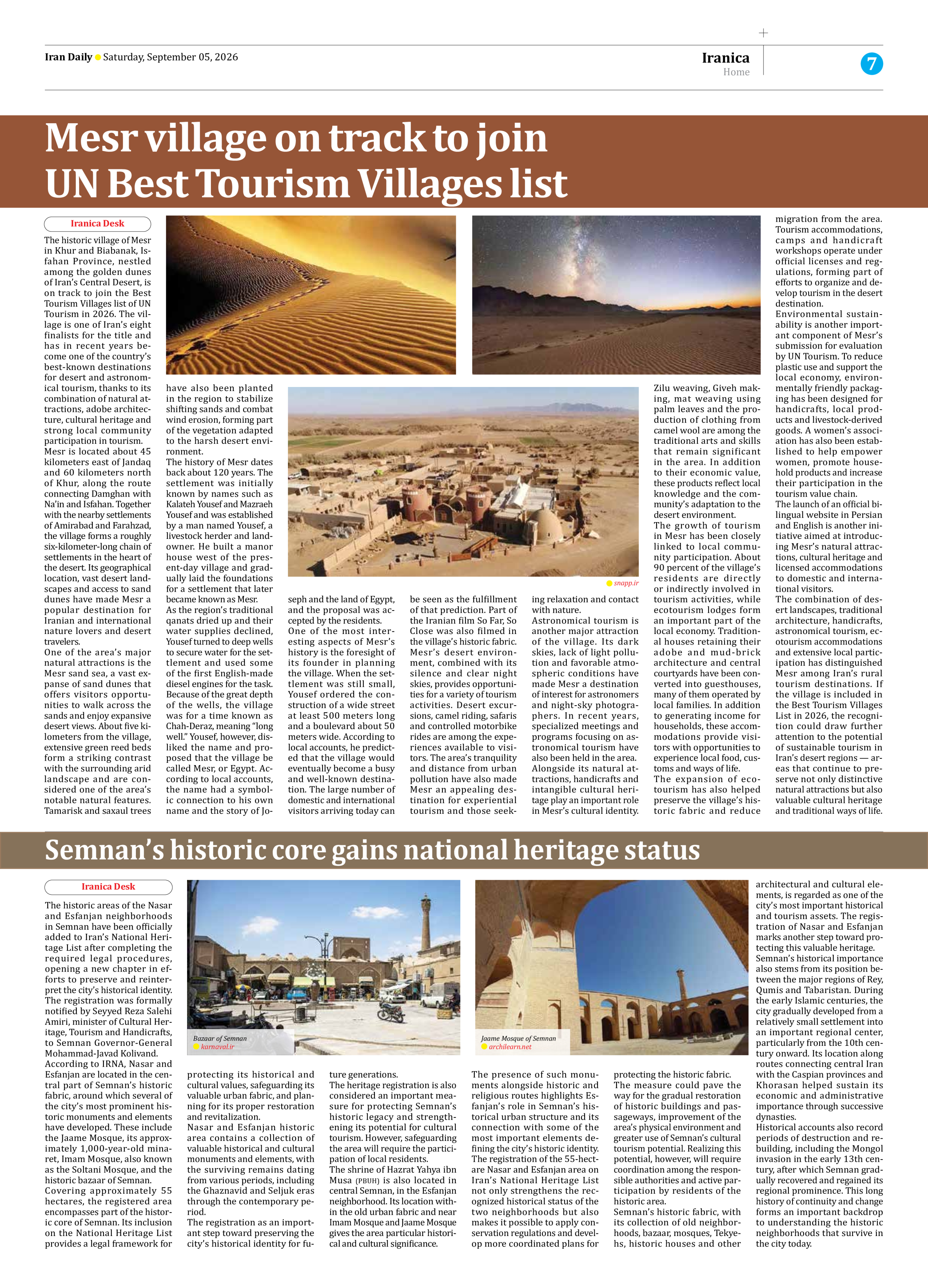
The historic village of Mesr in Khur and Biabanak, Isfahan Province, nestled among the golden dunes of Iran’s Central Desert, is on track to join the Best Tourism Villages list of UN Tourism in 2026. The village is one of Iran’s eight finalists for the title and has in recent years become one of the country’s best-known destinations for desert and astronomical tourism, thanks to its combination of natural attractions, adobe architecture, cultural heritage and strong local community participation in tourism.
Mesr is located about 45 kilometers east of Jandaq and 60 kilometers north of Khur, along the route connecting Damghan with Na’in and Isfahan. Together with the nearby settlements of Amirabad and Farahzad, the village forms a roughly six-kilometer-long chain of settlements in the heart of the desert. Its geographical location, vast desert landscapes and access to sand dunes have made Mesr a popular destination for Iranian and international nature lovers and desert travelers.
One of the area’s major natural attractions is the Mesr sand sea, a vast expanse of sand dunes that offers visitors opportunities to walk across the sands and enjoy expansive desert views. About five kilometers from the village, extensive green reed beds form a striking contrast with the surrounding arid landscape and are considered one of the area’s notable natural features. Tamarisk and saxaul trees have also been planted in the region to stabilize shifting sands and combat wind erosion, forming part of the vegetation adapted to the harsh desert environment.
The history of Mesr dates back about 120 years. The settlement was initially known by names such as Kalateh Yousef and Mazraeh Yousef and was established by a man named Yousef, a livestock herder and landowner. He built a manor house west of the present-day village and gradually laid the foundations for a settlement that later became known as Mesr.
As the region’s traditional qanats dried up and their water supplies declined, Yousef turned to deep wells to secure water for the settlement and used some of the first English-made diesel engines for the task. Because of the great depth of the wells, the village was for a time known as Chah-Deraz, meaning “long well.” Yousef, however, disliked the name and proposed that the village be called Mesr, or Egypt. According to local accounts, the name had a symbolic connection to his own name and the story of Joseph and the land of Egypt, and the proposal was accepted by the residents.
One of the most interesting aspects of Mesr’s history is the foresight of its founder in planning the village. When the settlement was still small, Yousef ordered the construction of a wide street at least 500 meters long and a boulevard about 50 meters wide. According to local accounts, he predicted that the village would eventually become a busy and well-known destination. The large number of domestic and international visitors arriving today can be seen as the fulfillment of that prediction. Part of the Iranian film So Far, So Close was also filmed in the village’s historic fabric.
Mesr’s desert environment, combined with its silence and clear night skies, provides opportunities for a variety of tourism activities. Desert excursions, camel riding, safaris and controlled motorbike rides are among the experiences available to visitors. The area’s tranquility and distance from urban pollution have also made Mesr an appealing destination for experiential tourism and those seeking relaxation and contact with nature.
Astronomical tourism is another major attraction of the village. Its dark skies, lack of light pollution and favorable atmospheric conditions have made Mesr a destination of interest for astronomers and night-sky photographers. In recent years, specialized meetings and programs focusing on astronomical tourism have also been held in the area.
Alongside its natural attractions, handicrafts and intangible cultural heritage play an important role in Mesr’s cultural identity. Zilu weaving, Giveh making, mat weaving using palm leaves and the production of clothing from camel wool are among the traditional arts and skills that remain significant in the area. In addition to their economic value, these products reflect local knowledge and the community’s adaptation to the desert environment.
The growth of tourism in Mesr has been closely linked to local community participation. About 90 percent of the village’s residents are directly or indirectly involved in tourism activities, while ecotourism lodges form an important part of the local economy. Traditional houses retaining their adobe and mud-brick architecture and central courtyards have been converted into guesthouses, many of them operated by local families. In addition to generating income for households, these accommodations provide visitors with opportunities to experience local food, customs and ways of life.
The expansion of ecotourism has also helped preserve the village’s historic fabric and reduce migration from the area. Tourism accommodations, camps and handicraft workshops operate under official licenses and regulations, forming part of efforts to organize and develop tourism in the desert destination.
Environmental sustainability is another important component of Mesr’s submission for evaluation by UN Tourism. To reduce plastic use and support the local economy, environmentally friendly packaging has been designed for handicrafts, local products and livestock-derived goods. A women’s association has also been established to help empower women, promote household products and increase their participation in the tourism value chain.
The launch of an official bilingual website in Persian and English is another initiative aimed at introducing Mesr’s natural attractions, cultural heritage and licensed accommodations to domestic and international visitors.
The combination of desert landscapes, traditional architecture, handicrafts, astronomical tourism, ecotourism accommodations and extensive local participation has distinguished Mesr among Iran’s rural tourism destinations. If the village is included in the Best Tourism Villages List in 2026, the recognition could draw further attention to the potential of sustainable tourism in Iran’s desert regions — areas that continue to preserve not only distinctive natural attractions but also valuable cultural heritage and traditional ways of life.