







Pezeshkian urges gradual approach to gasoline consumption control
President Masoud Pezeshkian on Friday said that the government would curb gasoline consumption gradually and mainly through “non-price measures”, saying it would avoid sudden decisions that could shock the public.
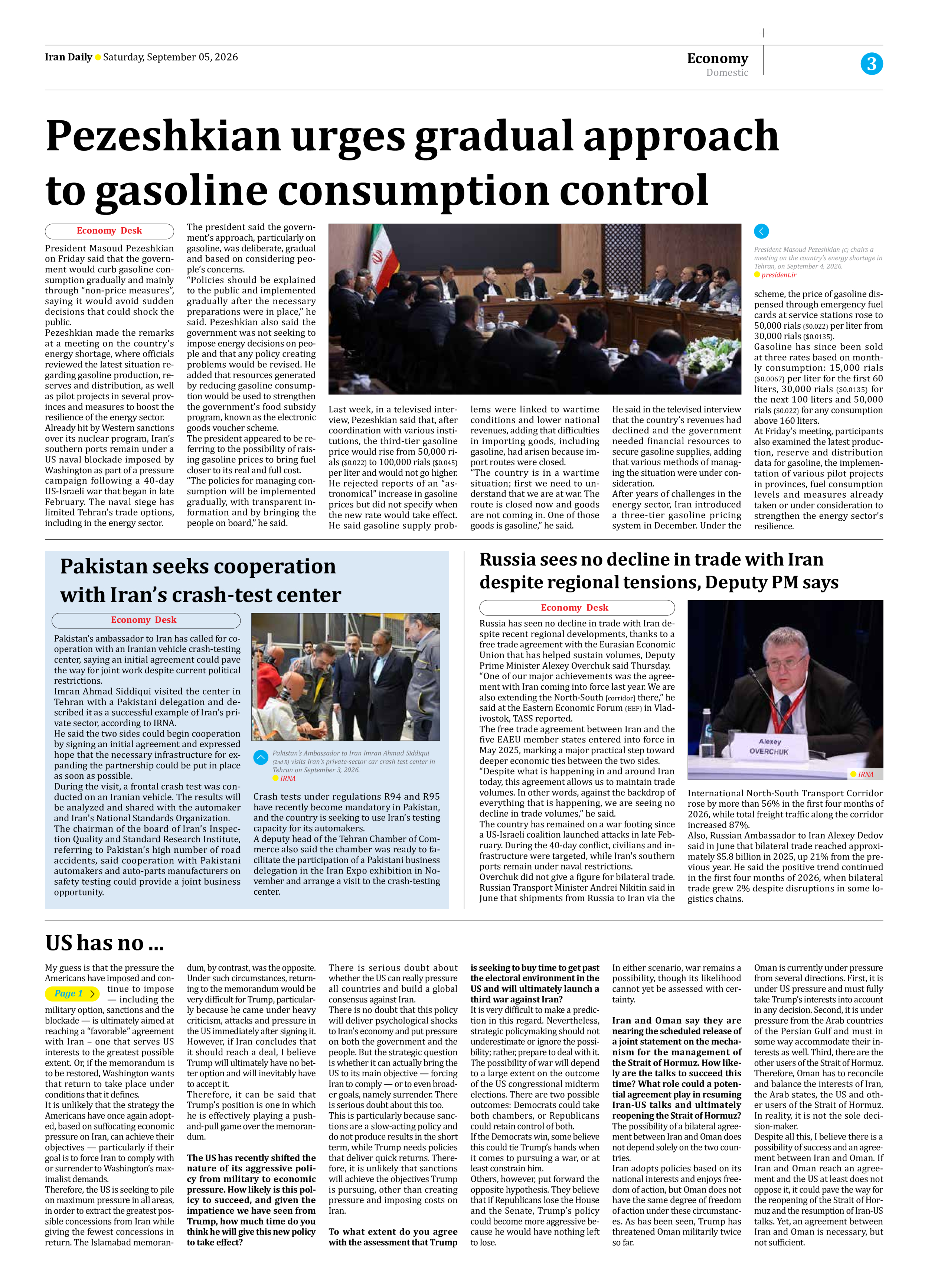
Pezeshkian made the remarks at a meeting on the country’s energy shortage, where officials reviewed the latest situation regarding gasoline production, reserves and distribution, as well as pilot projects in several provinces and measures to boost the resilience of the energy sector.
Already hit by Western sanctions over its nuclear program, Iran’s southern ports remain under a US naval blockade imposed by Washington as part of a pressure campaign following a 40-day US-Israeli war that began in late February. The naval siege has limited Tehran’s trade options, including in the energy sector.
The president said the government’s approach, particularly on gasoline, was deliberate, gradual and based on considering people’s concerns.
“Policies should be explained to the public and implemented gradually after the necessary preparations were in place,” he said. Pezeshkian also said the government was not seeking to impose energy decisions on people and that any policy creating problems would be revised. He added that resources generated by reducing gasoline consumption would be used to strengthen the government’s food subsidy program, known as the electronic goods voucher scheme.
The president appeared to be referring to the possibility of raising gasoline prices to bring fuel closer to its real and full cost.
“The policies for managing consumption will be implemented gradually, with transparent information and by bringing the people on board,” he said.
Last week, in a televised interview, Pezeshkian said that, after coordination with various institutions, the third-tier gasoline price would rise from 50,000 rials ($0.022) to 100,000 rials ($0.045) per liter and would not go higher.
He rejected reports of an “astronomical” increase in gasoline prices but did not specify when the new rate would take effect. He said gasoline supply problems were linked to wartime conditions and lower national revenues, adding that difficulties in importing goods, including gasoline, had arisen because import routes were closed.
“The country is in a wartime situation; first we need to understand that we are at war. The route is closed now and goods are not coming in. One of those goods is gasoline,” he said.
He said in the televised interview that the country’s revenues had declined and the government needed financial resources to secure gasoline supplies, adding that various methods of managing the situation were under consideration.
After years of challenges in the energy sector, Iran introduced a three-tier gasoline pricing system in December. Under the scheme, the price of gasoline dispensed through emergency fuel cards at service stations rose to 50,000 rials ($0.022) per liter from 30,000 rials ($0.0135).
Gasoline has since been sold at three rates based on monthly consumption: 15,000 rials ($0.0067) per liter for the first 60 liters, 30,000 rials ($0.0135) for the next 100 liters and 50,000 rials ($0.022) for any consumption above 160 liters.
At Friday’s meeting, participants also examined the latest production, reserve and distribution data for gasoline, the implementation of various pilot projects in provinces, fuel consumption levels and measures already taken or under consideration to strengthen the energy sector’s resilience.