







Ardakan National Water & Qanat Museum
From darkness of qanats to light of desert life
By Sadeq Dehqan
Staff writer
Despite its vast arid and desert regions, Iran is the birthplace of one of humanity’s most remarkable inventions: The qanat, an ingenious system that brought water from the darkness beneath the earth into the light of everyday life.
This engineering marvel, some examples of which date back 3,000 years, was far more than a means of extracting water. It embodied collective wisdom, social solidarity and sustainable living in the heart of the desert. Researchers regard Iran as the principal cradle of this valuable technology, while UNESCO has inscribed the Iranian qanat as a World Heritage site.
Against this backdrop, the historic city of Ardakan in Yazd Province, once home to one of Iran’s highest concentrations of qanats, now has a specialized national museum dedicated to water and qanats. The Ardakan National Water and Qanat Museum opened in June this year and houses a unique collection of qanat excavation tools, historical documents and correspondence belonging to qanat diggers, as well as artefacts associated with Iran’s water and qanat culture.
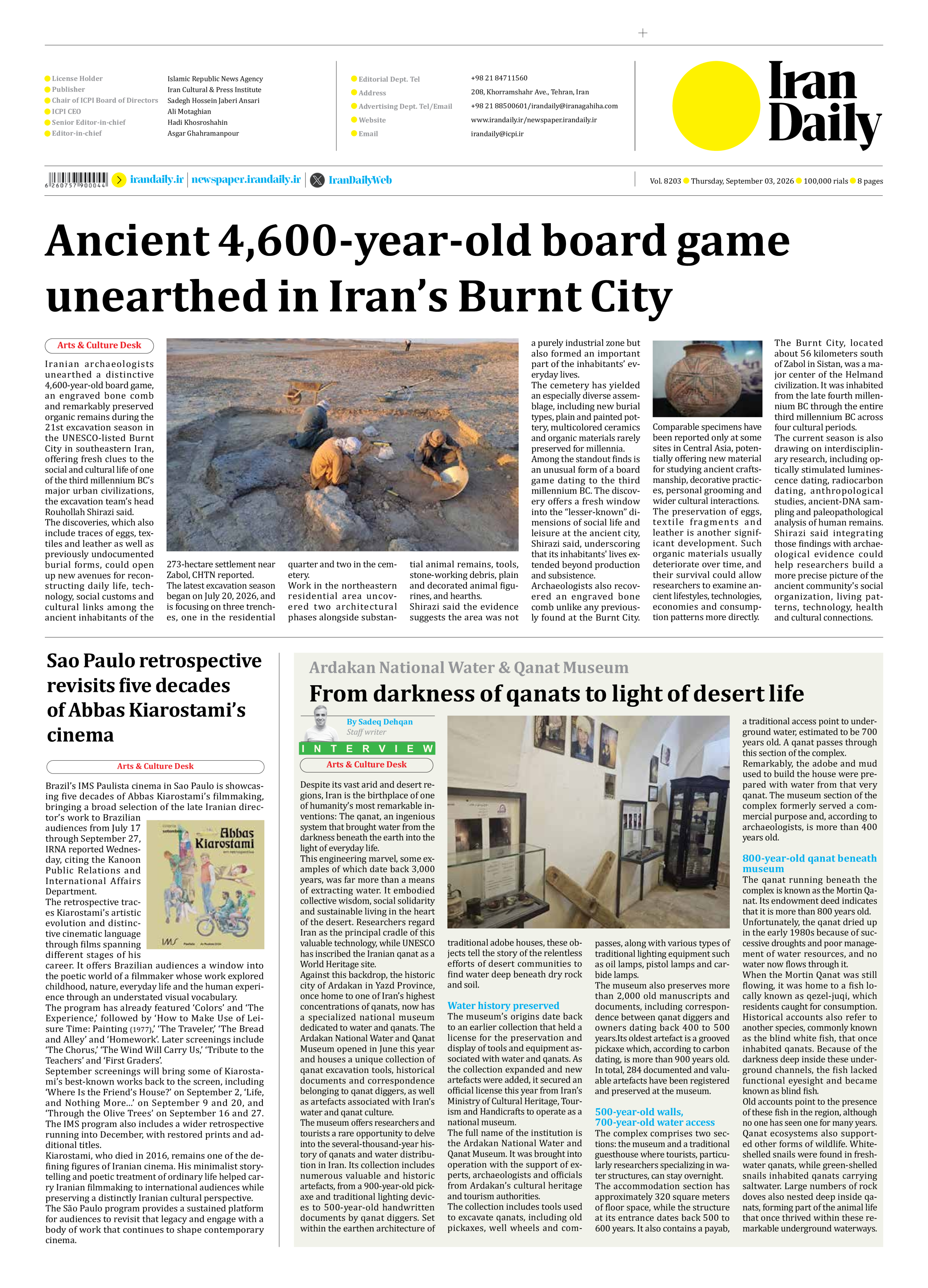
The museum offers researchers and tourists a rare opportunity to delve into the several-thousand-year history of qanats and water distribution in Iran. Its collection includes numerous valuable and historic artefacts, from a 900-year-old pickaxe and traditional lighting devices to 500-year-old handwritten documents by qanat diggers. Set within the earthen architecture of traditional adobe houses, these objects tell the story of the relentless efforts of desert communities to find water deep beneath dry rock and soil.
Water history preserved
The museum’s origins date back to an earlier collection that held a license for the preservation and display of tools and equipment associated with water and qanats. As the collection expanded and new artefacts were added, it secured an official license this year from Iran’s Ministry of Cultural Heritage, Tourism and Handicrafts to operate as a national museum.
The full name of the institution is the Ardakan National Water and Qanat Museum. It was brought into operation with the support of experts, archaeologists and officials from Ardakan’s cultural heritage and tourism authorities.
The collection includes tools used to excavate qanats, including old pickaxes, well wheels and compasses, along with various types of traditional lighting equipment such as oil lamps, pistol lamps and carbide lamps.
The museum also preserves more than 2,000 old manuscripts and documents, including correspondence between qanat diggers and owners dating back 400 to 500 years.Its oldest artefact is a grooved pickaxe which, according to carbon dating, is more than 900 years old. In total, 284 documented and valuable artefacts have been registered and preserved at the museum.
500-year-old walls, 700-year-old water access
The complex comprises two sections: the museum and a traditional guesthouse where tourists, particularly researchers specializing in water structures, can stay overnight.
The accommodation section has approximately 320 square meters of floor space, while the structure at its entrance dates back 500 to 600 years. It also contains a payab, a traditional access point to underground water, estimated to be 700 years old. A qanat passes through this section of the complex.
Remarkably, the adobe and mud used to build the house were prepared with water from that very qanat. The museum section of the complex formerly served a commercial purpose and, according to archaeologists, is more than 400 years old.
800-year-old qanat beneath museum
The qanat running beneath the complex is known as the Mortin Qanat. Its endowment deed indicates that it is more than 800 years old.
Unfortunately, the qanat dried up in the early 1980s because of successive droughts and poor management of water resources, and no water now flows through it.
When the Mortin Qanat was still flowing, it was home to a fish locally known as qezel-juqi, which residents caught for consumption. Historical accounts also refer to another species, commonly known as the blind white fish, that once inhabited qanats. Because of the darkness deep inside these underground channels, the fish lacked functional eyesight and became known as blind fish.
Old accounts point to the presence of these fish in the region, although no one has seen one for many years.
Qanat ecosystems also supported other forms of wildlife. White-shelled snails were found in freshwater qanats, while green-shelled snails inhabited qanats carrying saltwater. Large numbers of rock doves also nested deep inside qanats, forming part of the animal life that once thrived within these remarkable underground waterways.