





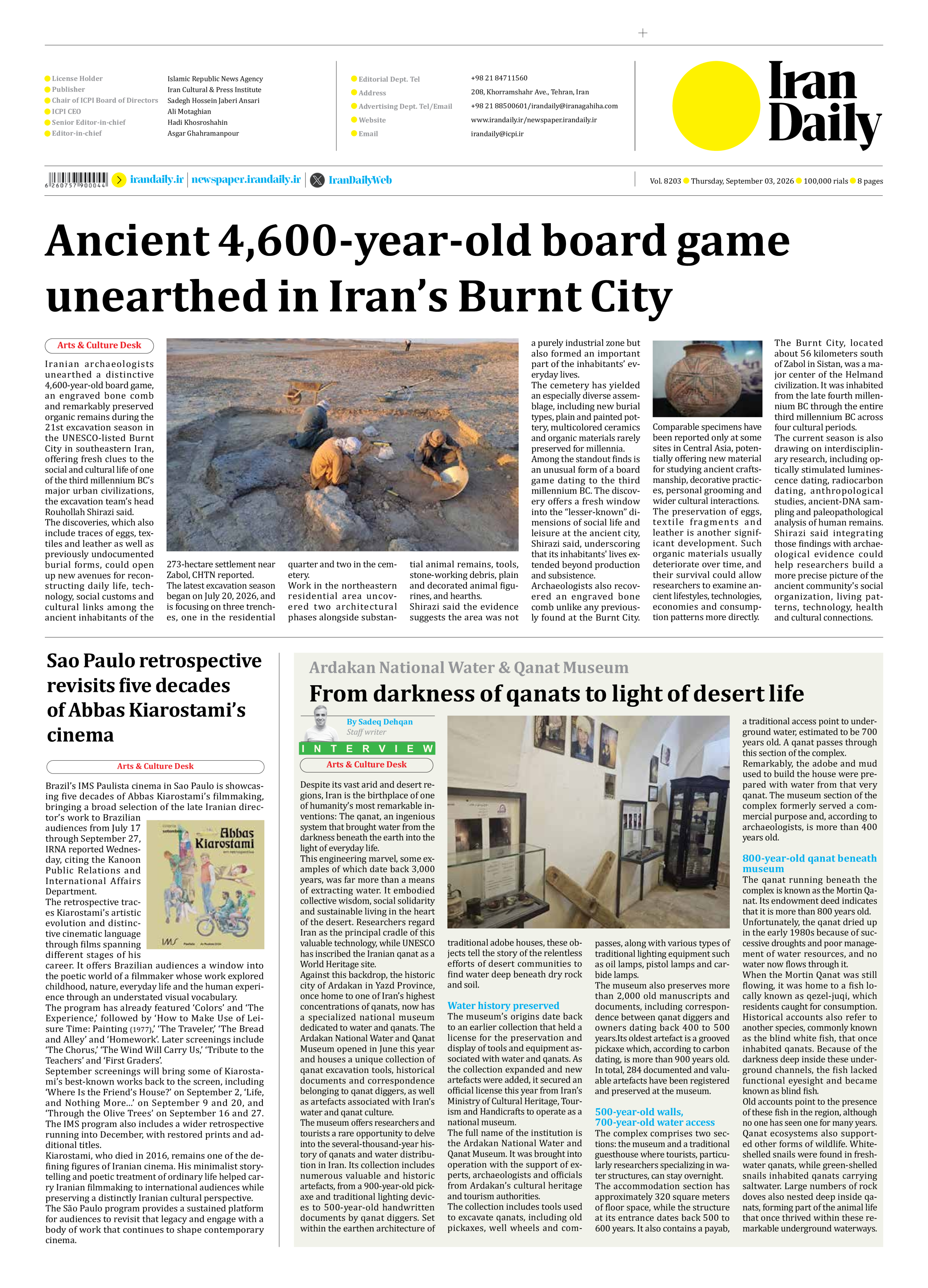


Ancient 4,600-year-old board game unearthed in Iran’s Burnt City
Iranian archaeologists unearthed a distinctive 4,600-year-old board game, an engraved bone comb and remarkably preserved organic remains during the 21st excavation season in the UNESCO-listed Burnt City in southeastern Iran, offering fresh clues to the social and cultural life of one of the third millennium BC’s major urban civilizations, the excavation team’s head Rouhollah Shirazi said.
The discoveries, which also include traces of eggs, textiles and leather as well as previously undocumented burial forms, could open up new avenues for reconstructing daily life, technology, social customs and cultural links among the ancient inhabitants of the 273-hectare settlement near Zabol, CHTN reported.
The latest excavation season began on July 20, 2026, and is focusing on three trenches, one in the residential quarter and two in the cemetery.
Work in the northeastern residential area uncovered two architectural phases alongside substantial animal remains, tools, stone-working debris, plain and decorated animal figurines, and hearths.
Shirazi said the evidence suggests the area was not a purely industrial zone but also formed an important part of the inhabitants’ everyday lives.
The cemetery has yielded an especially diverse assemblage, including new burial types, plain and painted pottery, multicolored ceramics and organic materials rarely preserved for millennia.
Among the standout finds is an unusual form of a board game dating to the third millennium BC. The discovery offers a fresh window into the “lesser-known” dimensions of social life and leisure at the ancient city, Shirazi said, underscoring that its inhabitants' lives extended beyond production and subsistence.
Archaeologists also recovered an engraved bone comb unlike any previously found at the Burnt City. Comparable specimens have been reported only at some sites in Central Asia, potentially offering new material for studying ancient craftsmanship, decorative practices, personal grooming and wider cultural interactions.
The preservation of eggs, textile fragments and leather is another significant development. Such organic materials usually deteriorate over time, and their survival could allow researchers to examine ancient lifestyles, technologies, economies and consumption patterns more directly.
The Burnt City, located about 56 kilometers south of Zabol in Sistan, was a major center of the Helmand civilization. It was inhabited from the late fourth millennium BC through the entire third millennium BC across four cultural periods.
The current season is also drawing on interdisciplinary research, including optically stimulated luminescence dating, radiocarbon dating, anthropological studies, ancient-DNA sampling and paleopathological analysis of human remains. Shirazi said integrating those findings with archaeological evidence could help researchers build a more precise picture of the ancient community's social organization, living patterns, technology, health and cultural connections.