







Avicenna’s journey from science to search for truth
Mohammad Reza Tavakoli-Saberi
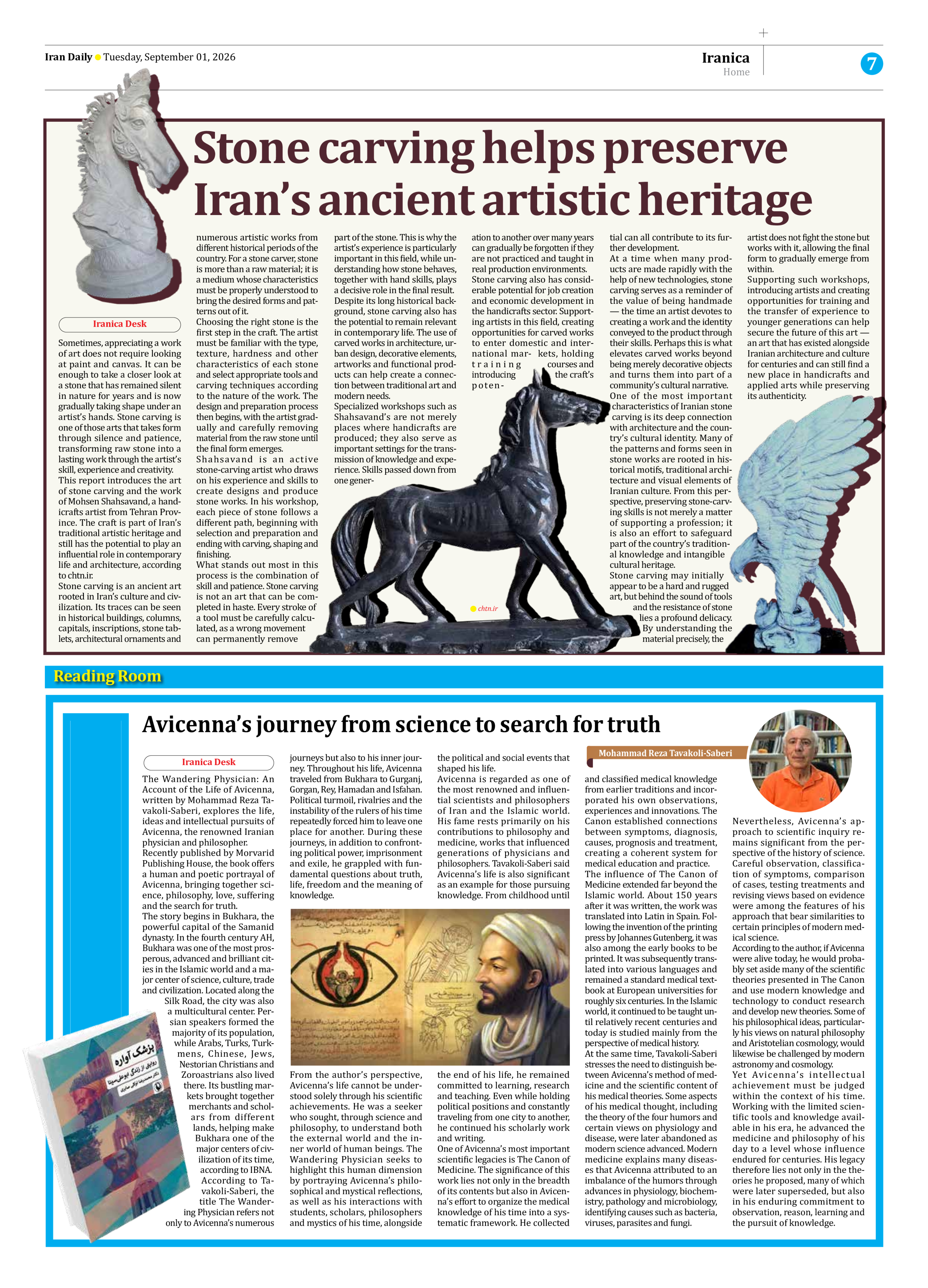
The Wandering Physician: An Account of the Life of Avicenna, written by Mohammad Reza Tavakoli-Saberi, explores the life, ideas and intellectual pursuits of Avicenna, the renowned Iranian physician and philosopher.
Recently published by Morvarid Publishing House, the book offers a human and poetic portrayal of Avicenna, bringing together science, philosophy, love, suffering and the search for truth.
The story begins in Bukhara, the powerful capital of the Samanid dynasty. In the fourth century AH, Bukhara was one of the most prosperous, advanced and brilliant cities in the Islamic world and a major center of science, culture, trade and civilization. Located along the Silk Road, the city was also a multicultural center. Persian speakers formed the majority of its population, while Arabs, Turks, Turkmens, Chinese, Jews, Nestorian Christians and Zoroastrians also lived there. Its bustling markets brought together merchants and scholars from different lands, helping make Bukhara one of the major centers of civilization of its time, according to IBNA.
According to Tavakoli-Saberi, the title The Wandering Physician refers not only to Avicenna’s numerous journeys but also to his inner journey. Throughout his life, Avicenna traveled from Bukhara to Gurganj, Gorgan, Rey, Hamadan and Isfahan. Political turmoil, rivalries and the instability of the rulers of his time repeatedly forced him to leave one place for another. During these journeys, in addition to confronting political power, imprisonment and exile, he grappled with fundamental questions about truth, life, freedom and the meaning of knowledge.
From the author’s perspective, Avicenna’s life cannot be understood solely through his scientific achievements. He was a seeker who sought, through science and philosophy, to understand both the external world and the inner world of human beings. The Wandering Physician seeks to highlight this human dimension by portraying Avicenna’s philosophical and mystical reflections, as well as his interactions with students, scholars, philosophers and mystics of his time, alongside the political and social events that shaped his life.
Avicenna is regarded as one of the most renowned and influential scientists and philosophers of Iran and the Islamic world. His fame rests primarily on his contributions to philosophy and medicine, works that influenced generations of physicians and philosophers. Tavakoli-Saberi said Avicenna’s life is also significant as an example for those pursuing knowledge. From childhood until the end of his life, he remained committed to learning, research and teaching. Even while holding political positions and constantly traveling from one city to another, he continued his scholarly work and writing.
One of Avicenna’s most important scientific legacies is The Canon of Medicine. The significance of this work lies not only in the breadth of its contents but also in Avicenna’s effort to organize the medical knowledge of his time into a systematic framework. He collected and classified medical knowledge from earlier traditions and incorporated his own observations, experiences and innovations. The Canon established connections between symptoms, diagnosis, causes, prognosis and treatment, creating a coherent system for medical education and practice.
The influence of The Canon of Medicine extended far beyond the Islamic world. About 150 years after it was written, the work was translated into Latin in Spain. Following the invention of the printing press by Johannes Gutenberg, it was also among the early books to be printed. It was subsequently translated into various languages and remained a standard medical textbook at European universities for roughly six centuries. In the Islamic world, it continued to be taught until relatively recent centuries and today is studied mainly from the perspective of medical history.
At the same time, Tavakoli-Saberi stresses the need to distinguish between Avicenna’s method of medicine and the scientific content of his medical theories. Some aspects of his medical thought, including the theory of the four humors and certain views on physiology and disease, were later abandoned as modern science advanced. Modern medicine explains many diseases that Avicenna attributed to an imbalance of the humors through advances in physiology, biochemistry, pathology and microbiology, identifying causes such as bacteria, viruses, parasites and fungi.
Nevertheless, Avicenna’s approach to scientific inquiry remains significant from the perspective of the history of science. Careful observation, classification of symptoms, comparison of cases, testing treatments and revising views based on evidence were among the features of his approach that bear similarities to certain principles of modern medical science.
According to the author, if Avicenna were alive today, he would probably set aside many of the scientific theories presented in The Canon and use modern knowledge and technology to conduct research and develop new theories. Some of his philosophical ideas, particularly his views on natural philosophy and Aristotelian cosmology, would likewise be challenged by modern astronomy and cosmology.
Yet Avicenna’s intellectual achievement must be judged within the context of his time. Working with the limited scientific tools and knowledge available in his era, he advanced the medicine and philosophy of his day to a level whose influence endured for centuries. His legacy therefore lies not only in the theories he proposed, many of which were later superseded, but also in his enduring commitment to observation, reason, learning and the pursuit of knowledge.