





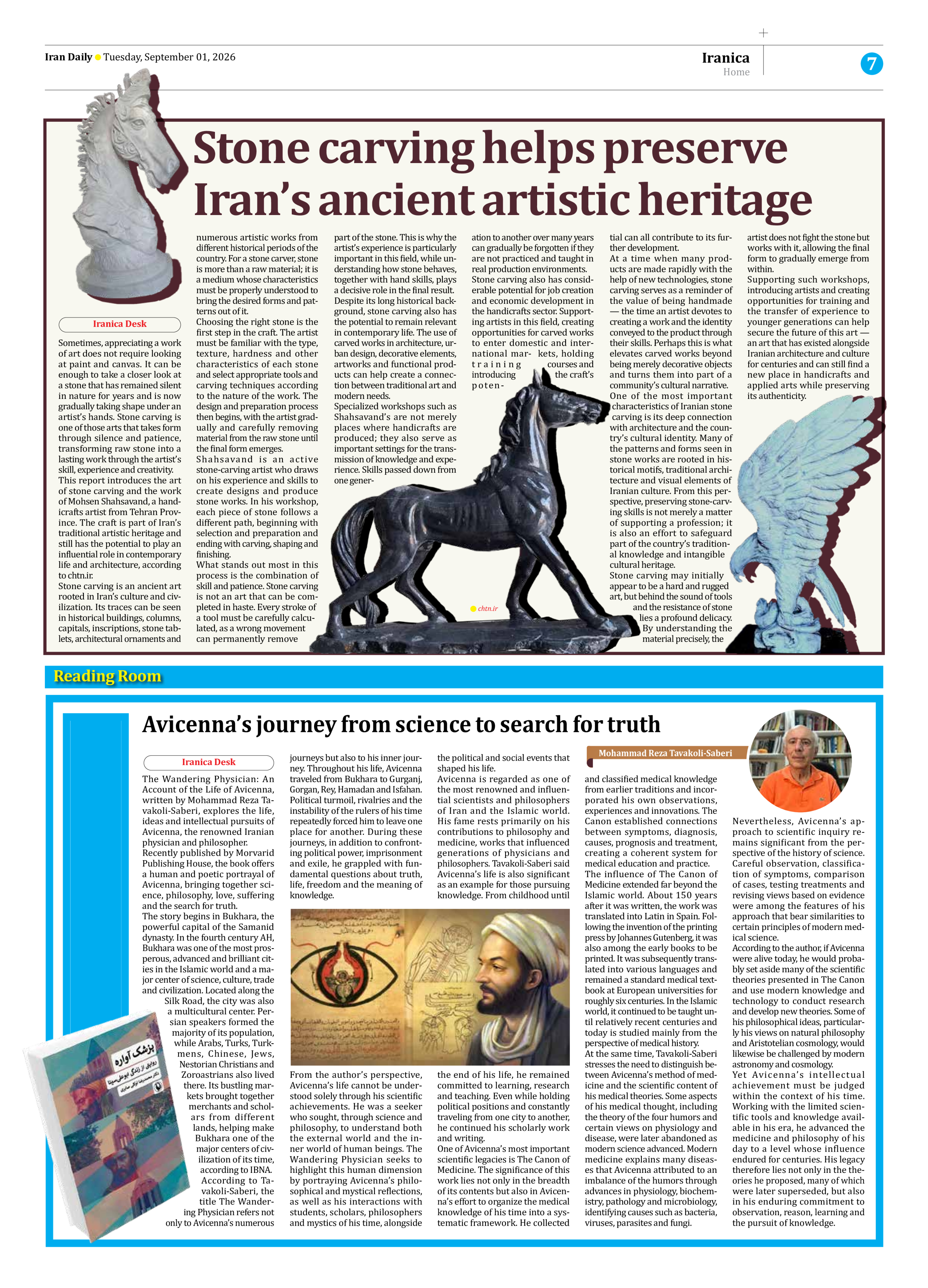


Stone carving helps preserve Iran’s ancient artistic heritage
Sometimes, appreciating a work of art does not require looking at paint and canvas. It can be enough to take a closer look at a stone that has remained silent in nature for years and is now gradually taking shape under an artist’s hands. Stone carving is one of those arts that takes form through silence and patience, transforming raw stone into a lasting work through the artist’s skill, experience and creativity.
This report introduces the art of stone carving and the work of Mohsen Shahsavand, a handicrafts artist from Tehran Province. The craft is part of Iran’s traditional artistic heritage and still has the potential to play an influential role in contemporary life and architecture, according to chtn.ir.
Stone carving is an ancient art rooted in Iran’s culture and civilization. Its traces can be seen in historical buildings, columns, capitals, inscriptions, stone tablets, architectural ornaments and numerous artistic works from different historical periods of the country. For a stone carver, stone is more than a raw material; it is a medium whose characteristics must be properly understood to bring the desired forms and patterns out of it.
Choosing the right stone is the first step in the craft. The artist must be familiar with the type, texture, hardness and other characteristics of each stone and select appropriate tools and carving techniques according to the nature of the work. The design and preparation process then begins, with the artist gradually and carefully removing material from the raw stone until the final form emerges.
Shahsavand is an active stone-carving artist who draws on his experience and skills to create designs and produce stone works. In his workshop, each piece of stone follows a different path, beginning with selection and preparation and ending with carving, shaping and finishing.
What stands out most in this process is the combination of skill and patience. Stone carving is not an art that can be completed in haste. Every stroke of a tool must be carefully calculated, as a wrong movement can permanently remove part of the stone. This is why the artist’s experience is particularly important in this field, while understanding how stone behaves, together with hand skills, plays a decisive role in the final result.
Despite its long historical background, stone carving also has the potential to remain relevant in contemporary life. The use of carved works in architecture, urban design, decorative elements, artworks and functional products can help create a connection between traditional art and modern needs.
Specialized workshops such as Shahsavand’s are not merely places where handicrafts are produced; they also serve as important settings for the transmission of knowledge and experience. Skills passed down from one generation to another over many years can gradually be forgotten if they are not practiced and taught in real production environments.
Stone carving also has considerable potential for job creation and economic development in the handicrafts sector. Supporting artists in this field, creating opportunities for carved works to enter domestic and international markets, holding training courses and introducing the craft’s potential can all contribute to its further development.
At a time when many products are made rapidly with the help of new technologies, stone carving serves as a reminder of the value of being handmade — the time an artist devotes to creating a work and the identity conveyed to the product through their skills. Perhaps this is what elevates carved works beyond being merely decorative objects and turns them into part of a community’s cultural narrative.
One of the most important characteristics of Iranian stone carving is its deep connection with architecture and the country’s cultural identity. Many of the patterns and forms seen in stone works are rooted in historical motifs, traditional architecture and visual elements of Iranian culture. From this perspective, preserving stone-carving skills is not merely a matter of supporting a profession; it is also an effort to safeguard part of the country’s traditional knowledge and intangible cultural heritage.
Stone carving may initially appear to be a hard and rugged art, but behind the sound of tools and the resistance of stone lies a profound delicacy. By understanding the material precisely, the artist does not fight the stone but works with it, allowing the final form to gradually emerge from within.
Supporting such workshops, introducing artists and creating opportunities for training and the transfer of experience to younger generations can help secure the future of this art — an art that has existed alongside Iranian architecture and culture for centuries and can still find a new place in handicrafts and applied arts while preserving its authenticity.