







Esfidan; a scenic destination in North Khorasan Province
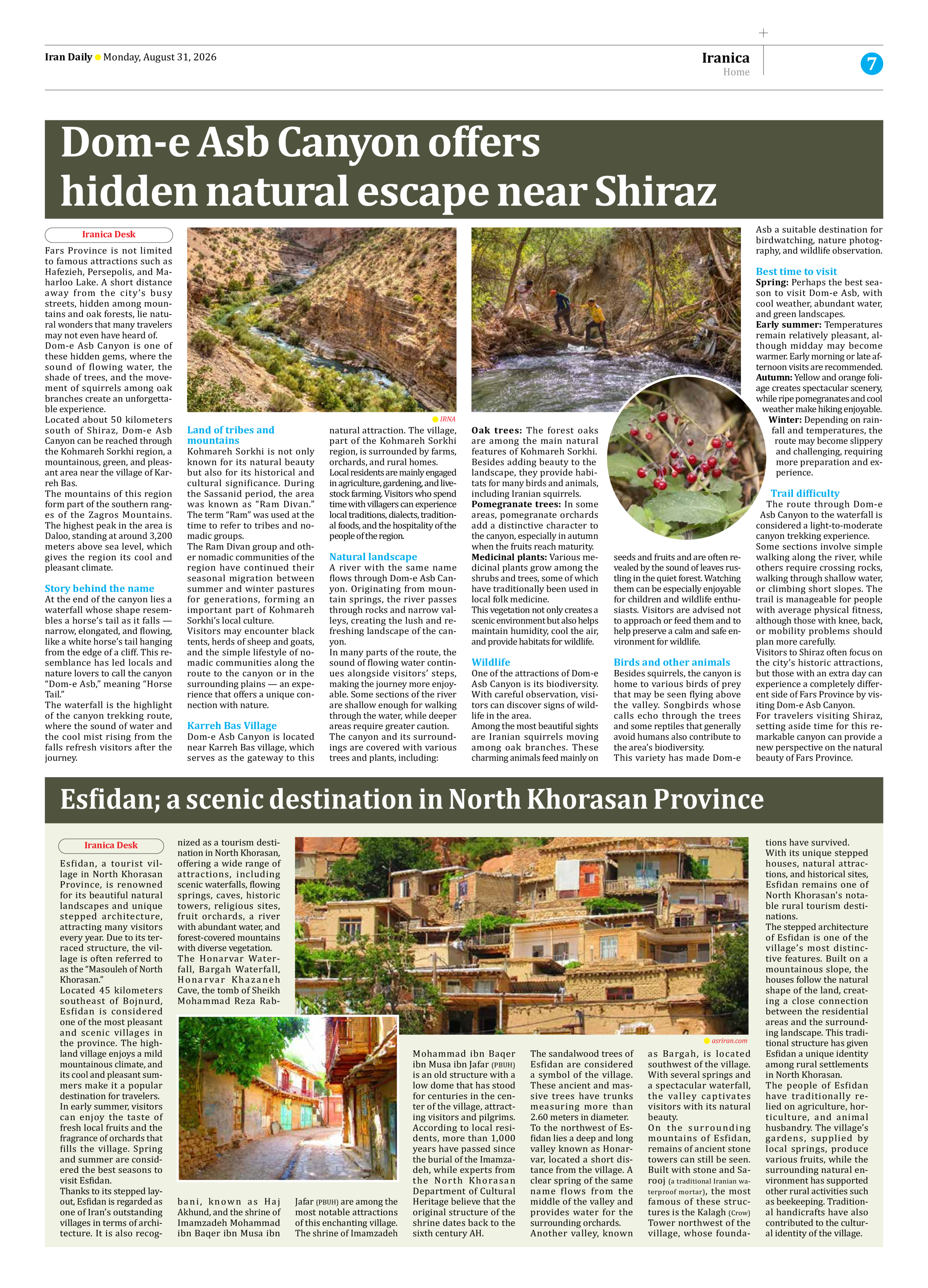
Esfidan, a tourist village in North Khorasan Province, is renowned for its beautiful natural landscapes and unique stepped architecture, attracting many visitors every year. Due to its terraced structure, the village is often referred to as the “Masouleh of North Khorasan.”
Located 45 kilometers southeast of Bojnurd, Esfidan is considered one of the most pleasant and scenic villages in the province. The highland village enjoys a mild mountainous climate, and its cool and pleasant summers make it a popular destination for travelers.
In early summer, visitors can enjoy the taste of fresh local fruits and the fragrance of orchards that fills the village. Spring and summer are considered the best seasons to visit Esfidan.
Thanks to its stepped layout, Esfidan is regarded as one of Iran’s outstanding villages in terms of architecture. It is also recognized as a tourism destination in North Khorasan, offering a wide range of attractions, including scenic waterfalls, flowing springs, caves, historic towers, religious sites, fruit orchards, a river with abundant water, and forest-covered mountains with diverse vegetation.
The Honarvar Waterfall, Bargah Waterfall, Honarvar Khazaneh Cave, the tomb of Sheikh Mohammad Reza Rabbani, known as Haj Akhund, and the shrine of Imamzadeh Mohammad ibn Baqer ibn Musa ibn Jafar (PBUH) are among the most notable attractions of this enchanting village.
The shrine of Imamzadeh Mohammad ibn Baqer ibn Musa ibn Jafar (PBUH) is an old structure with a low dome that has stood for centuries in the center of the village, attracting visitors and pilgrims. According to local residents, more than 1,000 years have passed since the burial of the Imamzadeh, while experts from the North Khorasan Department of Cultural Heritage believe that the original structure of the shrine dates back to the sixth century AH.
The sandalwood trees of Esfidan are considered a symbol of the village. These ancient and massive trees have trunks measuring more than 2.60 meters in diameter.
To the northwest of Esfidan lies a deep and long valley known as Honarvar, located a short distance from the village. A clear spring of the same name flows from the middle of the valley and provides water for the surrounding orchards.
Another valley, known as Bargah, is located southwest of the village. With several springs and a spectacular waterfall, the valley captivates visitors with its natural beauty.
On the surrounding mountains of Esfidan, remains of ancient stone towers can still be seen. Built with stone and Sarooj (a traditional Iranian waterproof mortar), the most famous of these structures is the Kalagh (Crow)Tower northwest of the village, whose foundations have survived.
With its unique stepped houses, natural attractions, and historical sites, Esfidan remains one of North Khorasan’s notable rural tourism destinations.
The stepped architecture of Esfidan is one of the village’s most distinctive features. Built on a mountainous slope, the houses follow the natural shape of the land, creating a close connection between the residential areas and the surrounding landscape. This traditional structure has given Esfidan a unique identity among rural settlements in North Khorasan.
The people of Esfidan have traditionally relied on agriculture, horticulture, and animal husbandry. The village’s gardens, supplied by local springs, produce various fruits, while the surrounding natural environment has supported other rural activities such as beekeeping. Traditional handicrafts have also contributed to the cultural identity of the village.