







From cheese to caves
Why Liqvan village deserves more than a day trip
At the foot of Mount Sahand, nestled between mountain slopes, orchards and a river, lies Liqvan, a village whose name has long been synonymous with cheese. Yet for visitors who make their way into its narrow streets, a much larger story unfolds. Liqvan brings together nature, livestock farming, agriculture, terraced architecture, local cuisine and historical landmarks, giving it the potential to become one of East Azarbaijan Province’s leading rural tourism destinations in the years ahead.
Liqvan is best appreciated from the road. As the route moves farther from Tabriz, the city gradually disappears behind the traveler and the mountains take its place. The air changes, and so does the landscape. The village lies about 36 kilometers east of Tabriz and 24 kilometers south of Basmenj, on the slopes of Mount Sahand in a cold, mountainous area. This setting is one of Liqvan’s first advantages for tourism. The area enjoys pleasant weather in spring and summer, while its natural scenery draws many visitors during the warmer months, according to chtn.ir.
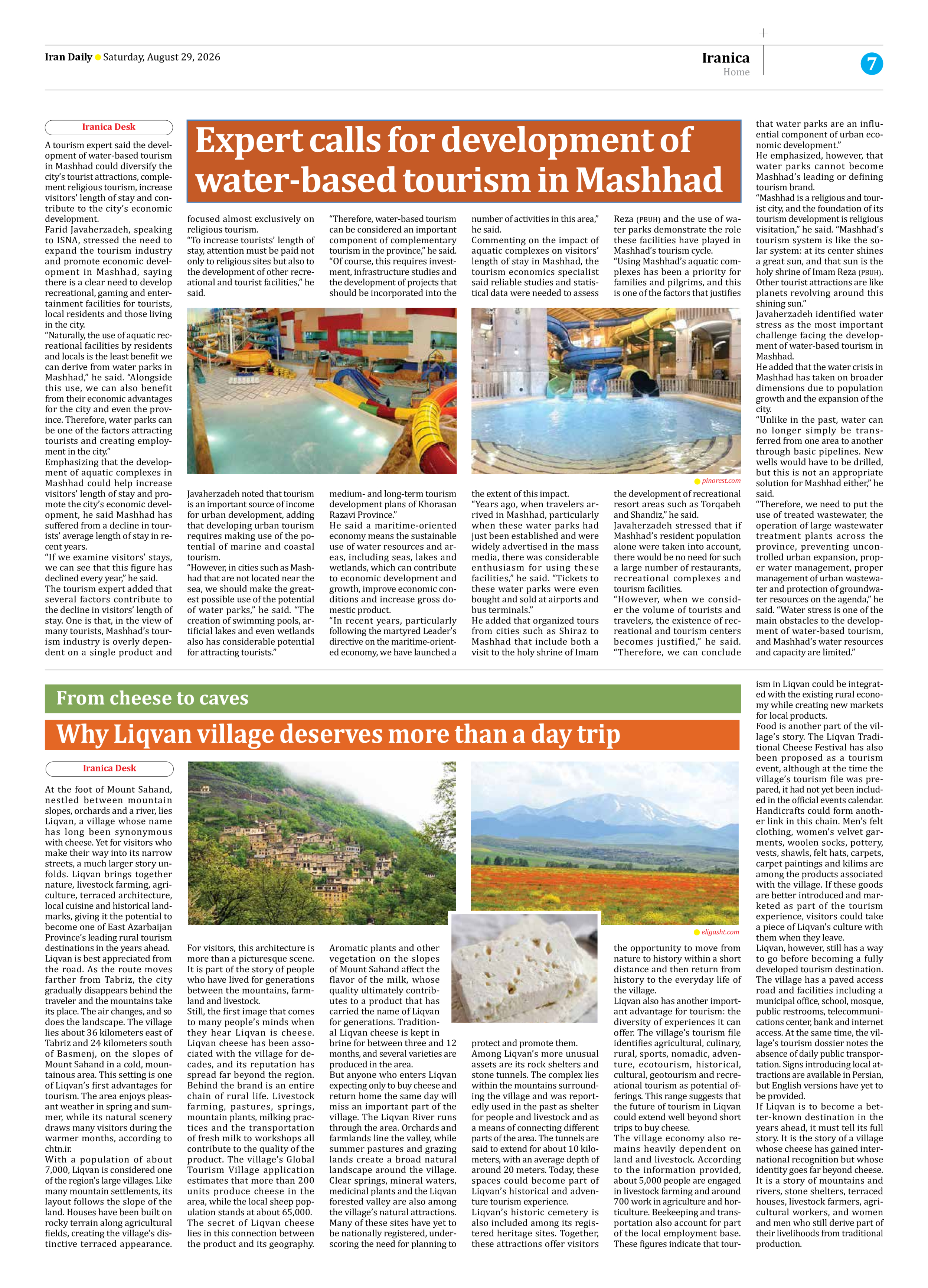
With a population of about 7,000, Liqvan is considered one of the region’s large villages. Like many mountain settlements, its layout follows the slope of the land. Houses have been built on rocky terrain along agricultural fields, creating the village’s distinctive terraced appearance. For visitors, this architecture is more than a picturesque scene. It is part of the story of people who have lived for generations between the mountains, farmland and livestock.
Still, the first image that comes to many people’s minds when they hear Liqvan is cheese. Liqvan cheese has been associated with the village for decades, and its reputation has spread far beyond the region. Behind the brand is an entire chain of rural life. Livestock farming, pastures, springs, mountain plants, milking practices and the transportation of fresh milk to workshops all contribute to the quality of the product. The village’s Global Tourism Village application estimates that more than 200 units produce cheese in the area, while the local sheep population stands at about 65,000.
The secret of Liqvan cheese lies in this connection between the product and its geography. Aromatic plants and other vegetation on the slopes of Mount Sahand affect the flavor of the milk, whose quality ultimately contributes to a product that has carried the name of Liqvan for generations. Traditional Liqvan cheese is kept in brine for between three and 12 months, and several varieties are produced in the area.
But anyone who enters Liqvan expecting only to buy cheese and return home the same day will miss an important part of the village. The Liqvan River runs through the area. Orchards and farmlands line the valley, while summer pastures and grazing lands create a broad natural landscape around the village. Clear springs, mineral waters, medicinal plants and the Liqvan forested valley are also among the village’s natural attractions. Many of these sites have yet to be nationally registered, underscoring the need for planning to protect and promote them.
Among Liqvan’s more unusual assets are its rock shelters and stone tunnels. The complex lies within the mountains surrounding the village and was reportedly used in the past as shelter for people and livestock and as a means of connecting different parts of the area. The tunnels are said to extend for about 10 kilometers, with an average depth of around 20 meters. Today, these spaces could become part of Liqvan’s historical and adventure tourism experience.
Liqvan’s historic cemetery is also included among its registered heritage sites. Together, these attractions offer visitors the opportunity to move from nature to history within a short distance and then return from history to the everyday life of the village.
Liqvan also has another important advantage for tourism: the diversity of experiences it can offer. The village’s tourism file identifies agricultural, culinary, rural, sports, nomadic, adventure, ecotourism, historical, cultural, geotourism and recreational tourism as potential offerings. This range suggests that the future of tourism in Liqvan could extend well beyond short trips to buy cheese.
The village economy also remains heavily dependent on land and livestock. According to the information provided, about 5,000 people are engaged in livestock farming and around 700 work in agriculture and horticulture. Beekeeping and transportation also account for part of the local employment base. These figures indicate that tourism in Liqvan could be integrated with the existing rural economy while creating new markets for local products.
Food is another part of the village’s story. The Liqvan Traditional Cheese Festival has also been proposed as a tourism event, although at the time the village’s tourism file was prepared, it had not yet been included in the official events calendar.
Handicrafts could form another link in this chain. Men’s felt clothing, women’s velvet garments, woolen socks, pottery, vests, shawls, felt hats, carpets, carpet paintings and kilims are among the products associated with the village. If these goods are better introduced and marketed as part of the tourism experience, visitors could take a piece of Liqvan’s culture with them when they leave.
Liqvan, however, still has a way to go before becoming a fully developed tourism destination. The village has a paved access road and facilities including a municipal office, school, mosque, public restrooms, telecommunications center, bank and internet access. At the same time, the village’s tourism dossier notes the absence of daily public transportation. Signs introducing local attractions are available in Persian, but English versions have yet to be provided.
If Liqvan is to become a better-known destination in the years ahead, it must tell its full story. It is the story of a village whose cheese has gained international recognition but whose identity goes far beyond cheese. It is a story of mountains and rivers, stone shelters, terraced houses, livestock farmers, agricultural workers, and women and men who still derive part of their livelihoods from traditional production.