





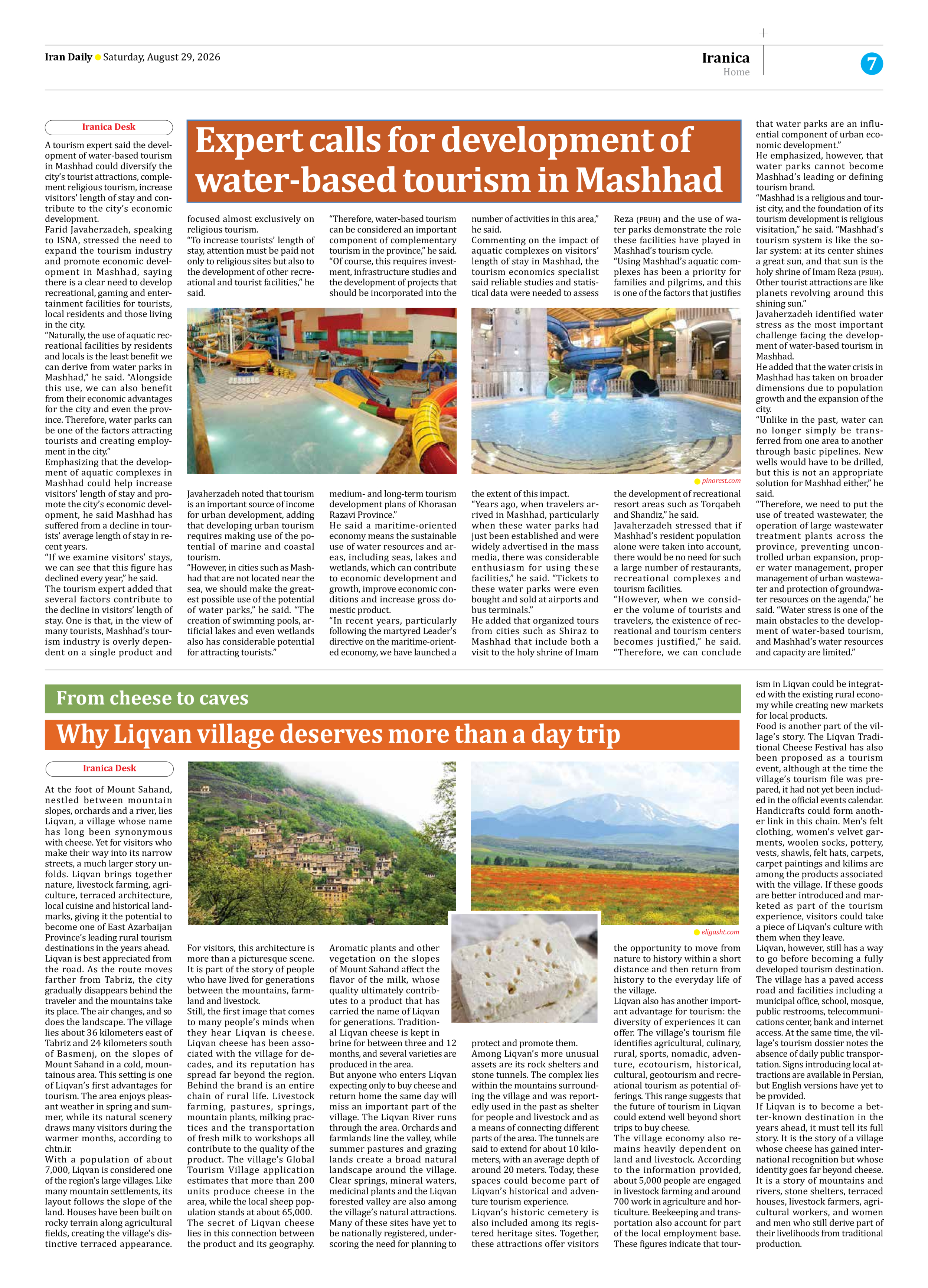


Expert calls for development of water-based tourism in Mashhad
A tourism expert said the development of water-based tourism in Mashhad could diversify the city’s tourist attractions, complement religious tourism, increase visitors’ length of stay and contribute to the city’s economic development.
Farid Javaherzadeh, speaking to ISNA, stressed the need to expand the tourism industry and promote economic development in Mashhad, saying there is a clear need to develop recreational, gaming and entertainment facilities for tourists, local residents and those living in the city.
“Naturally, the use of aquatic recreational facilities by residents and locals is the least benefit we can derive from water parks in Mashhad,” he said. “Alongside this use, we can also benefit from their economic advantages for the city and even the province. Therefore, water parks can be one of the factors attracting tourists and creating employment in the city.”
Emphasizing that the development of aquatic complexes in Mashhad could help increase visitors’ length of stay and promote the city’s economic development, he said Mashhad has suffered from a decline in tourists’ average length of stay in recent years.
“If we examine visitors’ stays, we can see that this figure has declined every year,” he said.
The tourism expert added that several factors contribute to the decline in visitors’ length of stay. One is that, in the view of many tourists, Mashhad’s tourism industry is overly dependent on a single product and focused almost exclusively on religious tourism.
“To increase tourists’ length of stay, attention must be paid not only to religious sites but also to the development of other recreational and tourist facilities,” he said.
Javaherzadeh noted that tourism is an important source of income for urban development, adding that developing urban tourism requires making use of the potential of marine and coastal tourism.
“However, in cities such as Mashhad that are not located near the sea, we should make the greatest possible use of the potential of water parks,” he said. “The creation of swimming pools, artificial lakes and even wetlands also has considerable potential for attracting tourists.”
“Therefore, water-based tourism can be considered an important component of complementary tourism in the province,” he said. “Of course, this requires investment, infrastructure studies and the development of projects that should be incorporated into the medium- and long-term tourism development plans of Khorasan Razavi Province.”
He said a maritime-oriented economy means the sustainable use of water resources and areas, including seas, lakes and wetlands, which can contribute to economic development and growth, improve economic conditions and increase gross domestic product.
“In recent years, particularly following the martyred Leader’s directive on the maritime-oriented economy, we have launched a number of activities in this area,” he said.
Commenting on the impact of aquatic complexes on visitors’ length of stay in Mashhad, the tourism economics specialist said reliable studies and statistical data were needed to assess the extent of this impact.
“Years ago, when travelers arrived in Mashhad, particularly when these water parks had just been established and were widely advertised in the mass media, there was considerable enthusiasm for using these facilities,” he said. “Tickets to these water parks were even bought and sold at airports and bus terminals.”
He added that organized tours from cities such as Shiraz to Mashhad that include both a visit to the holy shrine of Imam Reza (PBUH) and the use of water parks demonstrate the role these facilities have played in Mashhad’s tourism cycle.
“Using Mashhad’s aquatic complexes has been a priority for families and pilgrims, and this is one of the factors that justifies the development of recreational resort areas such as Torqabeh and Shandiz,” he said.
Javaherzadeh stressed that if Mashhad’s resident population alone were taken into account, there would be no need for such a large number of restaurants, recreational complexes and tourism facilities.
“However, when we consider the volume of tourists and travelers, the existence of recreational and tourism centers becomes justified,” he said. “Therefore, we can conclude that water parks are an influential component of urban economic development.”
He emphasized, however, that water parks cannot become Mashhad’s leading or defining tourism brand.
“Mashhad is a religious and tourist city, and the foundation of its tourism development is religious visitation,” he said. “Mashhad’s tourism system is like the solar system: at its center shines a great sun, and that sun is the holy shrine of Imam Reza (PBUH). Other tourist attractions are like planets revolving around this shining sun.”
Javaherzadeh identified water stress as the most important challenge facing the development of water-based tourism in Mashhad.
He added that the water crisis in Mashhad has taken on broader dimensions due to population growth and the expansion of the city.
“Unlike in the past, water can no longer simply be transferred from one area to another through basic pipelines. New wells would have to be drilled, but this is not an appropriate solution for Mashhad either,” he said.
“Therefore, we need to put the use of treated wastewater, the operation of large wastewater treatment plants across the province, preventing uncontrolled urban expansion, proper water management, proper management of urban wastewater and protection of groundwater resources on the agenda,” he said. “Water stress is one of the main obstacles to the development of water-based tourism, and Mashhad’s water resources and capacity are limited.”