





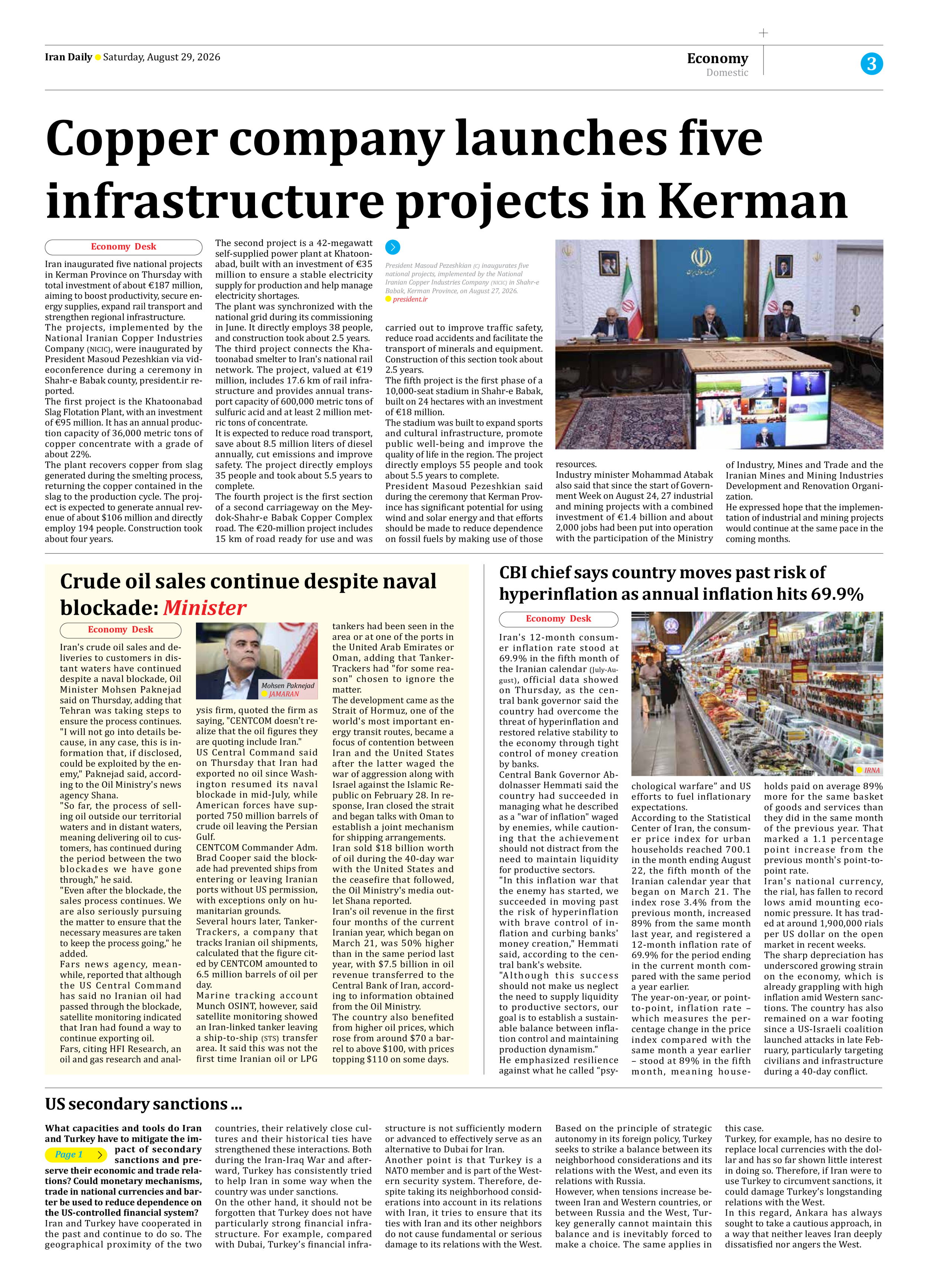


CBI chief says country moves past risk of hyperinflation as annual inflation hits 69.9%
Iran's 12-month consumer inflation rate stood at 69.9% in the fifth month of the Iranian calendar (July-August), official data showed on Thursday, as the central bank governor said the country had overcome the threat of hyperinflation and restored relative stability to the economy through tight control of money creation by banks.
Central Bank Governor Abdolnasser Hemmati said the country had succeeded in managing what he described as a "war of inflation" waged by enemies, while cautioning that the achievement should not distract from the need to maintain liquidity for productive sectors.
"In this inflation war that the enemy has started, we succeeded in moving past the risk of hyperinflation with brave control of inflation and curbing banks' money creation," Hemmati said, according to the central bank's website.
"Although this success should not make us neglect the need to supply liquidity to productive sectors, our goal is to establish a sustainable balance between inflation control and maintaining production dynamism."
He emphasized resilience against what he called “psychological warfare” and US efforts to fuel inflationary expectations.
According to the Statistical Center of Iran, the consumer price index for urban households reached 700.1 in the month ending August 22, the fifth month of the Iranian calendar year that began on March 21. The index rose 3.4% from the previous month, increased 89% from the same month last year, and registered a 12-month inflation rate of 69.9% for the period ending in the current month compared with the same period a year earlier.
The year-on-year, or point-to-point, inflation rate – which measures the percentage change in the price index compared with the same month a year earlier – stood at 89% in the fifth month, meaning households paid on average 89% more for the same basket of goods and services than they did in the same month of the previous year. That marked a 1.1 percentage point increase from the previous month's point-to-point rate.
Iran's national currency, the rial, has fallen to record lows amid mounting economic pressure. It has traded at around 1,900,000 rials per US dollar on the open market in recent weeks.
The sharp depreciation has underscored growing strain on the economy, which is already grappling with high inflation amid Western sanctions. The country has also remained on a war footing since a US-Israeli coalition launched attacks in late February, particularly targeting civilians and infrastructure during a 40-day conflict.