







Crude oil sales continue despite naval blockade: Minister
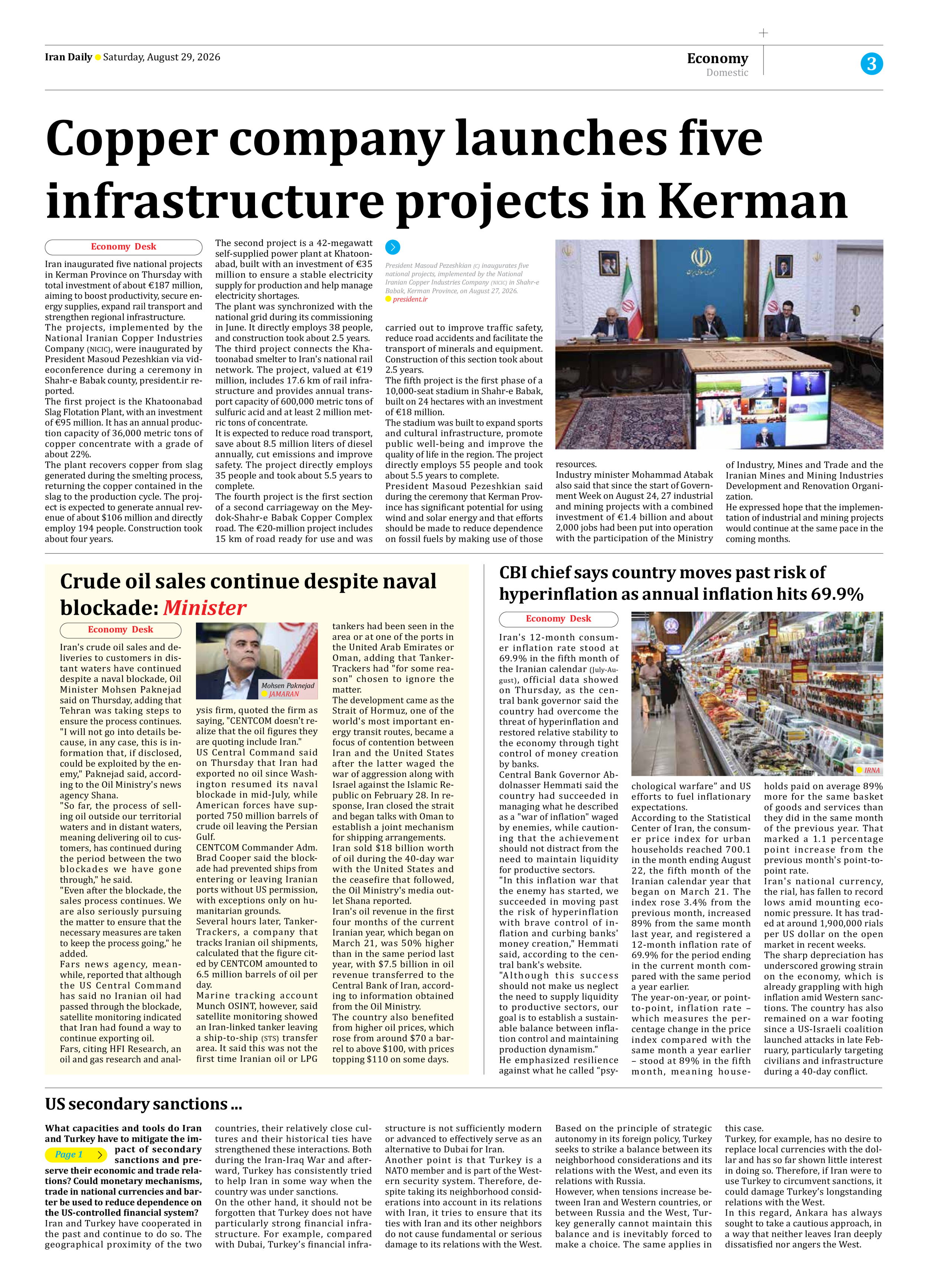
Iran's crude oil sales and deliveries to customers in distant waters have continued despite a naval blockade, Oil Minister Mohsen Paknejad said on Thursday, adding that Tehran was taking steps to ensure the process continues.
"I will not go into details because, in any case, this is information that, if disclosed, could be exploited by the enemy," Paknejad said, according to the Oil Ministry's news agency Shana.
"So far, the process of selling oil outside our territorial waters and in distant waters, meaning delivering oil to customers, has continued during the period between the two blockades we have gone through," he said.
"Even after the blockade, the sales process continues. We are also seriously pursuing the matter to ensure that the necessary measures are taken to keep the process going," he added.
Fars news agency, meanwhile, reported that although the US Central Command has said no Iranian oil had passed through the blockade, satellite monitoring indicated that Iran had found a way to continue exporting oil.
Fars, citing HFI Research, an oil and gas research and analysis firm, quoted the firm as saying, "CENTCOM doesn't realize that the oil figures they are quoting include Iran."
US Central Command said on Thursday that Iran had exported no oil since Washington resumed its naval blockade in mid-July, while American forces have supported 750 million barrels of crude oil leaving the Persian Gulf.
CENTCOM Commander Adm. Brad Cooper said the blockade had prevented ships from entering or leaving Iranian ports without US permission, with exceptions only on humanitarian grounds.
Several hours later, TankerTrackers, a company that tracks Iranian oil shipments, calculated that the figure cited by CENTCOM amounted to 6.5 million barrels of oil per day.
Marine tracking account Munch OSINT, however, said satellite monitoring showed an Iran-linked tanker leaving a ship-to-ship (STS) transfer area. It said this was not the first time Iranian oil or LPG tankers had been seen in the area or at one of the ports in the United Arab Emirates or Oman, adding that TankerTrackers had "for some reason" chosen to ignore the matter.
The development came as the Strait of Hormuz, one of the world's most important energy transit routes, became a focus of contention between Iran and the United States after the latter waged the war of aggression along with Israel against the Islamic Republic on February 28. In response, Iran closed the strait and began talks with Oman to establish a joint mechanism for shipping arrangements.
Iran sold $18 billion worth of oil during the 40-day war with the United States and the ceasefire that followed, the Oil Ministry's media outlet Shana reported.
Iran's oil revenue in the first four months of the current Iranian year, which began on March 21, was 50% higher than in the same period last year, with $7.5 billion in oil revenue transferred to the Central Bank of Iran, according to information obtained from the Oil Ministry.
The country also benefited from higher oil prices, which rose from around $70 a barrel to above $100, with prices topping $110 on some days.