







Azarbaijan Museum demonstrates Tabriz’s rich historical heritage
Museums are among the most important historical sites in any city, offering a glimpse into its history and antiquity. Tabriz, known for its rich and ancient historical fabric, has the second-largest number of museums in Iran after Tehran. Among them is the Azarbaijan Museum, which houses a unique collection of historical artifacts.
The Azarbaijan Museum is one of Iran’s oldest and most important museums and a prominent historical site in Tabriz. Located in the heart of the city, it attracts large numbers of domestic and international tourists each year. Tabriz can aptly be described as a city of museums, with its wealth of historical monuments, buildings and museums, each showcasing a part of Iran’s history.
Azarbaijan Museum is regarded as one of Iran’s most important museums and the country’s second-largest archaeological museum after the National Museum of Iran. Covering a built-up area of 2,400 square meters, the museum has three floors, with an exhibition hall on each floor measuring 37 by 12 meters, as well as several administrative rooms and a library.
The museum was designed based on plans prepared by French archaeologist André Godard, drawing inspiration from the local architectural style of Iranian Azarbaijan, and was constructed under the supervision of Ismail Dibaj.
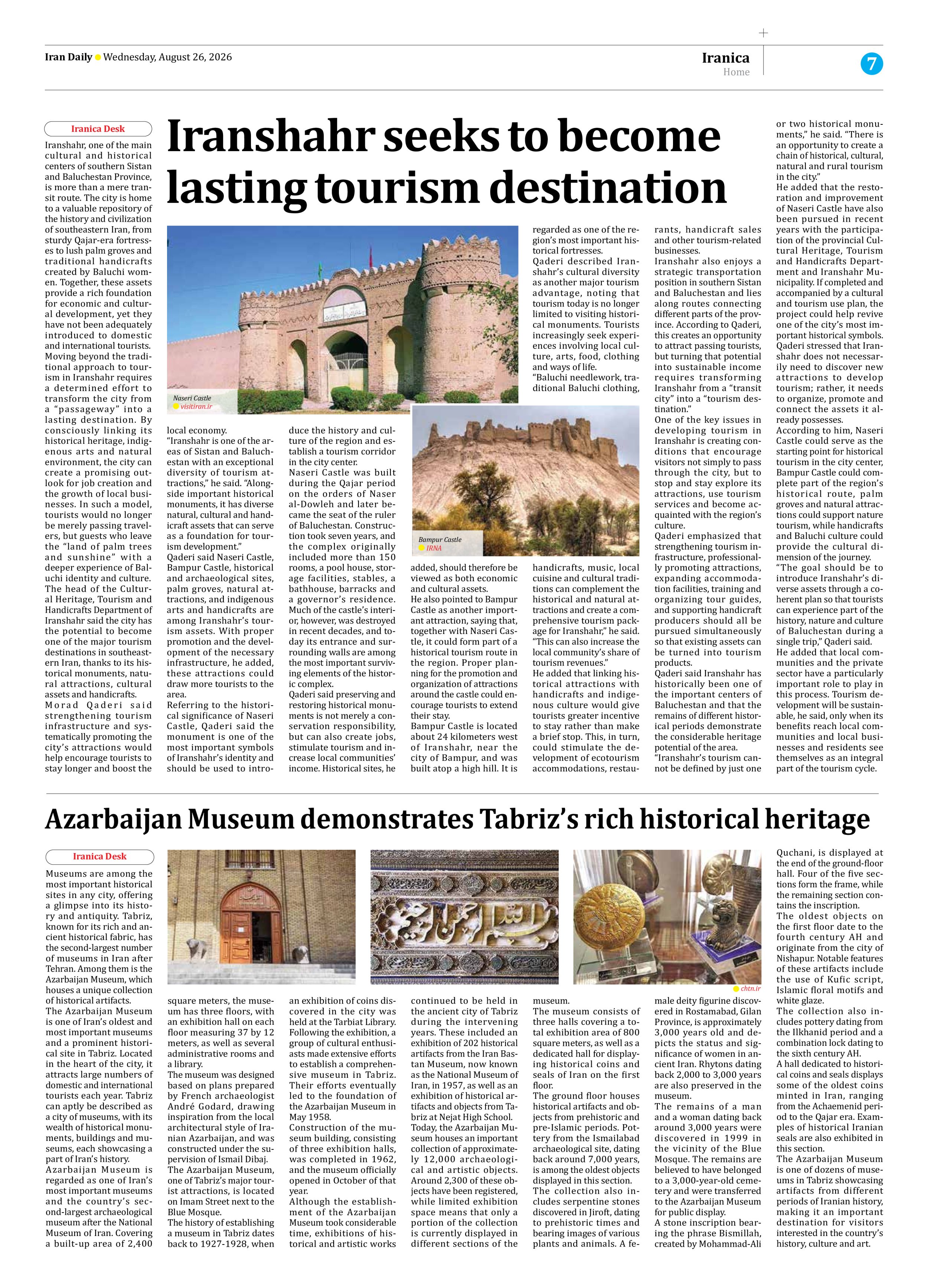
The Azarbaijan Museum, one of Tabriz’s major tourist attractions, is located on Imam Street next to the Blue Mosque.
The history of establishing a museum in Tabriz dates back to 1927-1928, when an exhibition of coins discovered in the city was held at the Tarbiat Library. Following the exhibition, a group of cultural enthusiasts made extensive efforts to establish a comprehensive museum in Tabriz. Their efforts eventually led to the foundation of the Azarbaijan Museum in May 1958.
Construction of the museum building, consisting of three exhibition halls, was completed in 1962, and the museum officially opened in October of that year.
Although the establishment of the Azarbaijan Museum took considerable time, exhibitions of historical and artistic works continued to be held in the ancient city of Tabriz during the intervening years. These included an exhibition of 202 historical artifacts from the Iran Bastan Museum, now known as the National Museum of Iran, in 1957, as well as an exhibition of historical artifacts and objects from Tabriz at Nejat High School.
Today, the Azarbaijan Museum houses an important collection of approximately 12,000 archaeological and artistic objects. Around 2,300 of these objects have been registered, while limited exhibition space means that only a portion of the collection is currently displayed in different sections of the museum.
The museum consists of three halls covering a total exhibition area of 800 square meters, as well as a dedicated hall for displaying historical coins and seals of Iran on the first floor.
The ground floor houses historical artifacts and objects from prehistoric and pre-Islamic periods. Pottery from the Ismailabad archaeological site, dating back around 7,000 years, is among the oldest objects displayed in this section.
The collection also includes serpentine stones discovered in Jiroft, dating to prehistoric times and bearing images of various plants and animals. A female deity figurine discovered in Rostamabad, Gilan Province, is approximately 3,000 years old and depicts the status and significance of women in ancient Iran. Rhytons dating back 2,000 to 3,000 years are also preserved in the museum.
The remains of a man and a woman dating back around 3,000 years were discovered in 1999 in the vicinity of the Blue Mosque. The remains are believed to have belonged to a 3,000-year-old cemetery and were transferred to the Azarbaijan Museum for public display.
A stone inscription bearing the phrase Bismillah, created by Mohammad-Ali Quchani, is displayed at the end of the ground-floor hall. Four of the five sections form the frame, while the remaining section contains the inscription.
The oldest objects on the first floor date to the fourth century AH and originate from the city of Nishapur. Notable features of these artifacts include the use of Kufic script, Islamic floral motifs and white glaze.
The collection also includes pottery dating from the Ilkhanid period and a combination lock dating to the sixth century AH.
A hall dedicated to historical coins and seals displays some of the oldest coins minted in Iran, ranging from the Achaemenid period to the Qajar era. Examples of historical Iranian seals are also exhibited in this section.
The Azarbaijan Museum is one of dozens of museums in Tabriz showcasing artifacts from different periods of Iranian history, making it an important destination for visitors interested in the country’s history, culture and art.