







Iranshahr seeks to become lasting tourism destination
Iranshahr, one of the main cultural and historical centers of southern Sistan and Baluchestan Province, is more than a mere transit route. The city is home to a valuable repository of the history and civilization of southeastern Iran, from sturdy Qajar-era fortresses to lush palm groves and traditional handicrafts created by Baluchi women. Together, these assets provide a rich foundation for economic and cultural development, yet they have not been adequately introduced to domestic and international tourists.
Moving beyond the traditional approach to tourism in Iranshahr requires a determined effort to transform the city from a “passageway” into a lasting destination. By consciously linking its historical heritage, indigenous arts and natural environment, the city can create a promising outlook for job creation and the growth of local businesses. In such a model, tourists would no longer be merely passing travelers, but guests who leave the “land of palm trees and sunshine” with a deeper experience of Baluchi identity and culture.
The head of the Cultural Heritage, Tourism and Handicrafts Department of Iranshahr said the city has the potential to become one of the major tourism destinations in southeastern Iran, thanks to its historical monuments, natural attractions, cultural assets and handicrafts.
Morad Qaderi said strengthening tourism infrastructure and systematically promoting the city’s attractions would help encourage tourists to stay longer and boost the local economy.
“Iranshahr is one of the areas of Sistan and Baluchestan with an exceptional diversity of tourism attractions,” he said. “Alongside important historical monuments, it has diverse natural, cultural and handicraft assets that can serve as a foundation for tourism development.”
Qaderi said Naseri Castle, Bampur Castle, historical and archaeological sites, palm groves, natural attractions, and indigenous arts and handicrafts are among Iranshahr’s tourism assets. With proper promotion and the development of the necessary infrastructure, he added, these attractions could draw more tourists to the area.
Referring to the historical significance of Naseri Castle, Qaderi said the monument is one of the most important symbols of Iranshahr’s identity and should be used to introduce the history and culture of the region and establish a tourism corridor in the city center.
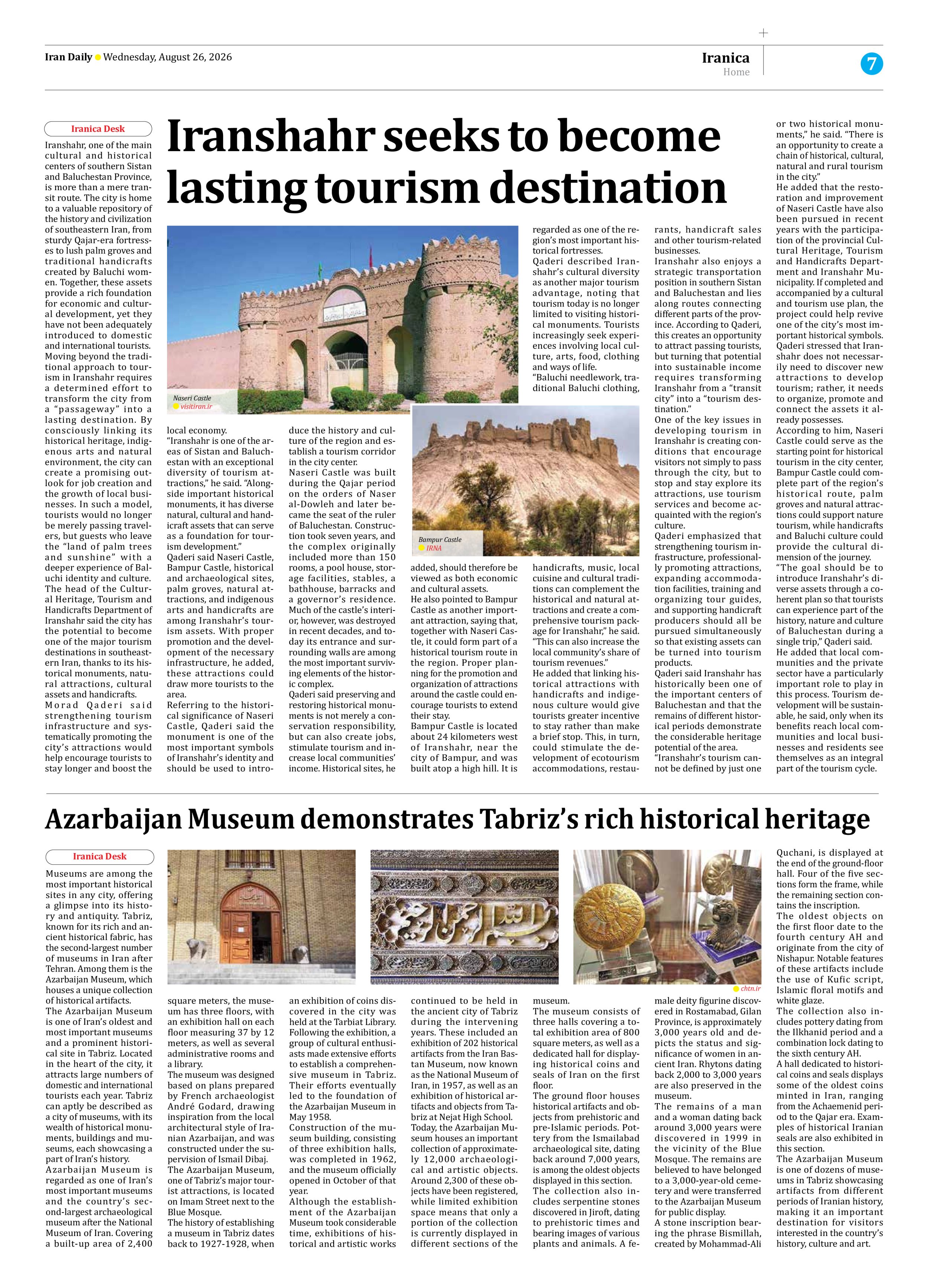
Naseri Castle was built during the Qajar period on the orders of Naser al-Dowleh and later became the seat of the ruler of Baluchestan. Construction took seven years, and the complex originally included more than 150 rooms, a pool house, storage facilities, stables, a bathhouse, barracks and a governor’s residence. Much of the castle’s interior, however, was destroyed in recent decades, and today its entrance and surrounding walls are among the most important surviving elements of the historic complex.
Qaderi said preserving and restoring historical monuments is not merely a conservation responsibility, but can also create jobs, stimulate tourism and increase local communities’ income. Historical sites, he added, should therefore be viewed as both economic and cultural assets.
He also pointed to Bampur Castle as another important attraction, saying that, together with Naseri Castle, it could form part of a historical tourism route in the region. Proper planning for the promotion and organization of attractions around the castle could encourage tourists to extend their stay.
Bampur Castle is located about 24 kilometers west of Iranshahr, near the city of Bampur, and was built atop a high hill. It is regarded as one of the region’s most important historical fortresses.
Qaderi described Iranshahr’s cultural diversity as another major tourism advantage, noting that tourism today is no longer limited to visiting historical monuments. Tourists increasingly seek experiences involving local culture, arts, food, clothing and ways of life.
“Baluchi needlework, traditional Baluchi clothing, handicrafts, music, local cuisine and cultural traditions can complement the historical and natural attractions and create a comprehensive tourism package for Iranshahr,” he said. “This can also increase the local community’s share of tourism revenues.”
He added that linking historical attractions with handicrafts and indigenous culture would give tourists greater incentive to stay rather than make a brief stop. This, in turn, could stimulate the development of ecotourism accommodations, restaurants, handicraft sales and other tourism-related businesses.
Iranshahr also enjoys a strategic transportation position in southern Sistan and Baluchestan and lies along routes connecting different parts of the province. According to Qaderi, this creates an opportunity to attract passing tourists, but turning that potential into sustainable income requires transforming Iranshahr from a “transit city” into a “tourism destination.”
One of the key issues in developing tourism in Iranshahr is creating conditions that encourage visitors not simply to pass through the city, but to stop and stay explore its attractions, use tourism services and become acquainted with the region’s culture.
Qaderi emphasized that strengthening tourism infrastructure, professionally promoting attractions, expanding accommodation facilities, training and organizing tour guides, and supporting handicraft producers should all be pursued simultaneously so that existing assets can be turned into tourism products.
Qaderi said Iranshahr has historically been one of the important centers of Baluchestan and that the remains of different historical periods demonstrate the considerable heritage potential of the area.
“Iranshahr’s tourism cannot be defined by just one or two historical monuments,” he said. “There is an opportunity to create a chain of historical, cultural, natural and rural tourism in the city.”
He added that the restoration and improvement of Naseri Castle have also been pursued in recent years with the participation of the provincial Cultural Heritage, Tourism and Handicrafts Department and Iranshahr Municipality. If completed and accompanied by a cultural and tourism use plan, the project could help revive one of the city’s most important historical symbols.
Qaderi stressed that Iranshahr does not necessarily need to discover new attractions to develop tourism; rather, it needs to organize, promote and connect the assets it already possesses.
According to him, Naseri Castle could serve as the starting point for historical tourism in the city center, Bampur Castle could complete part of the region’s historical route, palm groves and natural attractions could support nature tourism, while handicrafts and Baluchi culture could provide the cultural dimension of the journey.
“The goal should be to introduce Iranshahr’s diverse assets through a coherent plan so that tourists can experience part of the history, nature and culture of Baluchestan during a single trip,” Qaderi said.
He added that local communities and the private sector have a particularly important role to play in this process. Tourism development will be sustainable, he said, only when its benefits reach local communities and local businesses and residents see themselves as an integral part of the tourism cycle.