







Reading Room
Hafezieh Library preserves Shiraz’s literary heritage
Stepping into the serene grounds of the mausoleum of Shiraz’s renowned lyric poet Hafez, a sign for an old library just behind his tomb catches the eye and invites visitors to explore. Above its modest entrance is a sign reading “Hafezieh Library,” while a door decorated with the traditional woodcarving artistry of Shiraz opens the way to this repository of books.
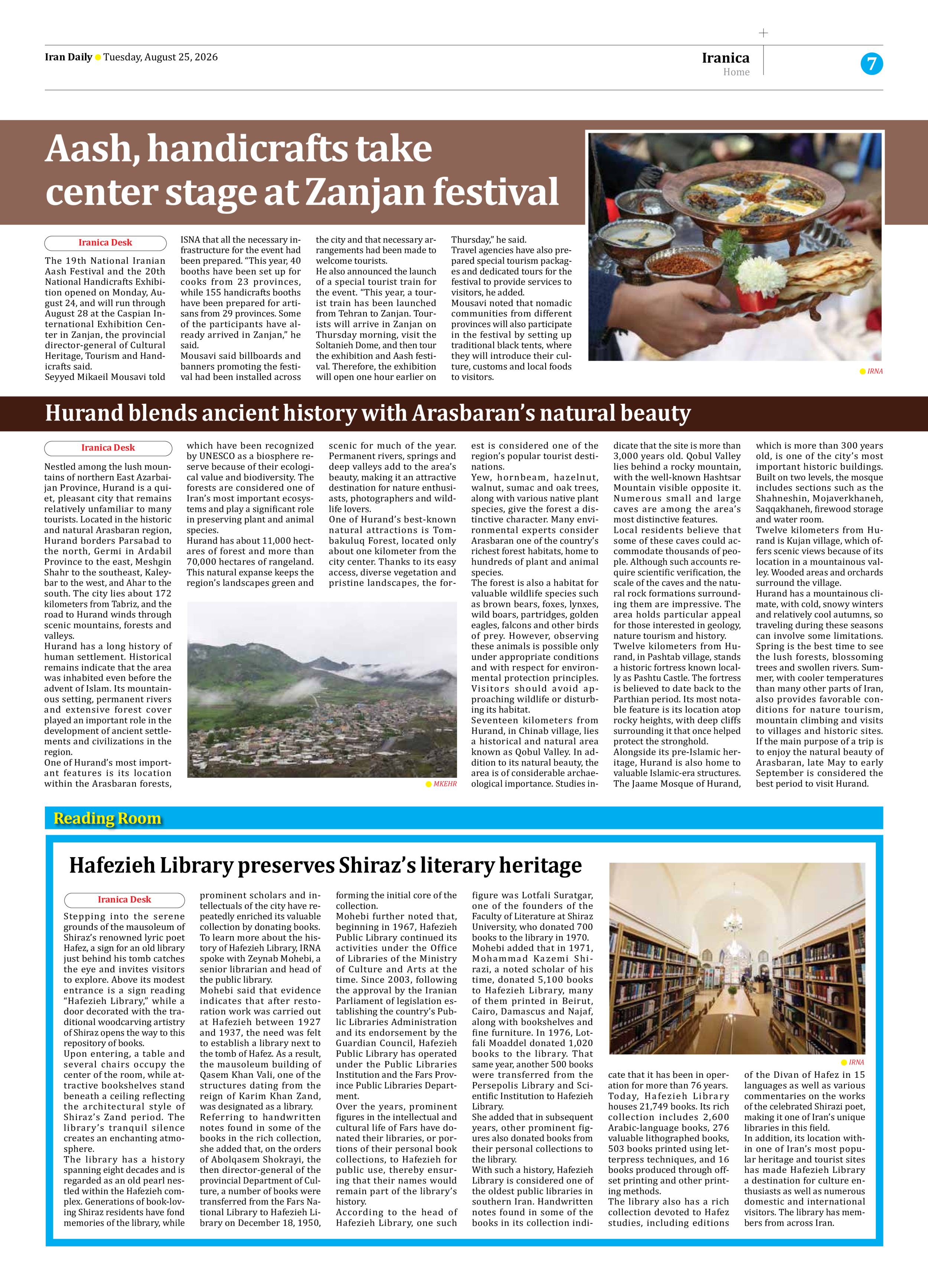
Upon entering, a table and several chairs occupy the center of the room, while attractive bookshelves stand beneath a ceiling reflecting the architectural style of Shiraz’s Zand period. The library’s tranquil silence creates an enchanting atmosphere.
The library has a history spanning eight decades and is regarded as an old pearl nestled within the Hafezieh complex. Generations of book-loving Shiraz residents have fond memories of the library, while prominent scholars and intellectuals of the city have repeatedly enriched its valuable collection by donating books.
To learn more about the history of Hafezieh Library, IRNA spoke with Zeynab Mohebi, a senior librarian and head of the public library.
Mohebi said that evidence indicates that after restoration work was carried out at Hafezieh between 1927 and 1937, the need was felt to establish a library next to the tomb of Hafez. As a result, the mausoleum building of Qasem Khan Vali, one of the structures dating from the reign of Karim Khan Zand, was designated as a library.
Referring to handwritten notes found in some of the books in the rich collection, she added that, on the orders of Abolqasem Shokrayi, the then director-general of the provincial Department of Culture, a number of books were transferred from the Fars National Library to Hafezieh Library on December 18, 1950, forming the initial core of the collection.
Mohebi further noted that, beginning in 1967, Hafezieh Public Library continued its activities under the Office of Libraries of the Ministry of Culture and Arts at the time. Since 2003, following the approval by the Iranian Parliament of legislation establishing the country’s Public Libraries Administration and its endorsement by the Guardian Council, Hafezieh Public Library has operated under the Public Libraries Institution and the Fars Province Public Libraries Department.
Over the years, prominent figures in the intellectual and cultural life of Fars have donated their libraries, or portions of their personal book collections, to Hafezieh for public use, thereby ensuring that their names would remain part of the library’s history.
According to the head of Hafezieh Library, one such figure was Lotfali Suratgar, one of the founders of the Faculty of Literature at Shiraz University, who donated 700 books to the library in 1970.
Mohebi added that in 1971, Mohammad Kazemi Shirazi, a noted scholar of his time, donated 5,100 books to Hafezieh Library, many of them printed in Beirut, Cairo, Damascus and Najaf, along with bookshelves and fine furniture. In 1976, Lotfali Moaddel donated 1,020 books to the library. That same year, another 500 books were transferred from the Persepolis Library and Scientific Institution to Hafezieh Library.
She added that in subsequent years, other prominent figures also donated books from their personal collections to the library.
With such a history, Hafezieh Library is considered one of the oldest public libraries in southern Iran. Handwritten notes found in some of the books in its collection indicate that it has been in operation for more than 76 years.
Today, Hafezieh Library houses 21,749 books. Its rich collection includes 2,600 Arabic-language books, 276 valuable lithographed books, 503 books printed using letterpress techniques, and 16 books produced through offset printing and other printing methods.
The library also has a rich collection devoted to Hafez studies, including editions of the Divan of Hafez in 15 languages as well as various commentaries on the works of the celebrated Shirazi poet, making it one of Iran’s unique libraries in this field.
In addition, its location within one of Iran’s most popular heritage and tourist sites has made Hafezieh Library a destination for culture enthusiasts as well as numerous domestic and international visitors. The library has members from across Iran.