





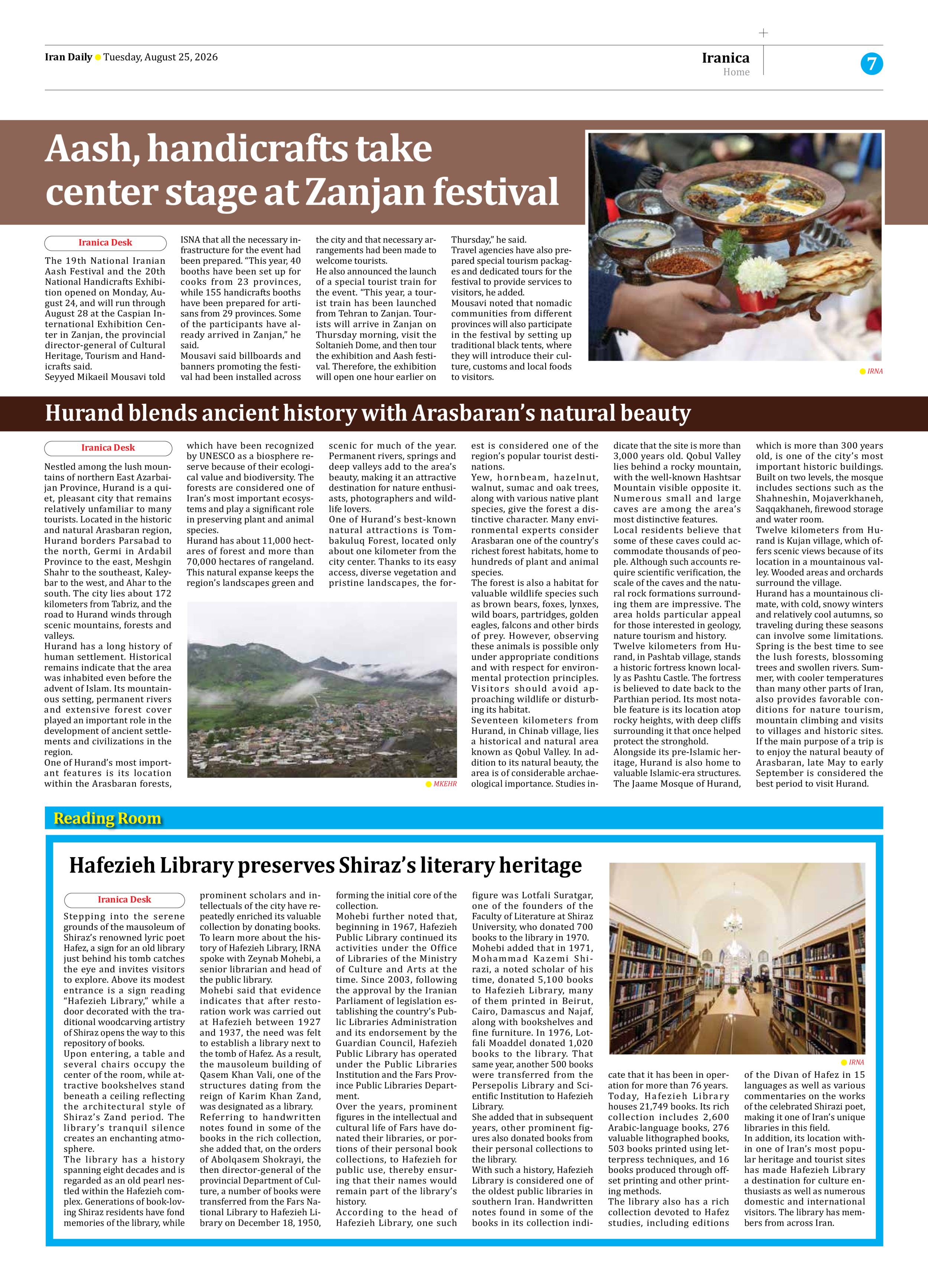


Hurand blends ancient history with Arasbaran’s natural beauty
Nestled among the lush mountains of northern East Azarbaijan Province, Hurand is a quiet, pleasant city that remains relatively unfamiliar to many tourists. Located in the historic and natural Arasbaran region, Hurand borders Parsabad to the north, Germi in Ardabil Province to the east, Meshgin Shahr to the southeast, Kaleybar to the west, and Ahar to the south. The city lies about 172 kilometers from Tabriz, and the road to Hurand winds through scenic mountains, forests and valleys.
Hurand has a long history of human settlement. Historical remains indicate that the area was inhabited even before the advent of Islam. Its mountainous setting, permanent rivers and extensive forest cover played an important role in the development of ancient settlements and civilizations in the region.
One of Hurand’s most important features is its location within the Arasbaran forests, which have been recognized by UNESCO as a biosphere reserve because of their ecological value and biodiversity. The forests are considered one of Iran’s most important ecosystems and play a significant role in preserving plant and animal species.
Hurand has about 11,000 hectares of forest and more than 70,000 hectares of rangeland. This natural expanse keeps the region’s landscapes green and scenic for much of the year. Permanent rivers, springs and deep valleys add to the area’s beauty, making it an attractive destination for nature enthusiasts, photographers and wildlife lovers.
One of Hurand’s best-known natural attractions is Tombakuluq Forest, located only about one kilometer from the city center. Thanks to its easy access, diverse vegetation and pristine landscapes, the forest is considered one of the region’s popular tourist destinations.
Yew, hornbeam, hazelnut, walnut, sumac and oak trees, along with various native plant species, give the forest a distinctive character. Many environmental experts consider Arasbaran one of the country’s richest forest habitats, home to hundreds of plant and animal species.
The forest is also a habitat for valuable wildlife species such as brown bears, foxes, lynxes, wild boars, partridges, golden eagles, falcons and other birds of prey. However, observing these animals is possible only under appropriate conditions and with respect for environmental protection principles. Visitors should avoid approaching wildlife or disturbing its habitat.
Seventeen kilometers from Hurand, in Chinab village, lies a historical and natural area known as Qobul Valley. In addition to its natural beauty, the area is of considerable archaeological importance. Studies indicate that the site is more than 3,000 years old. Qobul Valley lies behind a rocky mountain, with the well-known Hashtsar Mountain visible opposite it. Numerous small and large caves are among the area’s most distinctive features.
Local residents believe that some of these caves could accommodate thousands of people. Although such accounts require scientific verification, the scale of the caves and the natural rock formations surrounding them are impressive. The area holds particular appeal for those interested in geology, nature tourism and history.
Twelve kilometers from Hurand, in Pashtab village, stands a historic fortress known locally as Pashtu Castle. The fortress is believed to date back to the Parthian period. Its most notable feature is its location atop rocky heights, with deep cliffs surrounding it that once helped protect the stronghold.
Alongside its pre-Islamic heritage, Hurand is also home to valuable Islamic-era structures. The Jaame Mosque of Hurand, which is more than 300 years old, is one of the city’s most important historic buildings. Built on two levels, the mosque includes sections such as the Shahneshin, Mojaverkhaneh, Saqqakhaneh, firewood storage and water room.
Twelve kilometers from Hurand is Kujan village, which offers scenic views because of its location in a mountainous valley. Wooded areas and orchards surround the village.
Hurand has a mountainous climate, with cold, snowy winters and relatively cool autumns, so traveling during these seasons can involve some limitations. Spring is the best time to see the lush forests, blossoming trees and swollen rivers. Summer, with cooler temperatures than many other parts of Iran, also provides favorable conditions for nature tourism, mountain climbing and visits to villages and historic sites. If the main purpose of a trip is to enjoy the natural beauty of Arasbaran, late May to early September is considered the best period to visit Hurand.