





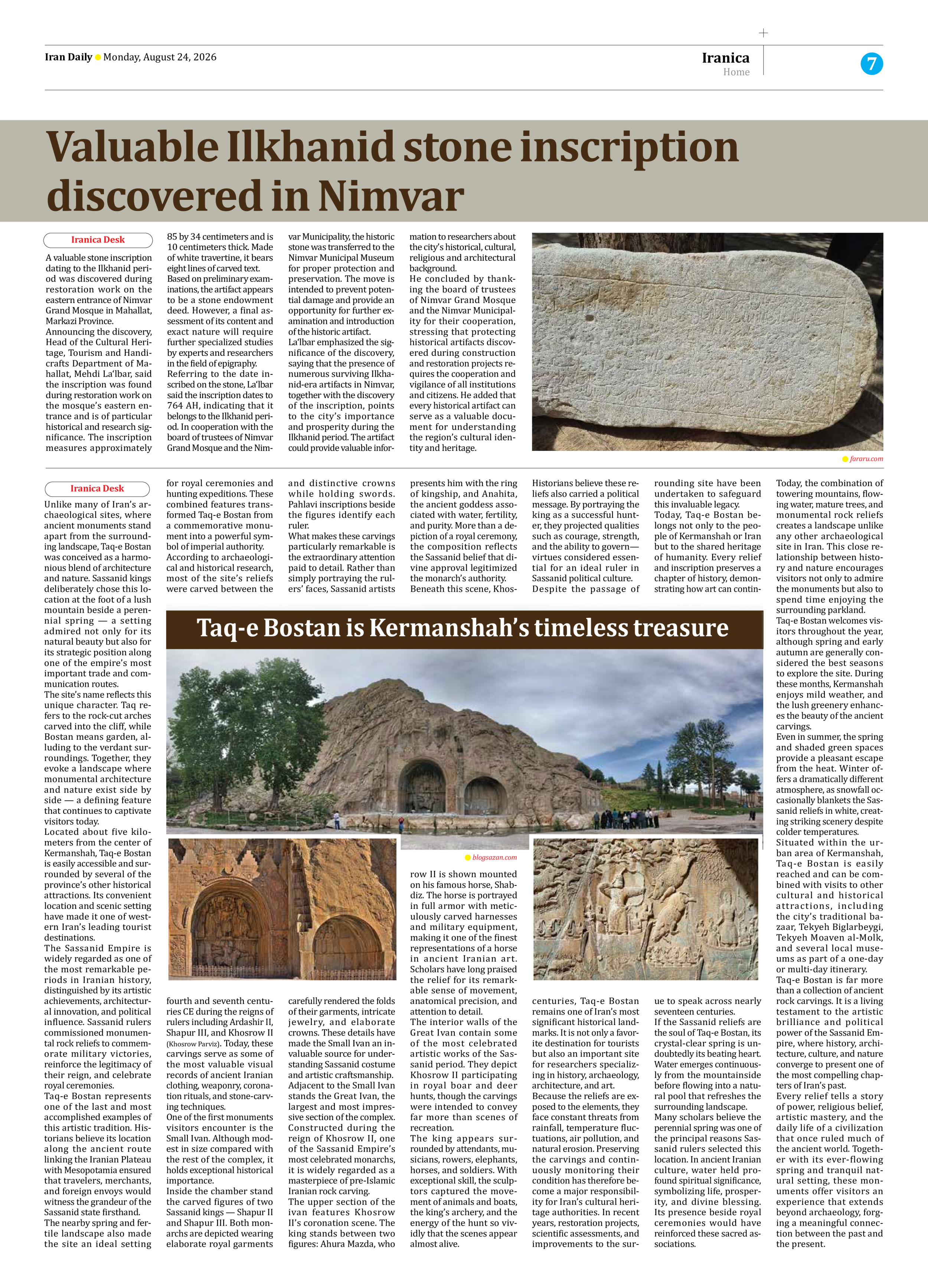


Taq-e Bostan is Kermanshah’s timeless treasure
Unlike many of Iran’s archaeological sites, where ancient monuments stand apart from the surrounding landscape, Taq-e Bostan was conceived as a harmonious blend of architecture and nature. Sassanid kings deliberately chose this location at the foot of a lush mountain beside a perennial spring — a setting admired not only for its natural beauty but also for its strategic position along one of the empire’s most important trade and communication routes.
The site’s name reflects this unique character. Taq refers to the rock-cut arches carved into the cliff, while Bostan means garden, alluding to the verdant surroundings. Together, they evoke a landscape where monumental architecture and nature exist side by side — a defining feature that continues to captivate visitors today.
Located about five kilometers from the center of Kermanshah, Taq-e Bostan is easily accessible and surrounded by several of the province’s other historical attractions. Its convenient location and scenic setting have made it one of western Iran’s leading tourist destinations.
The Sassanid Empire is widely regarded as one of the most remarkable periods in Iranian history, distinguished by its artistic achievements, architectural innovation, and political influence. Sassanid rulers commissioned monumental rock reliefs to commemorate military victories, reinforce the legitimacy of their reign, and celebrate royal ceremonies.
Taq-e Bostan represents one of the last and most accomplished examples of this artistic tradition. Historians believe its location along the ancient route linking the Iranian Plateau with Mesopotamia ensured that travelers, merchants, and foreign envoys would witness the grandeur of the Sassanid state firsthand.
The nearby spring and fertile landscape also made the site an ideal setting for royal ceremonies and hunting expeditions. These combined features transformed Taq-e Bostan from a commemorative monument into a powerful symbol of imperial authority.
According to archaeological and historical research, most of the site’s reliefs were carved between the fourth and seventh centuries CE during the reigns of rulers including Ardashir II, Shapur III, and Khosrow II (Khosrow Parviz). Today, these carvings serve as some of the most valuable visual records of ancient Iranian clothing, weaponry, coronation rituals, and stone-carving techniques.
One of the first monuments visitors encounter is the Small Ivan. Although modest in size compared with the rest of the complex, it holds exceptional historical importance.
Inside the chamber stand the carved figures of two Sassanid kings — Shapur II and Shapur III. Both monarchs are depicted wearing elaborate royal garments and distinctive crowns while holding swords. Pahlavi inscriptions beside the figures identify each ruler.
What makes these carvings particularly remarkable is the extraordinary attention paid to detail. Rather than simply portraying the rulers’ faces, Sassanid artists carefully rendered the folds of their garments, intricate jewelry, and elaborate crowns. These details have made the Small Ivan an invaluable source for understanding Sassanid costume and artistic craftsmanship.
Adjacent to the Small Ivan stands the Great Ivan, the largest and most impressive section of the complex. Constructed during the reign of Khosrow II, one of the Sassanid Empire’s most celebrated monarchs, it is widely regarded as a masterpiece of pre-Islamic Iranian rock carving.
The upper section of the ivan features Khosrow II’s coronation scene. The king stands between two figures: Ahura Mazda, who presents him with the ring of kingship, and Anahita, the ancient goddess associated with water, fertility, and purity. More than a depiction of a royal ceremony, the composition reflects the Sassanid belief that divine approval legitimized the monarch’s authority.
Beneath this scene, Khosrow II is shown mounted on his famous horse, Shabdiz. The horse is portrayed in full armor with meticulously carved harnesses and military equipment, making it one of the finest representations of a horse in ancient Iranian art. Scholars have long praised the relief for its remarkable sense of movement, anatomical precision, and attention to detail.
The interior walls of the Great Ivan contain some of the most celebrated artistic works of the Sassanid period. They depict Khosrow II participating in royal boar and deer hunts, though the carvings were intended to convey far more than scenes of recreation.
The king appears surrounded by attendants, musicians, rowers, elephants, horses, and soldiers. With exceptional skill, the sculptors captured the movement of animals and boats, the king’s archery, and the energy of the hunt so vividly that the scenes appear almost alive.
Historians believe these reliefs also carried a political message. By portraying the king as a successful hunter, they projected qualities such as courage, strength, and the ability to govern—virtues considered essential for an ideal ruler in Sassanid political culture.
Despite the passage of centuries, Taq-e Bostan remains one of Iran’s most significant historical landmarks. It is not only a favorite destination for tourists but also an important site for researchers specializing in history, archaeology, architecture, and art.
Because the reliefs are exposed to the elements, they face constant threats from rainfall, temperature fluctuations, air pollution, and natural erosion. Preserving the carvings and continuously monitoring their condition has therefore become a major responsibility for Iran’s cultural heritage authorities. In recent years, restoration projects, scientific assessments, and improvements to the surrounding site have been undertaken to safeguard this invaluable legacy.
Today, Taq-e Bostan belongs not only to the people of Kermanshah or Iran but to the shared heritage of humanity. Every relief and inscription preserves a chapter of history, demonstrating how art can continue to speak across nearly seventeen centuries.
If the Sassanid reliefs are the soul of Taq-e Bostan, its crystal-clear spring is undoubtedly its beating heart. Water emerges continuously from the mountainside before flowing into a natural pool that refreshes the surrounding landscape.
Many scholars believe the perennial spring was one of the principal reasons Sassanid rulers selected this location. In ancient Iranian culture, water held profound spiritual significance, symbolizing life, prosperity, and divine blessing. Its presence beside royal ceremonies would have reinforced these sacred associations.
Today, the combination of towering mountains, flowing water, mature trees, and monumental rock reliefs creates a landscape unlike any other archaeological site in Iran. This close relationship between history and nature encourages visitors not only to admire the monuments but also to spend time enjoying the surrounding parkland.
Taq-e Bostan welcomes visitors throughout the year, although spring and early autumn are generally considered the best seasons to explore the site. During these months, Kermanshah enjoys mild weather, and the lush greenery enhances the beauty of the ancient carvings.
Even in summer, the spring and shaded green spaces provide a pleasant escape from the heat. Winter offers a dramatically different atmosphere, as snowfall occasionally blankets the Sassanid reliefs in white, creating striking scenery despite colder temperatures.
Situated within the urban area of Kermanshah, Taq-e Bostan is easily reached and can be combined with visits to other cultural and historical attractions, including the city’s traditional bazaar, Tekyeh Biglarbeygi, Tekyeh Moaven al-Molk, and several local museums as part of a one-day or multi-day itinerary.
Taq-e Bostan is far more than a collection of ancient rock carvings. It is a living testament to the artistic brilliance and political power of the Sassanid Empire, where history, architecture, culture, and nature converge to present one of the most compelling chapters of Iran’s past.
Every relief tells a story of power, religious belief, artistic mastery, and the daily life of a civilization that once ruled much of the ancient world. Together with its ever-flowing spring and tranquil natural setting, these monuments offer visitors an experience that extends beyond archaeology, forging a meaningful connection between the past and the present.