







Valuable Ilkhanid stone inscription discovered in Nimvar
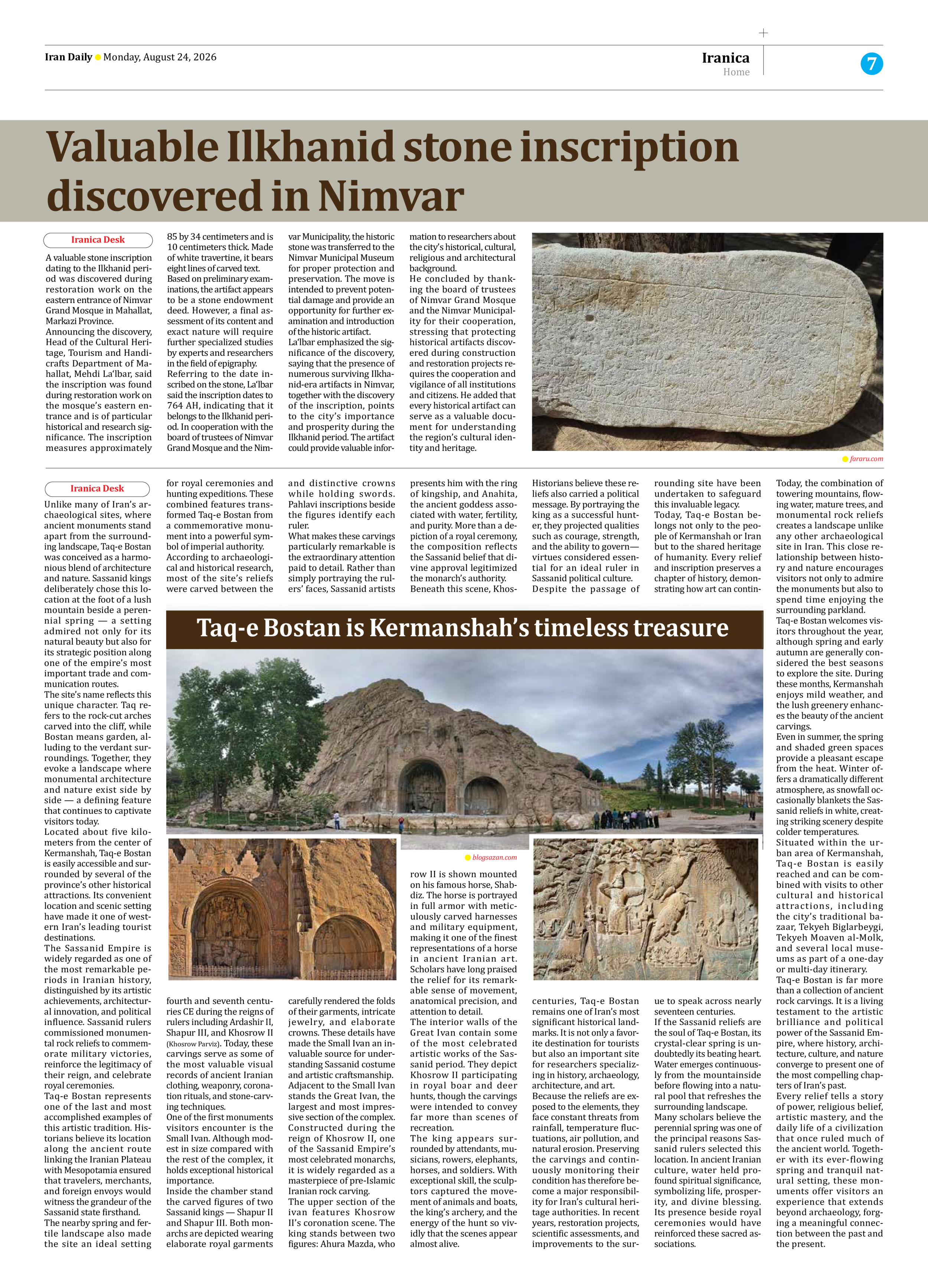
A valuable stone inscription dating to the Ilkhanid period was discovered during restoration work on the eastern entrance of Nimvar Grand Mosque in Mahallat, Markazi Province.
Announcing the discovery, Head of the Cultural Heritage, Tourism and Handicrafts Department of Mahallat, Mehdi La‘lbar, said the inscription was found during restoration work on the mosque’s eastern entrance and is of particular historical and research significance. The inscription measures approximately 85 by 34 centimeters and is 10 centimeters thick. Made of white travertine, it bears eight lines of carved text.
Based on preliminary examinations, the artifact appears to be a stone endowment deed. However, a final assessment of its content and exact nature will require further specialized studies by experts and researchers in the field of epigraphy.
Referring to the date inscribed on the stone, La‘lbar said the inscription dates to 764 AH, indicating that it belongs to the Ilkhanid period. In cooperation with the board of trustees of Nimvar Grand Mosque and the Nimvar Municipality, the historic stone was transferred to the Nimvar Municipal Museum for proper protection and preservation. The move is intended to prevent potential damage and provide an opportunity for further examination and introduction of the historic artifact.
La‘lbar emphasized the significance of the discovery, saying that the presence of numerous surviving Ilkhanid-era artifacts in Nimvar, together with the discovery of the inscription, points to the city’s importance and prosperity during the Ilkhanid period. The artifact could provide valuable information to researchers about the city’s historical, cultural, religious and architectural background.
He concluded by thanking the board of trustees of Nimvar Grand Mosque and the Nimvar Municipality for their cooperation, stressing that protecting historical artifacts discovered during construction and restoration projects requires the cooperation and vigilance of all institutions and citizens. He added that every historical artifact can serve as a valuable document for understanding the region’s cultural identity and heritage.