







Araei House stands among Isfahan’s best-preserved historic homes
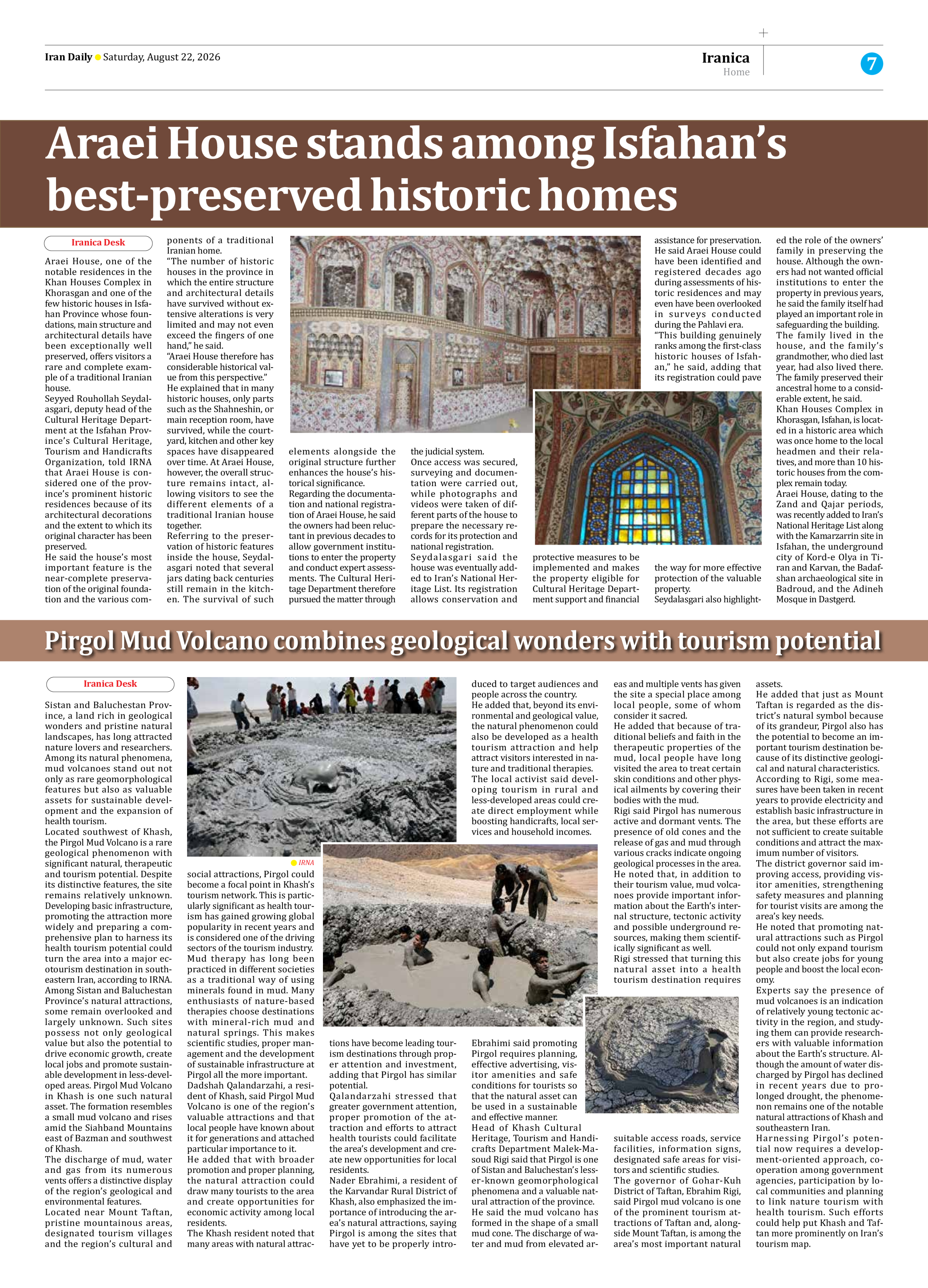
Araei House, one of the notable residences in the Khan Houses Complex in Khorasgan and one of the few historic houses in Isfahan Province whose foundations, main structure and architectural details have been exceptionally well preserved, offers visitors a rare and complete example of a traditional Iranian house.
Seyyed Rouhollah Seydalasgari, deputy head of the Cultural Heritage Department at the Isfahan Province’s Cultural Heritage, Tourism and Handicrafts Organization, told IRNA that Araei House is considered one of the province’s prominent historic residences because of its architectural decorations and the extent to which its original character has been preserved.
He said the house’s most important feature is the near-complete preservation of the original foundation and the various components of a traditional Iranian home.
“The number of historic houses in the province in which the entire structure and architectural details have survived without extensive alterations is very limited and may not even exceed the fingers of one hand,” he said.
“Araei House therefore has considerable historical value from this perspective.”
He explained that in many historic houses, only parts such as the Shahneshin, or main reception room, have survived, while the courtyard, kitchen and other key spaces have disappeared over time. At Araei House, however, the overall structure remains intact, allowing visitors to see the different elements of a traditional Iranian house together.
Referring to the preservation of historic features inside the house, Seydalasgari noted that several jars dating back centuries still remain in the kitchen. The survival of such elements alongside the original structure further enhances the house’s historical significance.
Regarding the documentation and national registration of Araei House, he said the owners had been reluctant in previous decades to allow government institutions to enter the property and conduct expert assessments. The Cultural Heritage Department therefore pursued the matter through the judicial system.
Once access was secured, surveying and documentation were carried out, while photographs and videos were taken of different parts of the house to prepare the necessary records for its protection and national registration.
Seydalasgari said the house was eventually added to Iran’s National Heritage List. Its registration allows conservation and protective measures to be implemented and makes the property eligible for Cultural Heritage Department support and financial assistance for preservation.
He said Araei House could have been identified and registered decades ago during assessments of historic residences and may even have been overlooked in surveys conducted during the Pahlavi era.
“This building genuinely ranks among the first-class historic houses of Isfahan,” he said, adding that its registration could pave the way for more effective protection of the valuable property.
Seydalasgari also highlighted the role of the owners’ family in preserving the house. Although the owners had not wanted official institutions to enter the property in previous years, he said the family itself had played an important role in safeguarding the building.
The family lived in the house, and the family’s grandmother, who died last year, had also lived there. The family preserved their ancestral home to a considerable extent, he said.
Khan Houses Complex in Khorasgan, Isfahan, is located in a historic area which was once home to the local headmen and their relatives, and more than 10 historic houses from the complex remain today.
Araei House, dating to the Zand and Qajar periods, was recently added to Iran’s National Heritage List along with the Kamarzarrin site in Isfahan, the underground city of Kord-e Olya in Tiran and Karvan, the Badafshan archaeological site in Badroud, and the Adineh Mosque in Dastgerd.