







Kamal Garden in Tabriz to become hub for Iran’s cultural luminaries
By Sadeq Dehqan
Staff writer
In the southern part of Mehraneh River and west of Bilankoh Bridge in Tabriz, northwestern Iran, a historic garden is being restored and redeveloped with an ambitious cultural purpose: to turn it into a center dedicated to the country’s literary, mystical and artistic luminaries.
Kamal Garden is regarded as one of Tabriz’s most valuable historic sites. Once a khanqah – a place where members of the Sufi orders meet and do their spiritual rituals – and a gathering place for prominent mystics and poets of the eighth century AH (14th century), the site is now the resting place of several major figures in Iran’s cultural history, including Kamaleddin Masoud Khujandi, the 14th-century Persian Sufi and poet; Kamaleddin Behzad, the renowned Persian artist of the 15th and 16th centuries who was one of the most prominent miniature painters in the history of Iranian art; Sultan Mohammad Tabrizi, an Iranian painter at the Safavid court in Tabriz in the 15th and 16th centuries; and Sultan Mahmoud Mojalled, a 16th-century master of book illumination who worked at the royal library in Tabriz.
The site was added to Iran’s national heritage list in 1998 under No. 2056.
Ramin Asbaqi, head of the Cultural Heritage, Tourism and Handicrafts Department of Tabriz, told Iran Daily that the department planned to restore, organize and expand the historic site.
“The development project is aimed at turning Kamal Garden into a center for introducing the great figures of Iran’s literary, mystical and artistic heritage,” Asbaqi said.
The garden is also known as “Two Kamals” because it contains the tombs of Kamaleddin Masoud Khujandi and Kamaleddin Behzad.
The site’s importance goes beyond its age and architecture. Dating back to the eighth century AH, it is also a place where the cultural legacy of several of Iran’s most influential artists and thinkers has come together.
“Following the acquisition and clearance of properties surrounding the complex, a comprehensive development plan for Kamal Garden has been put on the agenda,” Asbaqi said.
The aim is to organize the grounds and turn the historic site into a center for presenting the literary, mystical and artistic figures of Iran, allowing the cultural treasure to be passed on to future generations.
“Kamal Garden is a valuable legacy of the Jalayirid Sultanate and a testament to the inseparable bond between Iranian mysticism and art,” Asbaqi said. “Through these development projects, we are seeking to bring to greater prominence Tabriz’s cultural identity, which has endured through the ages.”
The history of the garden is closely linked to Kamaleddin Masoud Khujandi. Historical documents attribute the site to the mystic and poet, who chose Tabriz as his home after making a pilgrimage to Mecca.
“Sultan Hussein Jalayir, the ruler of the time, gave Khujandi a garden in Valyankoy, present-day Bilankoh, and built a khanqah there, laying the foundations for what would become the current site,” Asbaqi said.
Khujandi himself referred to the garden in his poetry in almost paradise-like terms, describing it as being “half a farsakh from paradise.”
Farsakh is an old measure of length which is equal to about 5 to 5.5 kilometers
“From the 14th through the 16th centuries, the garden remained a gathering place for mystics, poets and artists. After Khujandi died in 1400, he was buried in the same khanqah,” Asbaqi said.
The presence of tombs and underground burial chambers for mystics and their followers in the khanqahs of Azerbaijan was common between the 14th and 16th centuries, underscoring the special status of the site.
In later years, other prominent figures were laid to rest beside Khujandi, including Kamaleddin Behzad, the celebrated painter and a leading figure in the revival of the Herat and Tabriz schools of miniature painting, as well as Sultan Mohammad Tabrizi and Sultan Mahmoud Mojalled, two leading masters of book illumination and binding during the Safavid era.
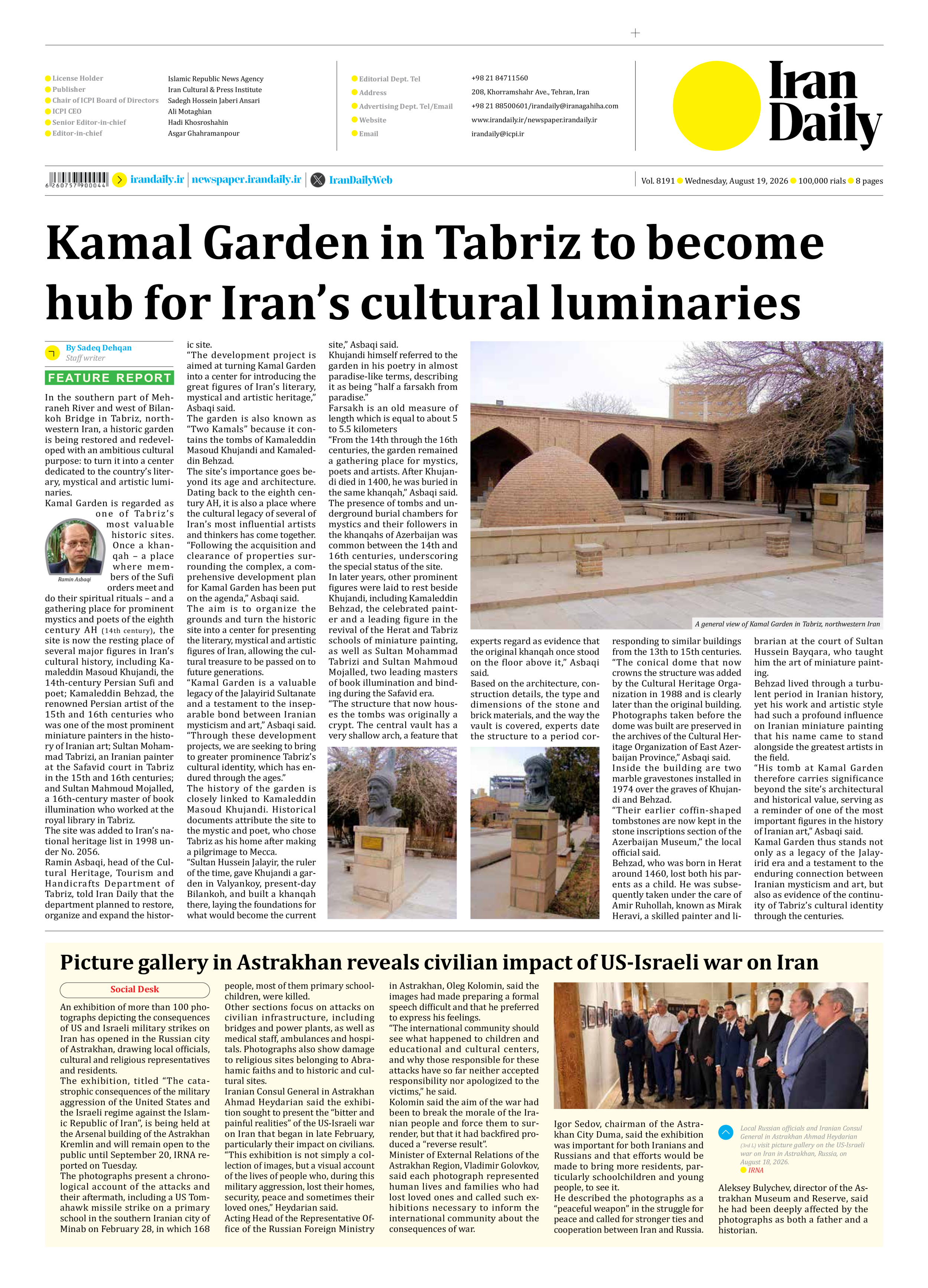
“The structure that now houses the tombs was originally a crypt. The central vault has a very shallow arch, a feature that experts regard as evidence that the original khanqah once stood on the floor above it,” Asbaqi said.
Based on the architecture, construction details, the type and dimensions of the stone and brick materials, and the way the vault is covered, experts date the structure to a period corresponding to similar buildings from the 13th to 15th centuries.
“The conical dome that now crowns the structure was added by the Cultural Heritage Organization in 1988 and is clearly later than the original building. Photographs taken before the dome was built are preserved in the archives of the Cultural Heritage Organization of East Azerbaijan Province,” Asbaqi said.
Inside the building are two marble gravestones installed in 1974 over the graves of Khujandi and Behzad.
“Their earlier coffin-shaped tombstones are now kept in the stone inscriptions section of the Azerbaijan Museum,” the local official said.
Behzad, who was born in Herat around 1460, lost both his parents as a child. He was subsequently taken under the care of Amir Ruhollah, known as Mirak Heravi, a skilled painter and librarian at the court of Sultan Hussein Bayqara, who taught him the art of miniature painting.
Behzad lived through a turbulent period in Iranian history, yet his work and artistic style had such a profound influence on Iranian miniature painting that his name came to stand alongside the greatest artists in the field.
“His tomb at Kamal Garden therefore carries significance beyond the site’s architectural and historical value, serving as a reminder of one of the most important figures in the history of Iranian art,” Asbaqi said.
Kamal Garden thus stands not only as a legacy of the Jalayirid era and a testament to the enduring connection between Iranian mysticism and art, but also as evidence of the continuity of Tabriz’s cultural identity through the centuries.