





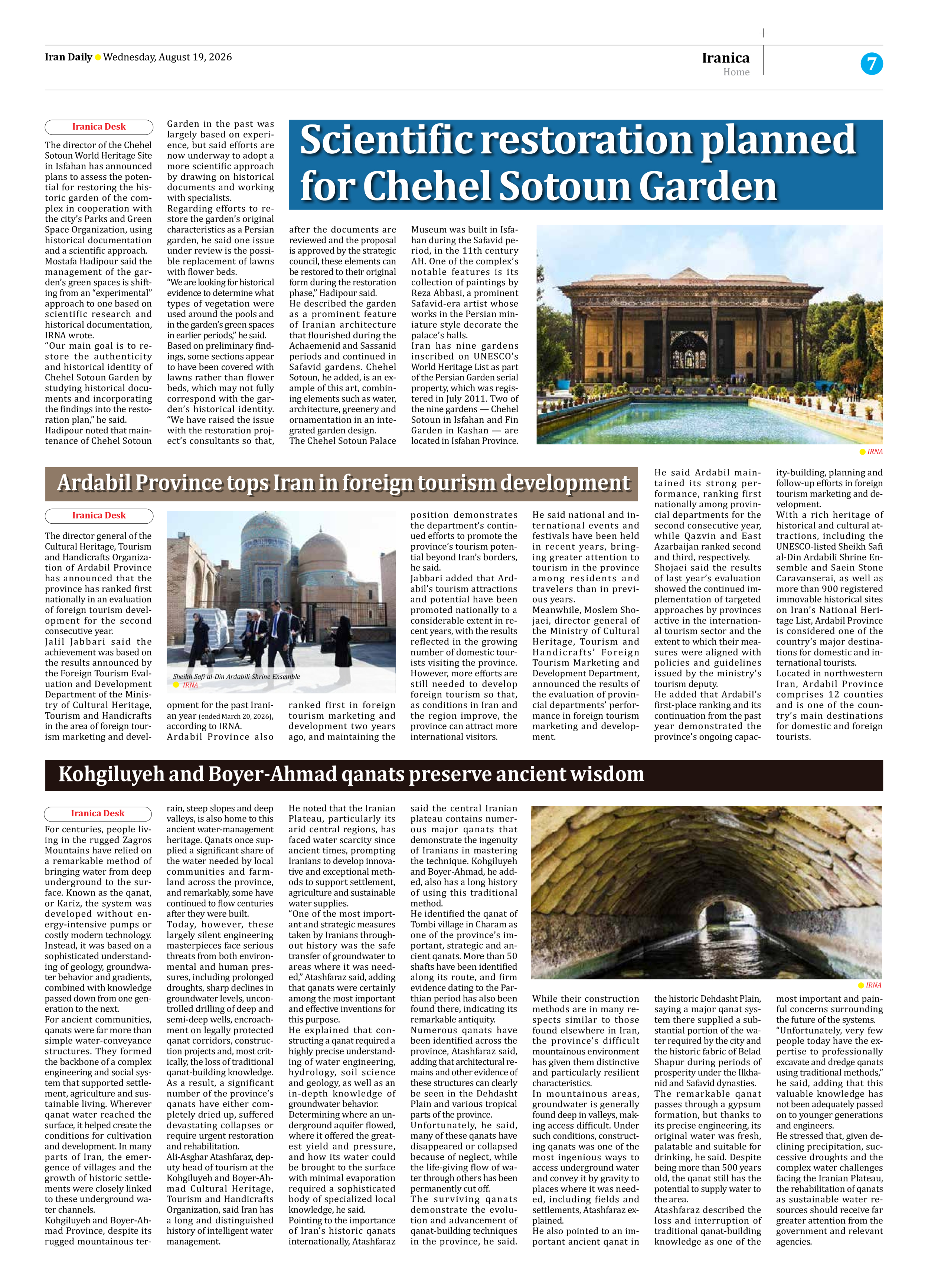


Kohgiluyeh and Boyer-Ahmad qanats preserve ancient wisdom
For centuries, people living in the rugged Zagros Mountains have relied on a remarkable method of bringing water from deep underground to the surface. Known as the qanat, or Kariz, the system was developed without energy-intensive pumps or costly modern technology. Instead, it was based on a sophisticated understanding of geology, groundwater behavior and gradients, combined with knowledge passed down from one generation to the next.
For ancient communities, qanats were far more than simple water-conveyance structures. They formed the backbone of a complex engineering and social system that supported settlement, agriculture and sustainable living. Wherever qanat water reached the surface, it helped create the conditions for cultivation and development. In many parts of Iran, the emergence of villages and the growth of historic settlements were closely linked to these underground water channels.
Kohgiluyeh and Boyer-Ahmad Province, despite its rugged mountainous terrain, steep slopes and deep valleys, is also home to this ancient water-management heritage. Qanats once supplied a significant share of the water needed by local communities and farmland across the province, and remarkably, some have continued to flow centuries after they were built.
Today, however, these largely silent engineering masterpieces face serious threats from both environmental and human pressures, including prolonged droughts, sharp declines in groundwater levels, uncontrolled drilling of deep and semi-deep wells, encroachment on legally protected qanat corridors, construction projects and, most critically, the loss of traditional qanat-building knowledge. As a result, a significant number of the province’s qanats have either completely dried up, suffered devastating collapses or require urgent restoration and rehabilitation.
Ali-Asghar Atashfaraz, deputy head of tourism at the Kohgiluyeh and Boyer-Ahmad Cultural Heritage, Tourism and Handicrafts Organization, said Iran has a long and distinguished history of intelligent water management.
He noted that the Iranian Plateau, particularly its arid central regions, has faced water scarcity since ancient times, prompting Iranians to develop innovative and exceptional methods to support settlement, agriculture and sustainable water supplies.
“One of the most important and strategic measures taken by Iranians throughout history was the safe transfer of groundwater to areas where it was needed,” Atashfaraz said, adding that qanats were certainly among the most important and effective inventions for this purpose.
He explained that constructing a qanat required a highly precise understanding of water engineering, hydrology, soil science and geology, as well as an in-depth knowledge of groundwater behavior.
Determining where an underground aquifer flowed, where it offered the greatest yield and pressure, and how its water could be brought to the surface with minimal evaporation required a sophisticated body of specialized local knowledge, he said.
Pointing to the importance of Iran’s historic qanats internationally, Atashfaraz said the central Iranian plateau contains numerous major qanats that demonstrate the ingenuity of Iranians in mastering the technique. Kohgiluyeh and Boyer-Ahmad, he added, also has a long history of using this traditional method.
He identified the qanat of Tombi village in Charam as one of the province’s important, strategic and ancient qanats. More than 50 shafts have been identified along its route, and firm evidence dating to the Parthian period has also been found there, indicating its remarkable antiquity.
Numerous qanats have been identified across the province, Atashfaraz said, adding that architectural remains and other evidence of these structures can clearly be seen in the Dehdasht Plain and various tropical parts of the province.
Unfortunately, he said, many of these qanats have disappeared or collapsed because of neglect, while the life-giving flow of water through others has been permanently cut off.
The surviving qanats demonstrate the evolution and advancement of qanat-building techniques in the province, he said. While their construction methods are in many respects similar to those found elsewhere in Iran, the province’s difficult mountainous environment has given them distinctive and particularly resilient characteristics.
In mountainous areas, groundwater is generally found deep in valleys, making access difficult. Under such conditions, constructing qanats was one of the most ingenious ways to access underground water and convey it by gravity to places where it was needed, including fields and settlements, Atashfaraz explained.
He also pointed to an important ancient qanat in the historic Dehdasht Plain, saying a major qanat system there supplied a substantial portion of the water required by the city and the historic fabric of Belad Shapur during periods of prosperity under the Ilkhanid and Safavid dynasties.
The remarkable qanat passes through a gypsum formation, but thanks to its precise engineering, its original water was fresh, palatable and suitable for drinking, he said. Despite being more than 500 years old, the qanat still has the potential to supply water to the area.
Atashfaraz described the loss and interruption of traditional qanat-building knowledge as one of the most important and painful concerns surrounding the future of the systems.
“Unfortunately, very few people today have the expertise to professionally excavate and dredge qanats using traditional methods,” he said, adding that this valuable knowledge has not been adequately passed on to younger generations and engineers.
He stressed that, given declining precipitation, successive droughts and the complex water challenges facing the Iranian Plateau, the rehabilitation of qanats as sustainable water resources should receive far greater attention from the government and relevant agencies.