





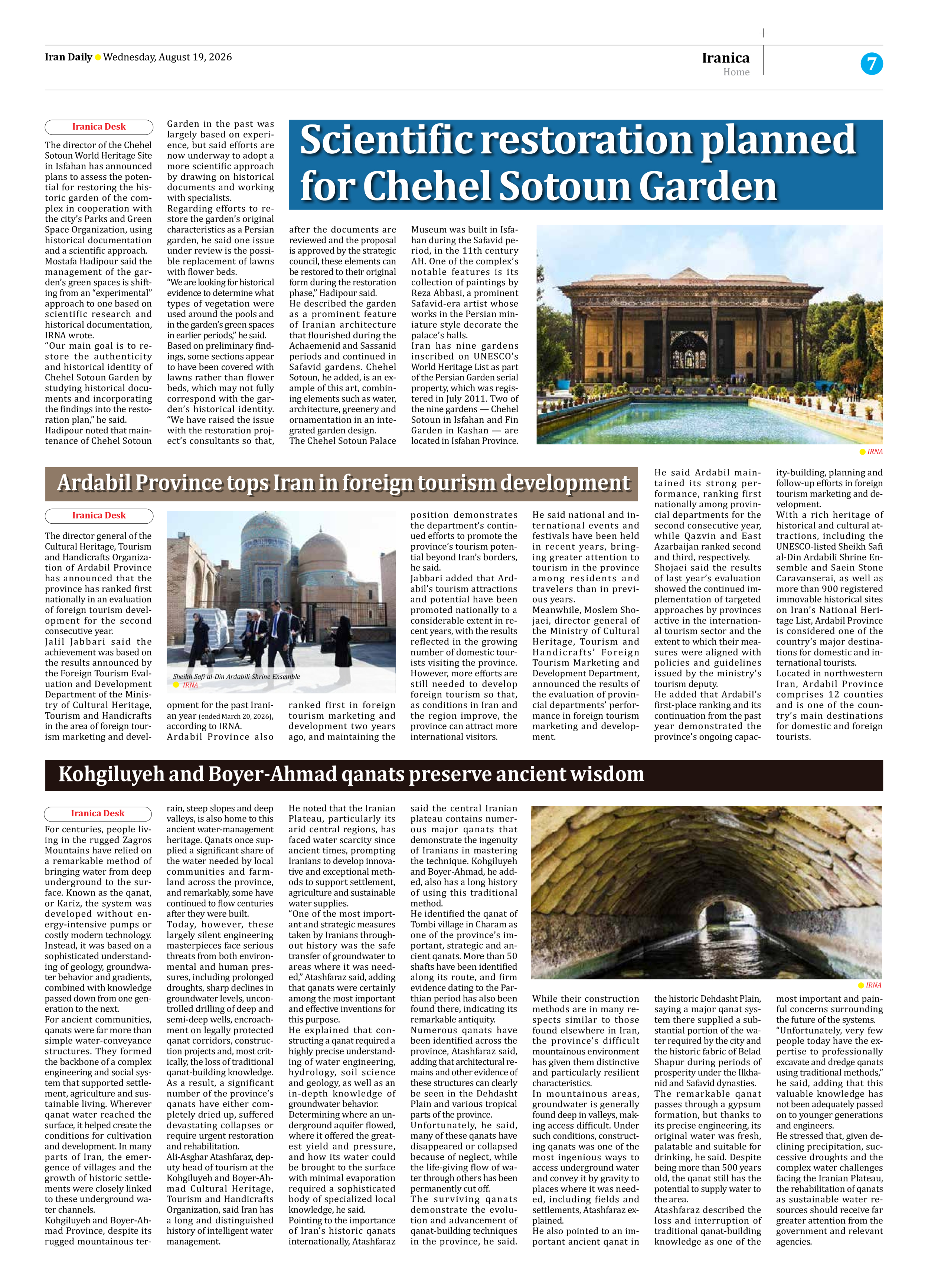


Scientific restoration planned for Chehel Sotoun Garden
The director of the Chehel Sotoun World Heritage Site in Isfahan has announced plans to assess the potential for restoring the historic garden of the complex in cooperation with the city’s Parks and Green Space Organization, using historical documentation and a scientific approach.
Mostafa Hadipour said the management of the garden’s green spaces is shifting from an “experimental” approach to one based on scientific research and historical documentation, IRNA wrote.
“Our main goal is to restore the authenticity and historical identity of Chehel Sotoun Garden by studying historical documents and incorporating the findings into the restoration plan,” he said.
Hadipour noted that maintenance of Chehel Sotoun Garden in the past was largely based on experience, but said efforts are now underway to adopt a more scientific approach by drawing on historical documents and working with specialists.
Regarding efforts to restore the garden’s original characteristics as a Persian garden, he said one issue under review is the possible replacement of lawns with flower beds.
“We are looking for historical evidence to determine what types of vegetation were used around the pools and in the garden’s green spaces in earlier periods,” he said.
Based on preliminary findings, some sections appear to have been covered with lawns rather than flower beds, which may not fully correspond with the garden’s historical identity. “We have raised the issue with the restoration project’s consultants so that, after the documents are reviewed and the proposal is approved by the strategic council, these elements can be restored to their original form during the restoration phase,” Hadipour said.
He described the garden as a prominent feature of Iranian architecture that flourished during the Achaemenid and Sassanid periods and continued in Safavid gardens. Chehel Sotoun, he added, is an example of this art, combining elements such as water, architecture, greenery and ornamentation in an integrated garden design.
The Chehel Sotoun Palace Museum was built in Isfahan during the Safavid period, in the 11th century AH. One of the complex’s notable features is its collection of paintings by Reza Abbasi, a prominent Safavid-era artist whose works in the Persian miniature style decorate the palace’s halls.
Iran has nine gardens inscribed on UNESCO’s World Heritage List as part of the Persian Garden serial property, which was registered in July 2011. Two of the nine gardens — Chehel Sotoun in Isfahan and Fin Garden in Kashan — are located in Isfahan Province.