





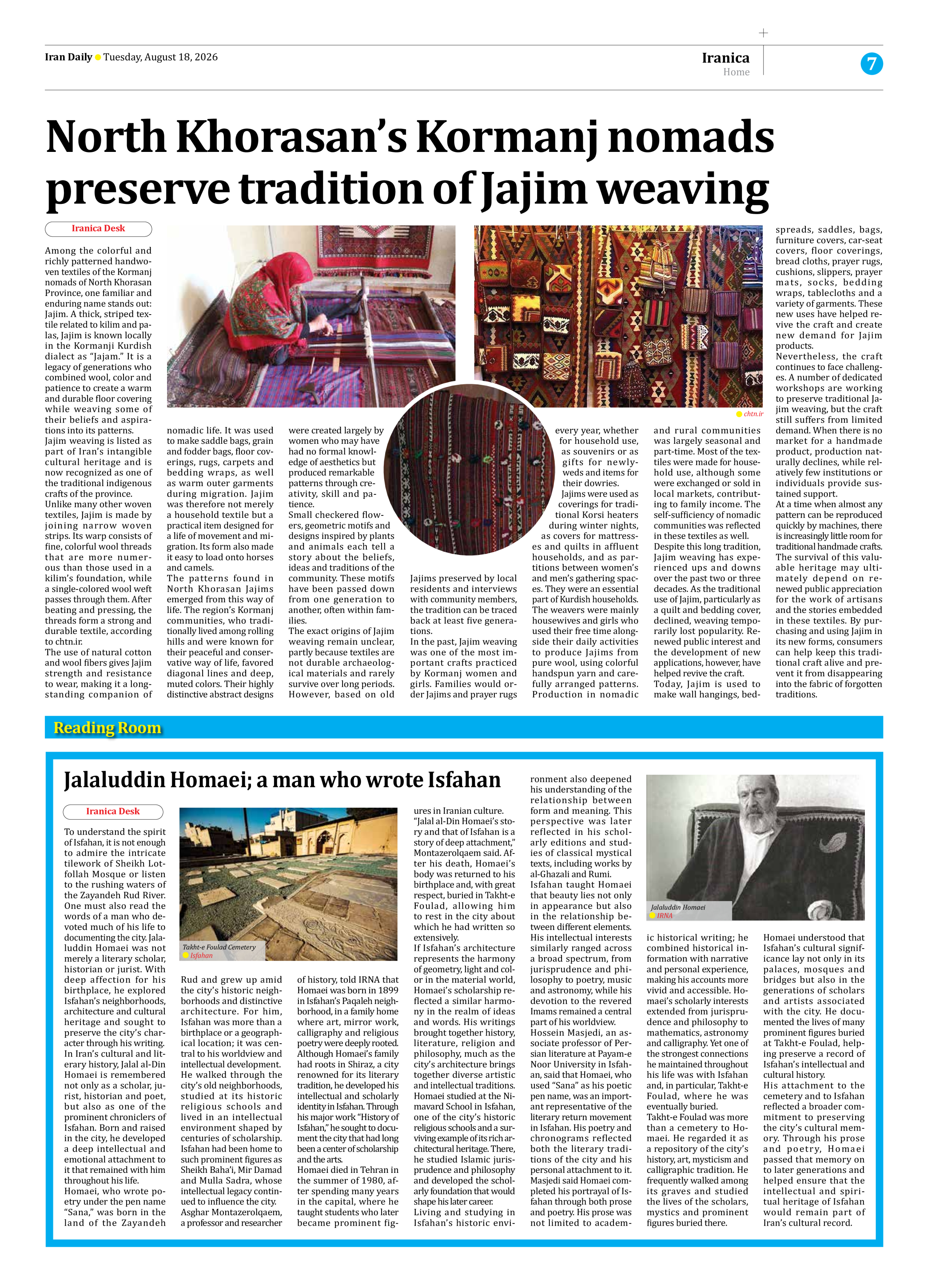


Jalaluddin Homaei; a man who wrote Isfahan
To understand the spirit of Isfahan, it is not enough to admire the intricate tilework of Sheikh Lotfollah Mosque or listen to the rushing waters of the Zayandeh Rud River. One must also read the words of a man who devoted much of his life to documenting the city. Jalaluddin Homaei was not merely a literary scholar, historian or jurist. With deep affection for his birthplace, he explored Isfahan’s neighborhoods, architecture and cultural heritage and sought to preserve the city’s character through his writing.
In Iran’s cultural and literary history, Jalal al-Din Homaei is remembered not only as a scholar, jurist, historian and poet, but also as one of the prominent chroniclers of Isfahan. Born and raised in the city, he developed a deep intellectual and emotional attachment to it that remained with him throughout his life.
Homaei, who wrote poetry under the pen name “Sana,” was born in the land of the Zayandeh Rud and grew up amid the city’s historic neighborhoods and distinctive architecture. For him, Isfahan was more than a birthplace or a geographical location; it was central to his worldview and intellectual development.
He walked through the city’s old neighborhoods, studied at its historic religious schools and lived in an intellectual environment shaped by centuries of scholarship. Isfahan had been home to such prominent figures as Sheikh Baha’i, Mir Damad and Mulla Sadra, whose intellectual legacy continued to influence the city.
Asghar Montazerolqaem, a professor and researcher of history, told IRNA that Homaei was born in 1899 in Isfahan’s Paqaleh neighborhood, in a family home where art, mirror work, calligraphy and religious poetry were deeply rooted.
Although Homaei’s family had roots in Shiraz, a city renowned for its literary tradition, he developed his intellectual and scholarly identity in Isfahan. Through his major work “History of Isfahan,” he sought to document the city that had long been a center of scholarship and the arts.
Homaei died in Tehran in the summer of 1980, after spending many years in the capital, where he taught students who later became prominent figures in Iranian culture.
“Jalal al-Din Homaei’s story and that of Isfahan is a story of deep attachment,” Montazerolqaem said. After his death, Homaei’s body was returned to his birthplace and, with great respect, buried in Takht-e Foulad, allowing him to rest in the city about which he had written so extensively.
If Isfahan’s architecture represents the harmony of geometry, light and color in the material world, Homaei’s scholarship reflected a similar harmony in the realm of ideas and words. His writings brought together history, literature, religion and philosophy, much as the city’s architecture brings together diverse artistic and intellectual traditions.
Homaei studied at the Nimavard School in Isfahan, one of the city’s historic religious schools and a surviving example of its rich architectural heritage. There, he studied Islamic jurisprudence and philosophy and developed the scholarly foundation that would shape his later career.
Living and studying in Isfahan’s historic environment also deepened his understanding of the relationship between form and meaning. This perspective was later reflected in his scholarly editions and studies of classical mystical texts, including works by al-Ghazali and Rumi.
Isfahan taught Homaei that beauty lies not only in appearance but also in the relationship between different elements. His intellectual interests similarly ranged across a broad spectrum, from jurisprudence and philosophy to poetry, music and astronomy, while his devotion to the revered Imams remained a central part of his worldview.
Hossein Masjedi, an associate professor of Persian literature at Payam-e Noor University in Isfahan, said that Homaei, who used “Sana” as his poetic pen name, was an important representative of the literary return movement in Isfahan. His poetry and chronograms reflected both the literary traditions of the city and his personal attachment to it.
Masjedi said Homaei completed his portrayal of Isfahan through both prose and poetry. His prose was not limited to academic historical writing; he combined historical information with narrative and personal experience, making his accounts more vivid and accessible. Homaei’s scholarly interests extended from jurisprudence and philosophy to mathematics, astronomy and calligraphy. Yet one of the strongest connections he maintained throughout his life was with Isfahan and, in particular, Takht-e Foulad, where he was eventually buried.
Takht-e Foulad was more than a cemetery to Homaei. He regarded it as a repository of the city’s history, art, mysticism and calligraphic tradition. He frequently walked among its graves and studied the lives of the scholars, mystics and prominent figures buried there.
Homaei understood that Isfahan’s cultural significance lay not only in its palaces, mosques and bridges but also in the generations of scholars and artists associated with the city. He documented the lives of many prominent figures buried at Takht-e Foulad, helping preserve a record of Isfahan’s intellectual and cultural history.
His attachment to the cemetery and to Isfahan reflected a broader commitment to preserving the city’s cultural memory. Through his prose and poetry, Homaei passed that memory on to later generations and helped ensure that the intellectual and spiritual heritage of Isfahan would remain part of Iran’s cultural record.