







North Khorasan’s Kormanj nomads preserve tradition of Jajim weaving
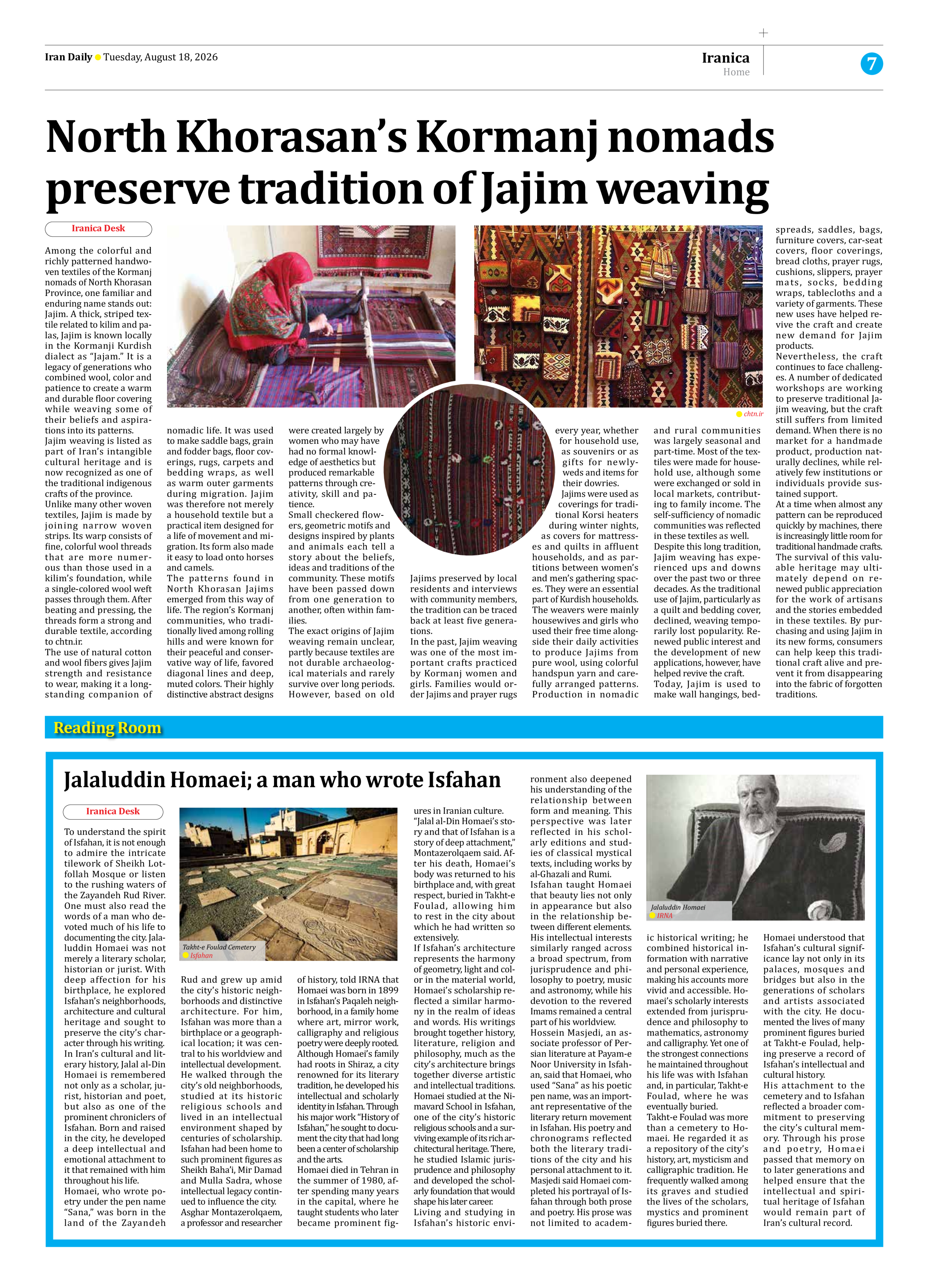
Among the colorful and richly patterned handwoven textiles of the Kormanj nomads of North Khorasan Province, one familiar and enduring name stands out: Jajim. A thick, striped textile related to kilim and palas, Jajim is known locally in the Kormanji Kurdish dialect as “Jajam.” It is a legacy of generations who combined wool, color and patience to create a warm and durable floor covering while weaving some of their beliefs and aspirations into its patterns.
Jajim weaving is listed as part of Iran’s intangible cultural heritage and is now recognized as one of the traditional indigenous crafts of the province.
Unlike many other woven textiles, Jajim is made by joining narrow woven strips. Its warp consists of fine, colorful wool threads that are more numerous than those used in a kilim’s foundation, while a single-colored wool weft passes through them. After beating and pressing, the threads form a strong and durable textile, according to chtn.ir.
The use of natural cotton and wool fibers gives Jajim strength and resistance to wear, making it a longstanding companion of nomadic life. It was used to make saddle bags, grain and fodder bags, floor coverings, rugs, carpets and bedding wraps, as well as warm outer garments during migration. Jajim was therefore not merely a household textile but a practical item designed for a life of movement and migration. Its form also made it easy to load onto horses and camels.
The patterns found in North Khorasan Jajims emerged from this way of life. The region’s Kormanj communities, who traditionally lived among rolling hills and were known for their peaceful and conservative way of life, favored diagonal lines and deep, muted colors. Their highly distinctive abstract designs were created largely by women who may have had no formal knowledge of aesthetics but produced remarkable patterns through creativity, skill and patience.
Small checkered flowers, geometric motifs and designs inspired by plants and animals each tell a story about the beliefs, ideas and traditions of the community. These motifs have been passed down from one generation to another, often within families.
The exact origins of Jajim weaving remain unclear, partly because textiles are not durable archaeological materials and rarely survive over long periods. However, based on old Jajims preserved by local residents and interviews with community members, the tradition can be traced back at least five generations.
In the past, Jajim weaving was one of the most important crafts practiced by Kormanj women and girls. Families would order Jajims and prayer rugs every year, whether for household use, as souvenirs or as gifts for newlyweds and items for their dowries.
Jajims were used as coverings for traditional Korsi heaters during winter nights, as covers for mattresses and quilts in affluent households, and as partitions between women’s and men’s gathering spaces. They were an essential part of Kurdish households.
The weavers were mainly housewives and girls who used their free time alongside their daily activities to produce Jajims from pure wool, using colorful handspun yarn and carefully arranged patterns. Production in nomadic and rural communities was largely seasonal and part-time. Most of the textiles were made for household use, although some were exchanged or sold in local markets, contributing to family income. The self-sufficiency of nomadic communities was reflected in these textiles as well.
Despite this long tradition, Jajim weaving has experienced ups and downs over the past two or three decades. As the traditional use of Jajim, particularly as a quilt and bedding cover, declined, weaving temporarily lost popularity. Renewed public interest and the development of new applications, however, have helped revive the craft.
Today, Jajim is used to make wall hangings, bedspreads, saddles, bags, furniture covers, car-seat covers, floor coverings, bread cloths, prayer rugs, cushions, slippers, prayer mats, socks, bedding wraps, tablecloths and a variety of garments. These new uses have helped revive the craft and create new demand for Jajim products.
Nevertheless, the craft continues to face challenges. A number of dedicated workshops are working to preserve traditional Jajim weaving, but the craft still suffers from limited demand. When there is no market for a handmade product, production naturally declines, while relatively few institutions or individuals provide sustained support.
At a time when almost any pattern can be reproduced quickly by machines, there is increasingly little room for traditional handmade crafts.
The survival of this valuable heritage may ultimately depend on renewed public appreciation for the work of artisans and the stories embedded in these textiles. By purchasing and using Jajim in its new forms, consumers can help keep this traditional craft alive and prevent it from disappearing into the fabric of forgotten traditions.