





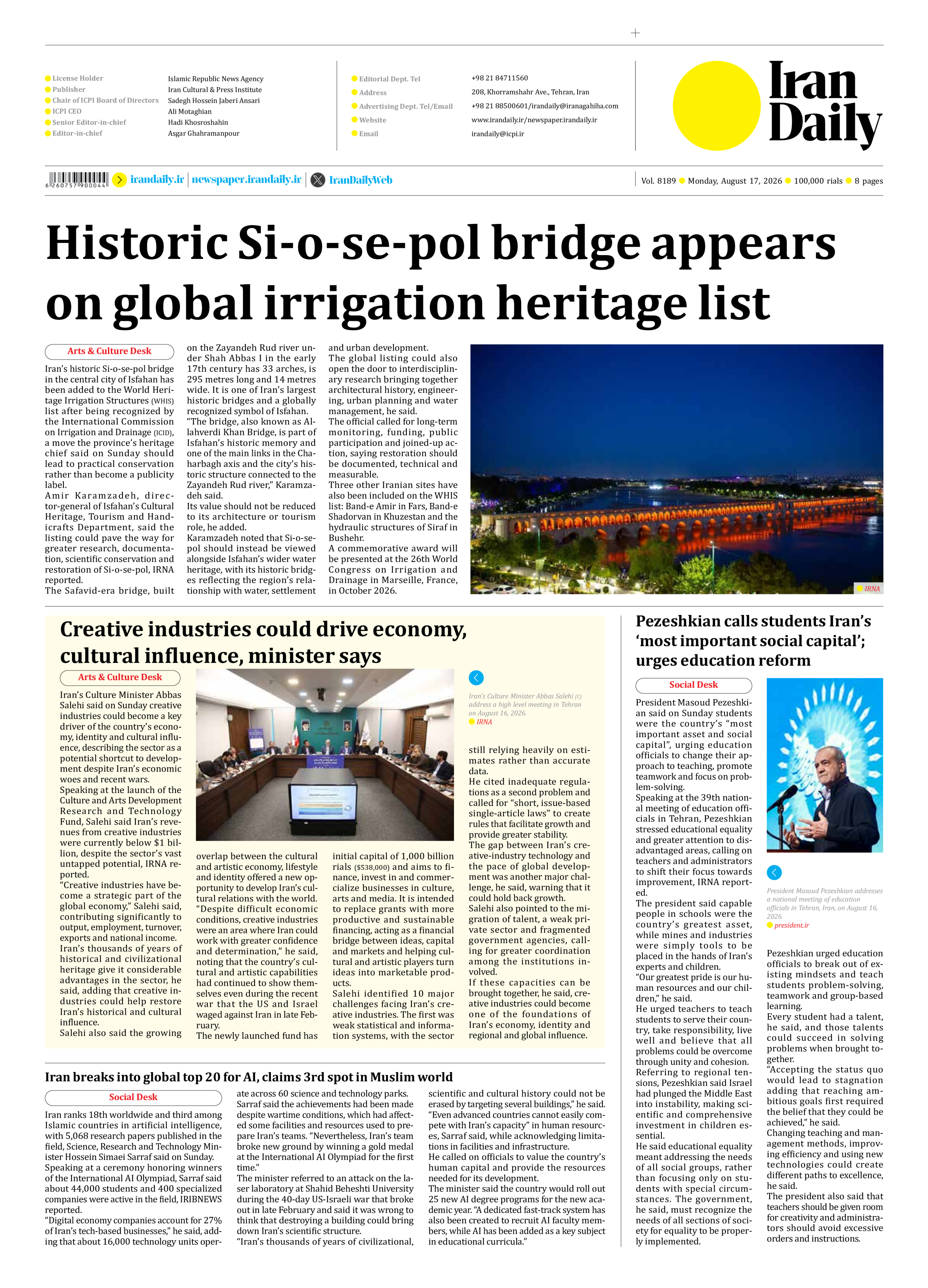


Historic Si-o-se-pol bridge appears on global irrigation heritage list
Iran’s historic Si-o-se-pol bridge in the central city of Isfahan has been added to the World Heritage Irrigation Structures (WHIS) list after being recognized by the International Commission on Irrigation and Drainage (ICID), a move the province’s heritage chief said on Sunday should lead to practical conservation rather than become a publicity label.
Amir Karamzadeh, director-general of Isfahan’s Cultural Heritage, Tourism and Handicrafts Department, said the listing could pave the way for greater research, documentation, scientific conservation and restoration of Si-o-se-pol, IRNA reported.
The Safavid-era bridge, built on the Zayandeh Rud river under Shah Abbas I in the early 17th century has 33 arches, is 295 metres long and 14 metres wide. It is one of Iran’s largest historic bridges and a globally recognized symbol of Isfahan.
“The bridge, also known as Allahverdi Khan Bridge, is part of Isfahan’s historic memory and one of the main links in the Chaharbagh axis and the city’s historic structure connected to the Zayandeh Rud river,” Karamzadeh said.
Its value should not be reduced to its architecture or tourism role, he added.
Karamzadeh noted that Si-o-se-pol should instead be viewed alongside Isfahan’s wider water heritage, with its historic bridges reflecting the region’s relationship with water, settlement and urban development.
The global listing could also open the door to interdisciplinary research bringing together architectural history, engineering, urban planning and water management, he said.
The official called for long-term monitoring, funding, public participation and joined-up action, saying restoration should be documented, technical and measurable.
Three other Iranian sites have also been included on the WHIS list: Band-e Amir in Fars, Band-e Shadorvan in Khuzestan and the hydraulic structures of Siraf in Bushehr.
A commemorative award will be presented at the 26th World Congress on Irrigation and Drainage in Marseille, France, in October 2026.