





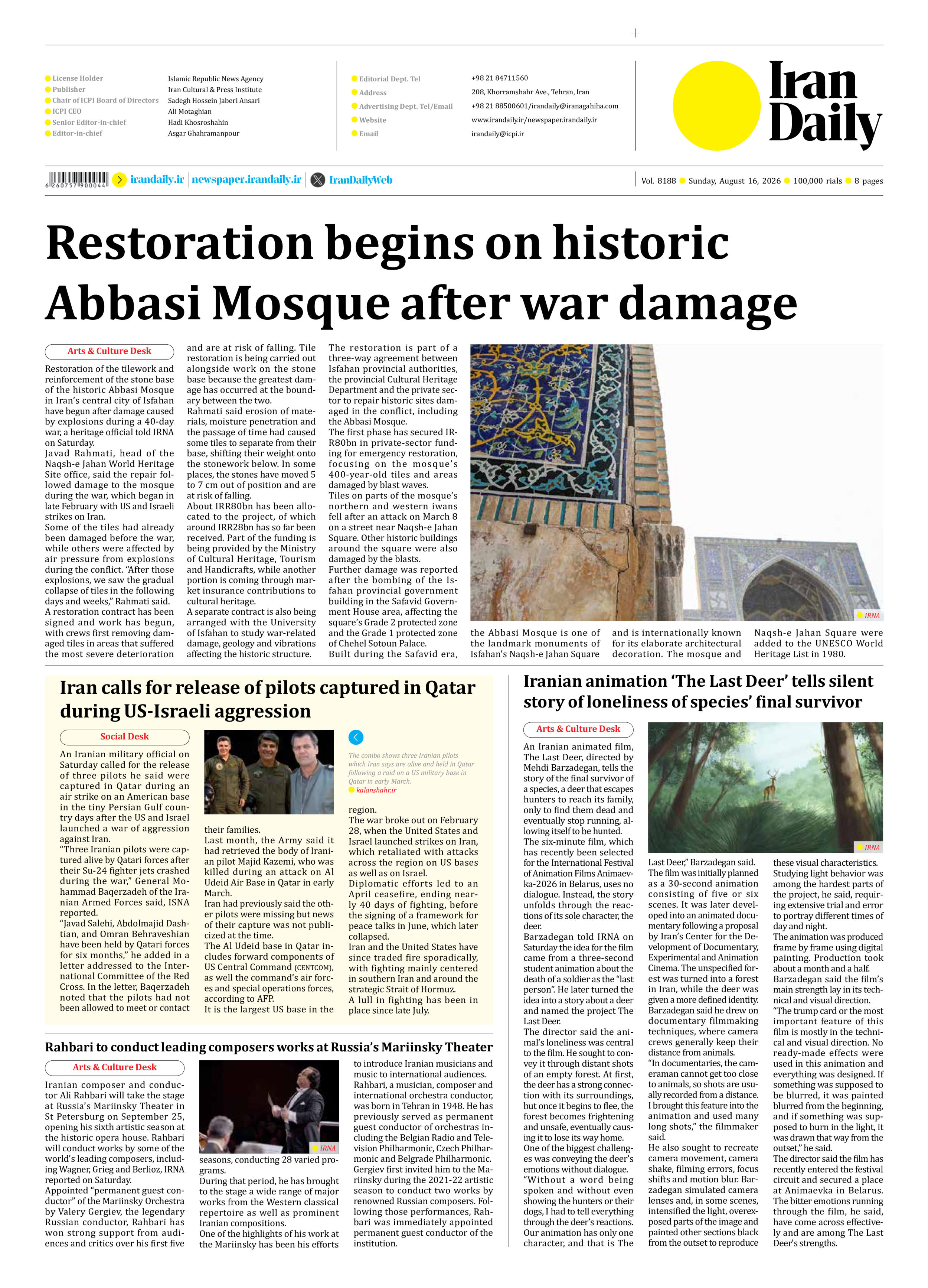


Iranian animation ‘The Last Deer’ tells silent story of loneliness of species’ final survivor
An Iranian animated film, The Last Deer, directed by Mehdi Barzadegan, tells the story of the final survivor of a species, a deer that escapes hunters to reach its family, only to find them dead and eventually stop running, allowing itself to be hunted.
The six-minute film, which has recently been selected for the International Festival of Animation Films Animaevka-2026 in Belarus, uses no dialogue. Instead, the story unfolds through the reactions of its sole character, the deer.
Barzadegan told IRNA on Saturday the idea for the film came from a three-second student animation about the death of a soldier as the “last person”. He later turned the idea into a story about a deer and named the project The Last Deer.
The director said the animal’s loneliness was central to the film. He sought to convey it through distant shots of an empty forest. At first, the deer has a strong connection with its surroundings, but once it begins to flee, the forest becomes frightening and unsafe, eventually causing it to lose its way home.
One of the biggest challenges was conveying the deer’s emotions without dialogue.
“Without a word being spoken and without even showing the hunters or their dogs, I had to tell everything through the deer’s reactions. Our animation has only one character, and that is The Last Deer,” Barzadegan said.
The film was initially planned as a 30-second animation consisting of five or six scenes. It was later developed into an animated documentary following a proposal by Iran’s Center for the Development of Documentary, Experimental and Animation Cinema. The unspecified forest was turned into a forest in Iran, while the deer was given a more defined identity.
Barzadegan said he drew on documentary filmmaking techniques, where camera crews generally keep their distance from animals.
“In documentaries, the cameraman cannot get too close to animals, so shots are usually recorded from a distance. I brought this feature into the animation and used many long shots,” the filmmaker said.
He also sought to recreate camera movement, camera shake, filming errors, focus shifts and motion blur. Barzadegan simulated camera lenses and, in some scenes, intensified the light, overexposed parts of the image and painted other sections black from the outset to reproduce these visual characteristics.
Studying light behavior was among the hardest parts of the project, he said, requiring extensive trial and error to portray different times of day and night.
The animation was produced frame by frame using digital painting. Production took about a month and a half.
Barzadegan said the film’s main strength lay in its technical and visual direction.
“The trump card or the most important feature of this film is mostly in the technical and visual direction. No ready-made effects were used in this animation and everything was designed. If something was supposed to be blurred, it was painted blurred from the beginning, and if something was supposed to burn in the light, it was drawn that way from the outset,” he said.
The director said the film has recently entered the festival circuit and secured a place at Animaevka in Belarus. The bitter emotions running through the film, he said, have come across effectively and are among The Last Deer’s strengths.