







Restoration begins on historic Abbasi Mosque after war damage
Restoration of the tilework and reinforcement of the stone base of the historic Abbasi Mosque in Iran’s central city of Isfahan have begun after damage caused by explosions during a 40-day war, a heritage official told IRNA on Saturday.
Javad Rahmati, head of the Naqsh-e Jahan World Heritage Site office, said the repair followed damage to the mosque during the war, which began in late February with US and Israeli strikes on Iran.
Some of the tiles had already been damaged before the war, while others were affected by air pressure from explosions during the conflict. “After those explosions, we saw the gradual collapse of tiles in the following days and weeks,” Rahmati said.
A restoration contract has been signed and work has begun, with crews first removing damaged tiles in areas that suffered the most severe deterioration and are at risk of falling. Tile restoration is being carried out alongside work on the stone base because the greatest damage has occurred at the boundary between the two.
Rahmati said erosion of materials, moisture penetration and the passage of time had caused some tiles to separate from their base, shifting their weight onto the stonework below. In some places, the stones have moved 5 to 7 cm out of position and are at risk of falling.
About IRR80bn has been allocated to the project, of which around IRR28bn has so far been received. Part of the funding is being provided by the Ministry of Cultural Heritage, Tourism and Handicrafts, while another portion is coming through market insurance contributions to cultural heritage.
A separate contract is also being arranged with the University of Isfahan to study war-related damage, geology and vibrations affecting the historic structure.
The restoration is part of a three-way agreement between Isfahan provincial authorities, the provincial Cultural Heritage Department and the private sector to repair historic sites damaged in the conflict, including the Abbasi Mosque.
The first phase has secured IRR80bn in private-sector funding for emergency restoration, focusing on the mosque’s 400-year-old tiles and areas damaged by blast waves.
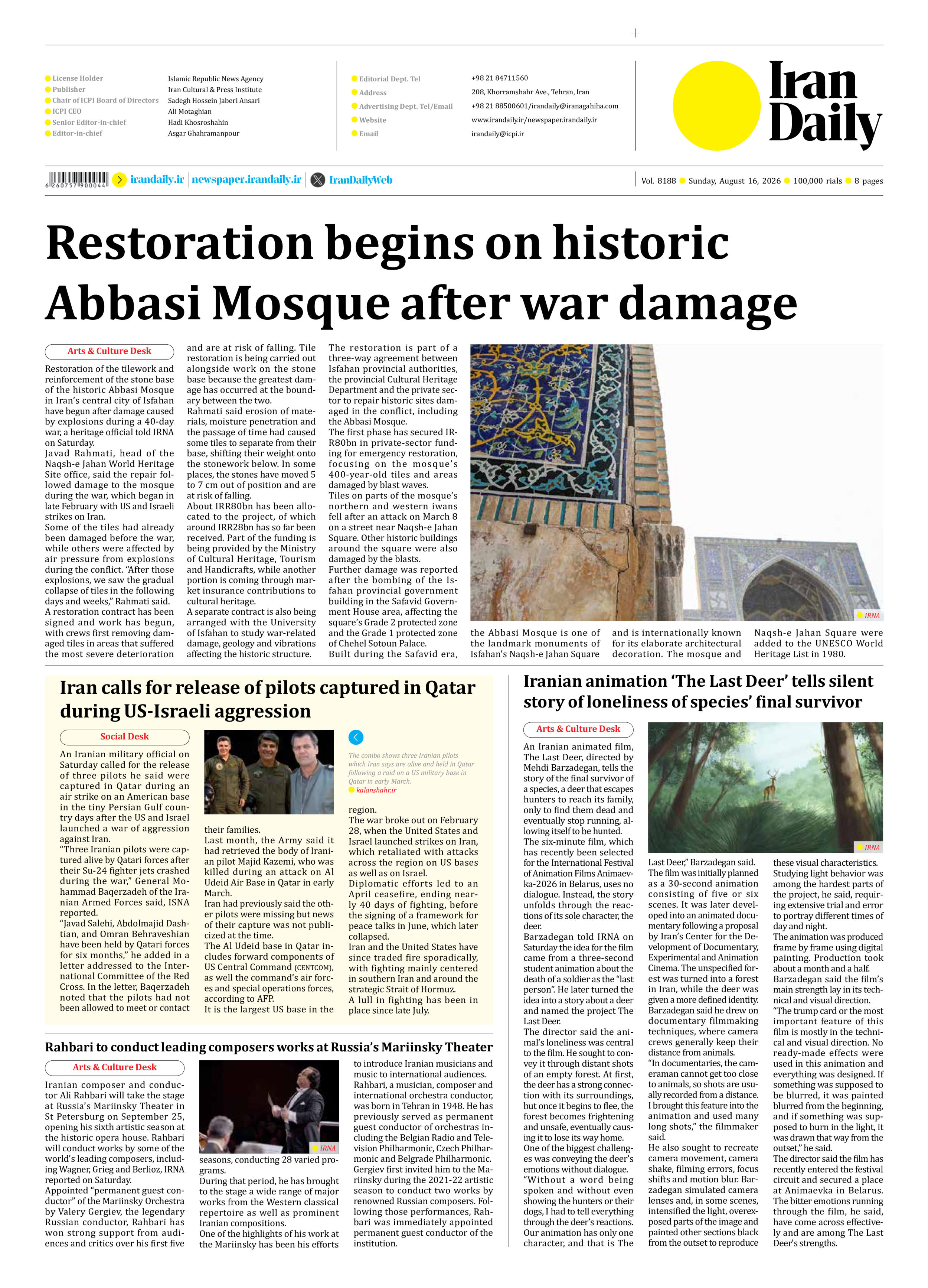
Tiles on parts of the mosque’s northern and western iwans fell after an attack on March 8 on a street near Naqsh-e Jahan Square. Other historic buildings around the square were also damaged by the blasts.
Further damage was reported after the bombing of the Isfahan provincial government building in the Safavid Government House area, affecting the square’s Grade 2 protected zone and the Grade 1 protected zone of Chehel Sotoun Palace.
Built during the Safavid era, the Abbasi Mosque is one of the landmark monuments of Isfahan’s Naqsh-e Jahan Square and is internationally known for its elaborate architectural decoration. The mosque and Naqsh-e Jahan Square were added to the UNESCO World Heritage List in 1980.