







Traditional weaving preserves centuries-old craft in Ilam
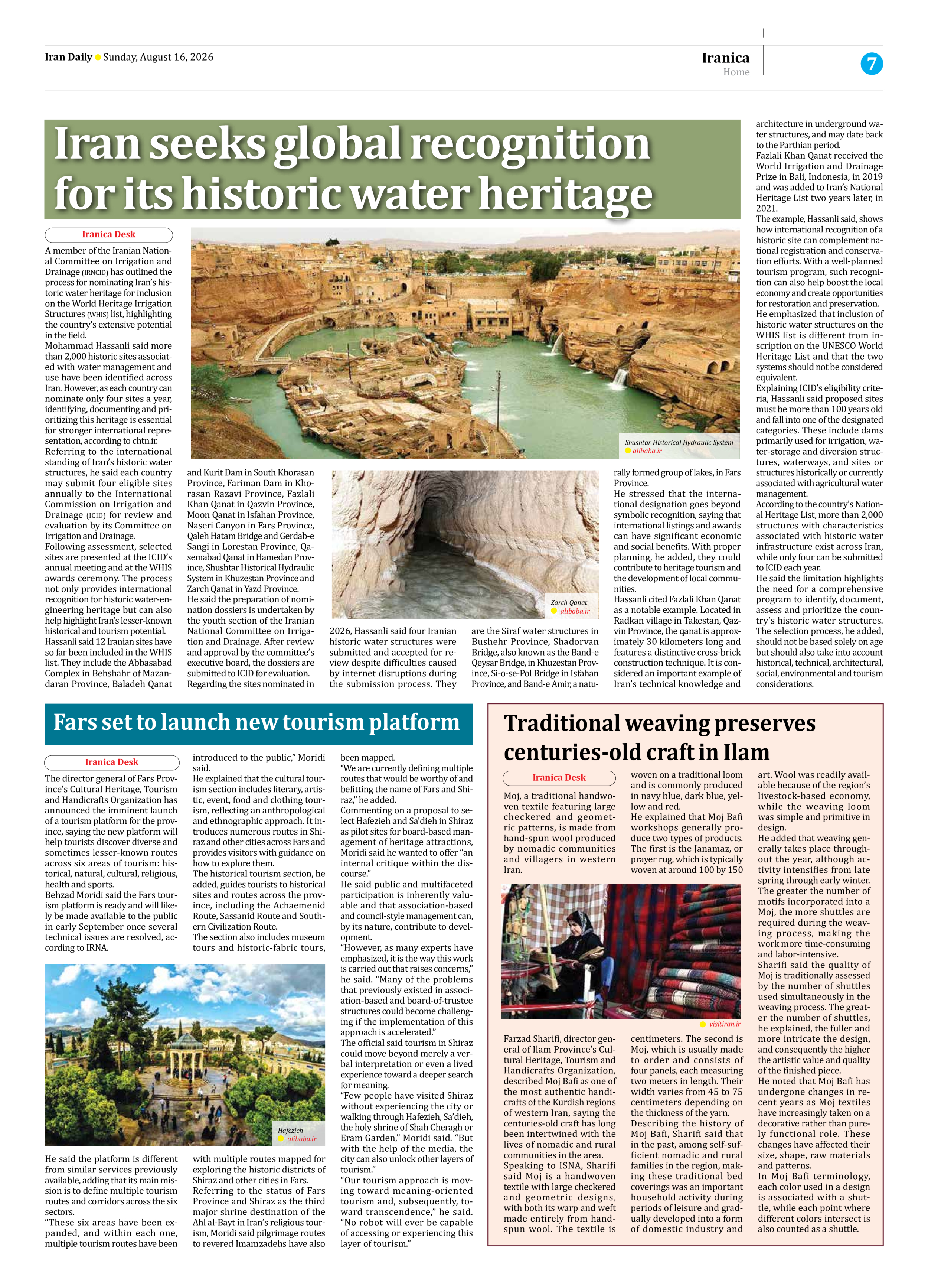
Moj, a traditional handwoven textile featuring large checkered and geometric patterns, is made from hand-spun wool produced by nomadic communities and villagers in western Iran.
Farzad Sharifi, director general of Ilam Province’s Cultural Heritage, Tourism and Handicrafts Organization, described Moj Bafi as one of the most authentic handicrafts of the Kurdish regions of western Iran, saying the centuries-old craft has long been intertwined with the lives of nomadic and rural communities in the area.
Speaking to ISNA, Sharifi said Moj is a handwoven textile with large checkered and geometric designs, with both its warp and weft made entirely from hand-spun wool. The textile is woven on a traditional loom and is commonly produced in navy blue, dark blue, yellow and red.
He explained that Moj Bafi workshops generally produce two types of products. The first is the Janamaz, or prayer rug, which is typically woven at around 100 by 150 centimeters. The second is Moj, which is usually made to order and consists of four panels, each measuring two meters in length. Their width varies from 45 to 75 centimeters depending on the thickness of the yarn.
Describing the history of Moj Bafi, Sharifi said that in the past, among self-sufficient nomadic and rural families in the region, making these traditional bed coverings was an important household activity during periods of leisure and gradually developed into a form of domestic industry and art. Wool was readily available because of the region’s livestock-based economy, while the weaving loom was simple and primitive in design.
He added that weaving generally takes place throughout the year, although activity intensifies from late spring through early winter. The greater the number of motifs incorporated into a Moj, the more shuttles are required during the weaving process, making the work more time-consuming and labor-intensive.
Sharifi said the quality of Moj is traditionally assessed by the number of shuttles used simultaneously in the weaving process. The greater the number of shuttles, he explained, the fuller and more intricate the design, and consequently the higher the artistic value and quality of the finished piece.
He noted that Moj Bafi has undergone changes in recent years as Moj textiles have increasingly taken on a decorative rather than purely functional role. These changes have affected their size, shape, raw materials and patterns.
In Moj Bafi terminology, each color used in a design is associated with a shuttle, while each point where different colors intersect is also counted as a shuttle.