







Iran seeks global recognition for its historic water heritage
A member of the Iranian National Committee on Irrigation and Drainage (IRNCID) has outlined the process for nominating Iran’s historic water heritage for inclusion on the World Heritage Irrigation Structures (WHIS) list, highlighting the country’s extensive potential in the field.
Mohammad Hassanli said more than 2,000 historic sites associated with water management and use have been identified across Iran. However, as each country can nominate only four sites a year, identifying, documenting and prioritizing this heritage is essential for stronger international representation, according to chtn.ir.
Referring to the international standing of Iran’s historic water structures, he said each country may submit four eligible sites annually to the International Commission on Irrigation and Drainage (ICID) for review and evaluation by its Committee on Irrigation and Drainage.
Following assessment, selected sites are presented at the ICID’s annual meeting and at the WHIS awards ceremony. The process not only provides international recognition for historic water-engineering heritage but can also help highlight Iran’s lesser-known historical and tourism potential.
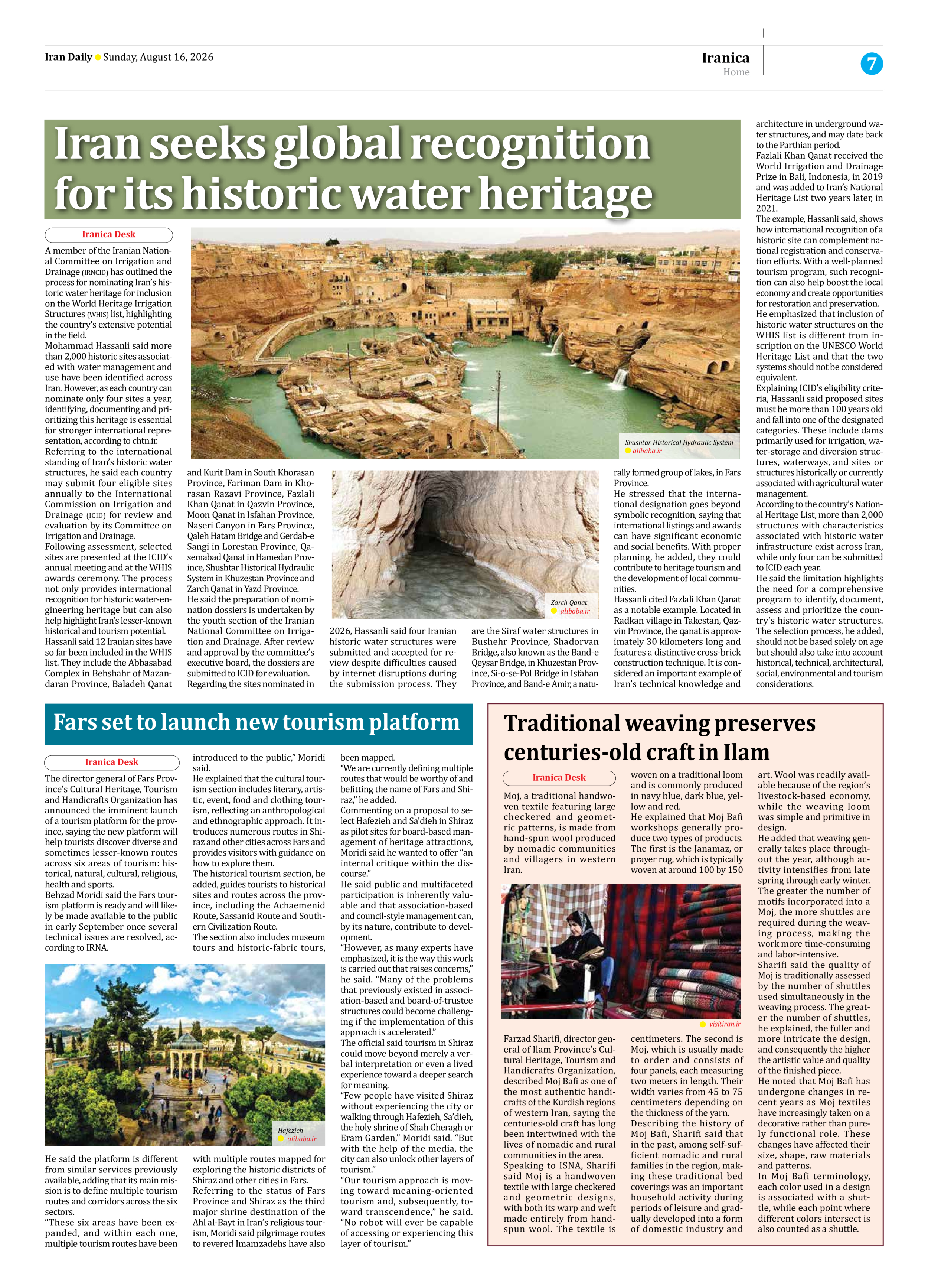
Hassanli said 12 Iranian sites have so far been included in the WHIS list. They include the Abbasabad Complex in Behshahr of Mazandaran Province, Baladeh Qanat and Kurit Dam in South Khorasan Province, Fariman Dam in Khorasan Razavi Province, Fazlali Khan Qanat in Qazvin Province, Moon Qanat in Isfahan Province, Naseri Canyon in Fars Province, Qaleh Hatam Bridge and Gerdab-e Sangi in Lorestan Province, Qasemabad Qanat in Hamedan Province, Shushtar Historical Hydraulic System in Khuzestan Province and Zarch Qanat in Yazd Province.
He said the preparation of nomination dossiers is undertaken by the youth section of the Iranian National Committee on Irrigation and Drainage. After review and approval by the committee’s executive board, the dossiers are submitted to ICID for evaluation.
Regarding the sites nominated in 2026, Hassanli said four Iranian historic water structures were submitted and accepted for review despite difficulties caused by internet disruptions during the submission process. They are the Siraf water structures in Bushehr Province, Shadorvan Bridge, also known as the Band-e Qeysar Bridge, in Khuzestan Province, Si-o-se-Pol Bridge in Isfahan Province, and Band-e Amir, a naturally formed group of lakes, in Fars Province.
He stressed that the international designation goes beyond symbolic recognition, saying that international listings and awards can have significant economic and social benefits. With proper planning, he added, they could contribute to heritage tourism and the development of local communities.
Hassanli cited Fazlali Khan Qanat as a notable example. Located in Radkan village in Takestan, Qazvin Province, the qanat is approximately 30 kilometers long and features a distinctive cross-brick construction technique. It is considered an important example of Iran’s technical knowledge and architecture in underground water structures, and may date back to the Parthian period.
Fazlali Khan Qanat received the World Irrigation and Drainage Prize in Bali, Indonesia, in 2019 and was added to Iran’s National Heritage List two years later, in 2021.
The example, Hassanli said, shows how international recognition of a historic site can complement national registration and conservation efforts. With a well-planned tourism program, such recognition can also help boost the local economy and create opportunities for restoration and preservation.
He emphasized that inclusion of historic water structures on the WHIS list is different from inscription on the UNESCO World Heritage List and that the two systems should not be considered equivalent.
Explaining ICID’s eligibility criteria, Hassanli said proposed sites must be more than 100 years old and fall into one of the designated categories. These include dams primarily used for irrigation, water-storage and diversion structures, waterways, and sites or structures historically or currently associated with agricultural water management.
According to the country’s National Heritage List, more than 2,000 structures with characteristics associated with historic water infrastructure exist across Iran, while only four can be submitted to ICID each year.
He said the limitation highlights the need for a comprehensive program to identify, document, assess and prioritize the country’s historic water structures. The selection process, he added, should not be based solely on age but should also take into account historical, technical, architectural, social, environmental and tourism considerations.