





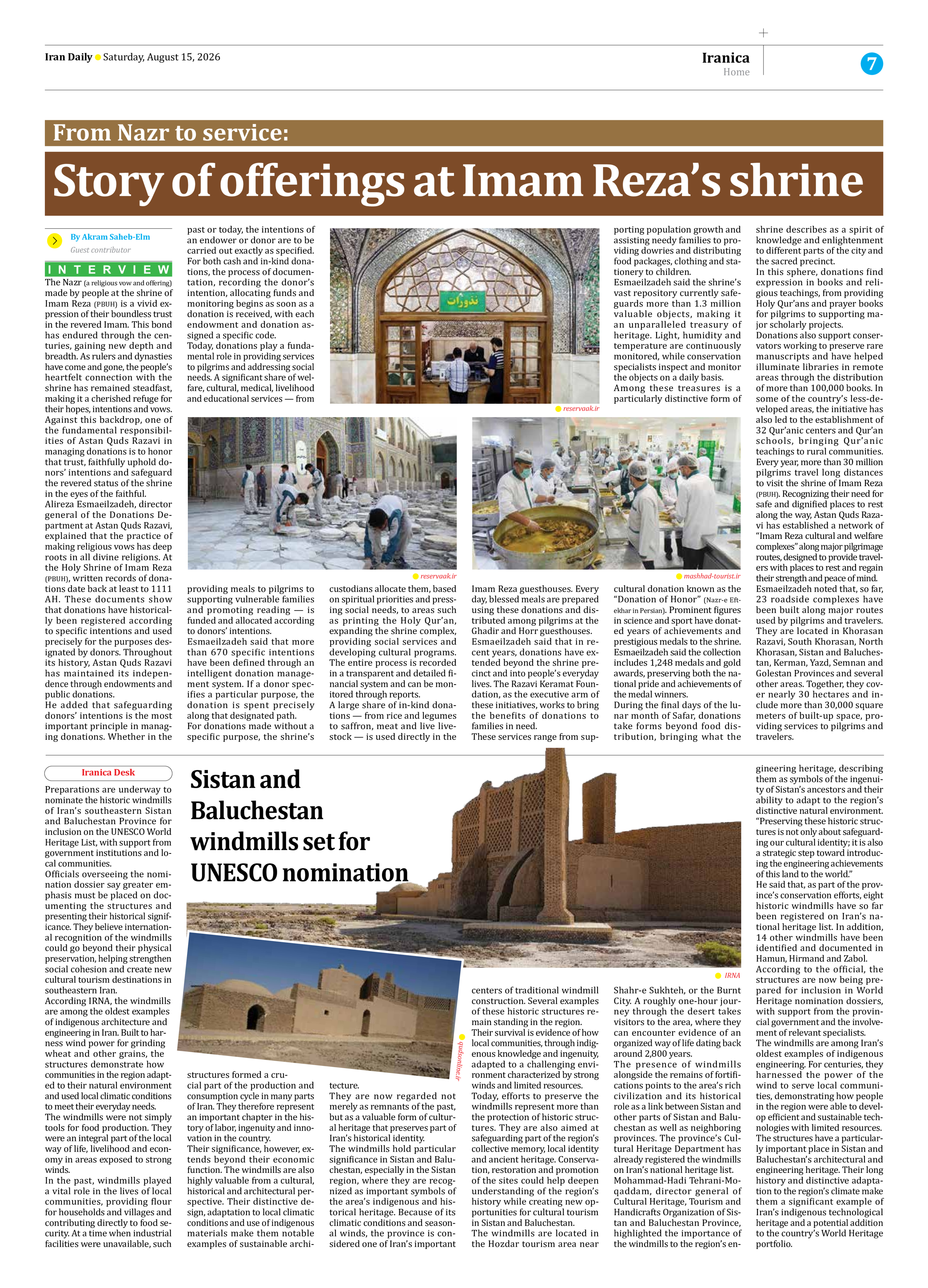


Sistan and Baluchestan windmills set for UNESCO nomination
Preparations are underway to nominate the historic windmills of Iran’s southeastern Sistan and Baluchestan Province for inclusion on the UNESCO World Heritage List, with support from government institutions and local communities.
Officials overseeing the nomination dossier say greater emphasis must be placed on documenting the structures and presenting their historical significance. They believe international recognition of the windmills could go beyond their physical preservation, helping strengthen social cohesion and create new cultural tourism destinations in southeastern Iran.
According IRNA, the windmills are among the oldest examples of indigenous architecture and engineering in Iran. Built to harness wind power for grinding wheat and other grains, the structures demonstrate how communities in the region adapted to their natural environment and used local climatic conditions to meet their everyday needs.
The windmills were not simply tools for food production. They were an integral part of the local way of life, livelihood and economy in areas exposed to strong winds.
In the past, windmills played a vital role in the lives of local communities, providing flour for households and villages and contributing directly to food security. At a time when industrial facilities were unavailable, such structures formed a crucial part of the production and consumption cycle in many parts of Iran. They therefore represent an important chapter in the history of labor, ingenuity and innovation in the country.
Their significance, however, extends beyond their economic function. The windmills are also highly valuable from a cultural, historical and architectural perspective. Their distinctive design, adaptation to local climatic conditions and use of indigenous materials make them notable examples of sustainable architecture.
They are now regarded not merely as remnants of the past, but as a valuable form of cultural heritage that preserves part of Iran’s historical identity.
The windmills hold particular significance in Sistan and Baluchestan, especially in the Sistan region, where they are recognized as important symbols of the area’s indigenous and historical heritage. Because of its climatic conditions and seasonal winds, the province is considered one of Iran’s important centers of traditional windmill construction. Several examples of these historic structures remain standing in the region.
Their survival is evidence of how local communities, through indigenous knowledge and ingenuity, adapted to a challenging environment characterized by strong winds and limited resources.
Today, efforts to preserve the windmills represent more than the protection of historic structures. They are also aimed at safeguarding part of the region’s collective memory, local identity and ancient heritage. Conservation, restoration and promotion of the sites could help deepen understanding of the region’s history while creating new opportunities for cultural tourism in Sistan and Baluchestan.
The windmills are located in the Hozdar tourism area near Shahr-e Sukhteh, or the Burnt City. A roughly one-hour journey through the desert takes visitors to the area, where they can encounter evidence of an organized way of life dating back around 2,800 years.
The presence of windmills alongside the remains of fortifications points to the area’s rich civilization and its historical role as a link between Sistan and other parts of Sistan and Baluchestan as well as neighboring provinces. The province’s Cultural Heritage Department has already registered the windmills on Iran’s national heritage list.
Mohammad-Hadi Tehrani-Moqaddam, director general of Cultural Heritage, Tourism and Handicrafts Organization of Sistan and Baluchestan Province, highlighted the importance of the windmills to the region’s engineering heritage, describing them as symbols of the ingenuity of Sistan’s ancestors and their ability to adapt to the region’s distinctive natural environment.
“Preserving these historic structures is not only about safeguarding our cultural identity; it is also a strategic step toward introducing the engineering achievements of this land to the world.”
He said that, as part of the province’s conservation efforts, eight historic windmills have so far been registered on Iran’s national heritage list. In addition, 14 other windmills have been identified and documented in Hamun, Hirmand and Zabol.
According to the official, the structures are now being prepared for inclusion in World Heritage nomination dossiers, with support from the provincial government and the involvement of relevant specialists.
The windmills are among Iran’s oldest examples of indigenous engineering. For centuries, they harnessed the power of the wind to serve local communities, demonstrating how people in the region were able to develop efficient and sustainable technologies with limited resources.
The structures have a particularly important place in Sistan and Baluchestan’s architectural and engineering heritage. Their long history and distinctive adaptation to the region’s climate make them a significant example of Iran’s indigenous technological heritage and a potential addition to the country’s World Heritage portfolio.