







From Nazr to service:
Story of offerings at Imam Reza’s shrine
By Akram Saheb-Elm
Guest contributor
The Nazr (a religious vow and offering) made by people at the shrine of Imam Reza (PBUH) is a vivid expression of their boundless trust in the revered Imam. This bond has endured through the centuries, gaining new depth and breadth. As rulers and dynasties have come and gone, the people’s heartfelt connection with the shrine has remained steadfast, making it a cherished refuge for their hopes, intentions and vows.
Against this backdrop, one of the fundamental responsibilities of Astan Quds Razavi in managing donations is to honor that trust, faithfully uphold donors’ intentions and safeguard the revered status of the shrine in the eyes of the faithful.
Alireza Esmaeilzadeh, director general of the Donations Department at Astan Quds Razavi, explained that the practice of making religious vows has deep roots in all divine religions. At the Holy Shrine of Imam Reza (PBUH), written records of donations date back at least to 1111 AH. These documents show that donations have historically been registered according to specific intentions and used precisely for the purposes designated by donors. Throughout its history, Astan Quds Razavi has maintained its independence through endowments and public donations.
He added that safeguarding donors’ intentions is the most important principle in managing donations. Whether in the past or today, the intentions of an endower or donor are to be carried out exactly as specified. For both cash and in-kind donations, the process of documentation, recording the donor’s intention, allocating funds and monitoring begins as soon as a donation is received, with each endowment and donation assigned a specific code.
Today, donations play a fundamental role in providing services to pilgrims and addressing social needs. A significant share of welfare, cultural, medical, livelihood and educational services — from providing meals to pilgrims to supporting vulnerable families and promoting reading — is funded and allocated according to donors’ intentions.
Esmaeilzadeh said that more than 670 specific intentions have been defined through an intelligent donation management system. If a donor specifies a particular purpose, the donation is spent precisely along that designated path.
For donations made without a specific purpose, the shrine’s custodians allocate them, based on spiritual priorities and pressing social needs, to areas such as printing the Holy Qur’an, expanding the shrine complex, providing social services and developing cultural programs. The entire process is recorded in a transparent and detailed financial system and can be monitored through reports.
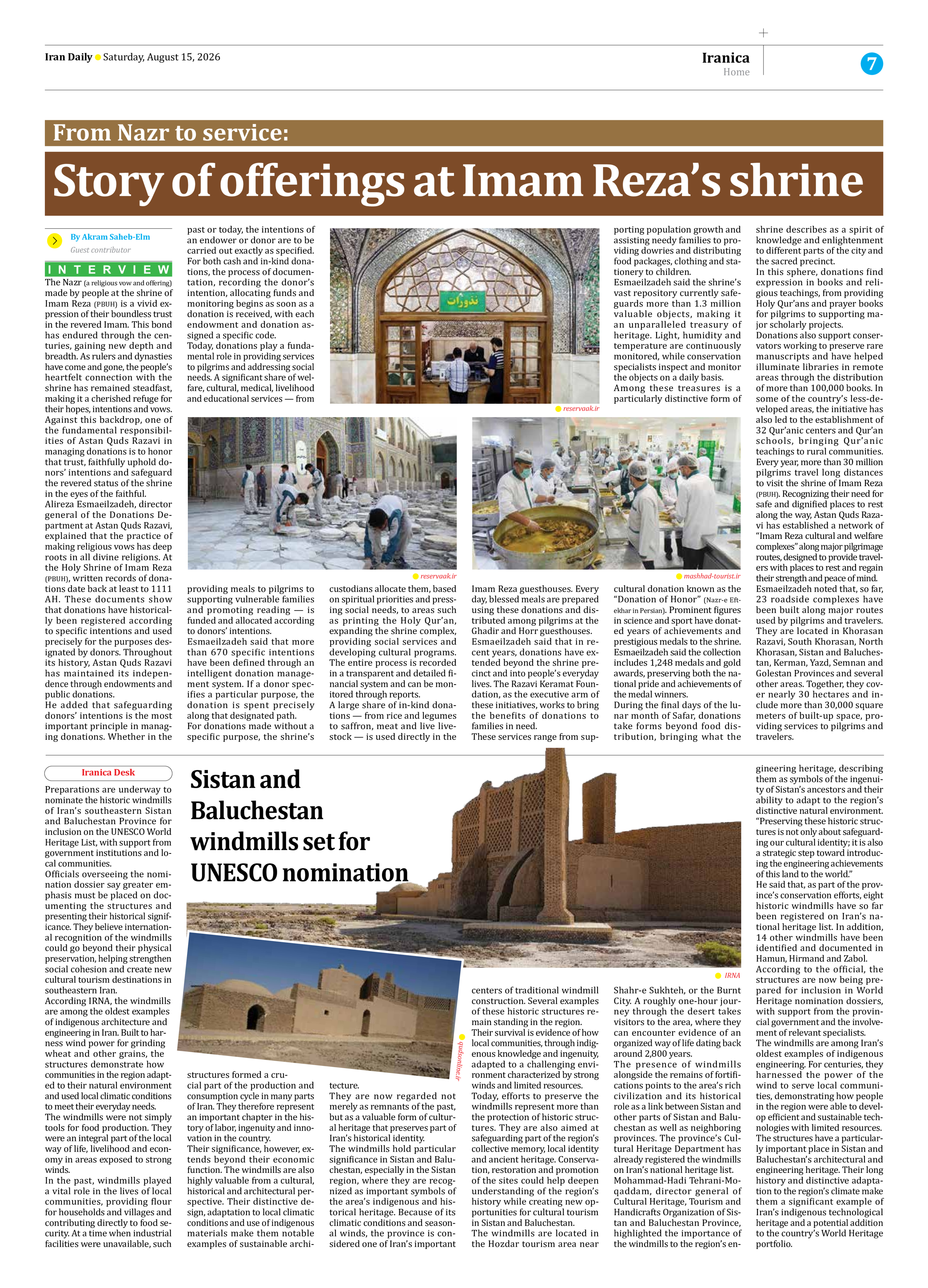
A large share of in-kind donations — from rice and legumes to saffron, meat and live livestock — is used directly in the Imam Reza guesthouses. Every day, blessed meals are prepared using these donations and distributed among pilgrims at the Ghadir and Horr guesthouses.
Esmaeilzadeh said that in recent years, donations have extended beyond the shrine precinct and into people’s everyday lives. The Razavi Keramat Foundation, as the executive arm of these initiatives, works to bring the benefits of donations to families in need.
These services range from supporting population growth and assisting needy families to providing dowries and distributing food packages, clothing and stationery to children.
Esmaeilzadeh said the shrine’s vast repository currently safeguards more than 1.3 million valuable objects, making it an unparalleled treasury of heritage. Light, humidity and temperature are continuously monitored, while conservation specialists inspect and monitor the objects on a daily basis.
Among these treasures is a particularly distinctive form of cultural donation known as the “Donation of Honor” (Nazr-e Eftekhar in Persian). Prominent figures in science and sport have donated years of achievements and prestigious medals to the shrine. Esmaeilzadeh said the collection includes 1,248 medals and gold awards, preserving both the national pride and achievements of the medal winners.
During the final days of the lunar month of Safar, donations take forms beyond food distribution, bringing what the shrine describes as a spirit of knowledge and enlightenment to different parts of the city and the sacred precinct.
In this sphere, donations find expression in books and religious teachings, from providing Holy Qur’ans and prayer books for pilgrims to supporting major scholarly projects.
Donations also support conservators working to preserve rare manuscripts and have helped illuminate libraries in remote areas through the distribution of more than 100,000 books. In some of the country’s less-developed areas, the initiative has also led to the establishment of 32 Qur’anic centers and Qur’an schools, bringing Qur’anic teachings to rural communities.
Every year, more than 30 million pilgrims travel long distances to visit the shrine of Imam Reza (PBUH). Recognizing their need for safe and dignified places to rest along the way, Astan Quds Razavi has established a network of “Imam Reza cultural and welfare complexes” along major pilgrimage routes, designed to provide travelers with places to rest and regain their strength and peace of mind.
Esmaeilzadeh noted that, so far, 23 roadside complexes have been built along major routes used by pilgrims and travelers. They are located in Khorasan Razavi, South Khorasan, North Khorasan, Sistan and Baluchestan, Kerman, Yazd, Semnan and Golestan Provinces and several other areas. Together, they cover nearly 30 hectares and include more than 30,000 square meters of built-up space, providing services to pilgrims and travelers.