







Bazargan customs sees imports surge 250%, exports up 40%
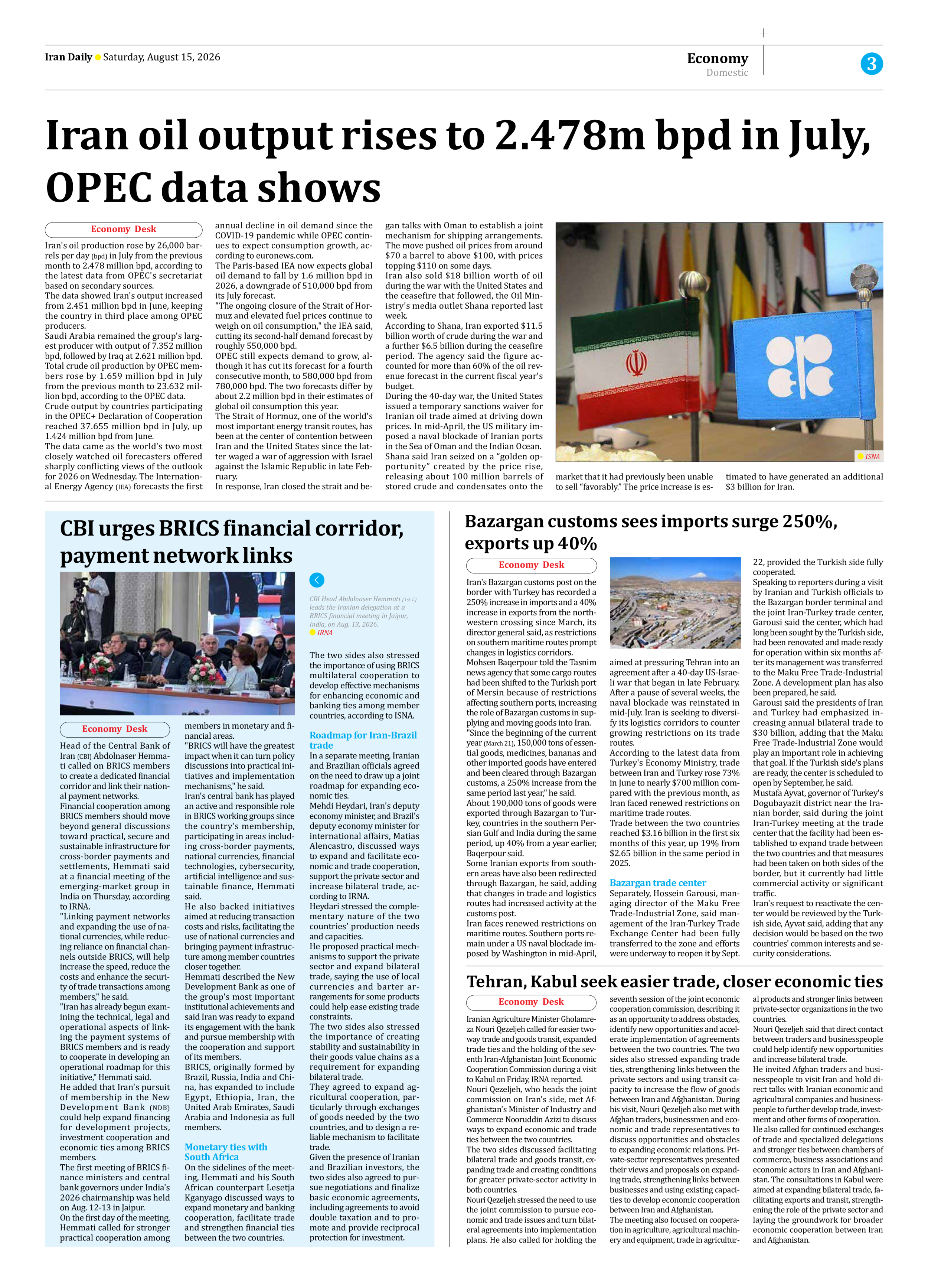
Iran's Bazargan customs post on the border with Turkey has recorded a 250% increase in imports and a 40% increase in exports from the northwestern crossing since March, its director general said, as restrictions on southern maritime routes prompt changes in logistics corridors.
Mohsen Baqerpour told the Tasnim news agency that some cargo routes had been shifted to the Turkish port of Mersin because of restrictions affecting southern ports, increasing the role of Bazargan customs in supplying and moving goods into Iran.
"Since the beginning of the current year (March 21), 150,000 tons of essential goods, medicines, bananas and other imported goods have entered and been cleared through Bazargan customs, a 250% increase from the same period last year," he said.
About 190,000 tons of goods were exported through Bazargan to Turkey, countries in the southern Persian Gulf and India during the same period, up 40% from a year earlier, Baqerpour said.
Some Iranian exports from southern areas have also been redirected through Bazargan, he said, adding that changes in trade and logistics routes had increased activity at the customs post.
Iran faces renewed restrictions on maritime routes. Southern ports remain under a US naval blockade imposed by Washington in mid-April, aimed at pressuring Tehran into an agreement after a 40-day US-Israeli war that began in late February. After a pause of several weeks, the naval blockade was reinstated in mid-July. Iran is seeking to diversify its logistics corridors to counter growing restrictions on its trade routes.
According to the latest data from Turkey's Economy Ministry, trade between Iran and Turkey rose 73% in June to nearly $700 million compared with the previous month, as Iran faced renewed restrictions on maritime trade routes.
Trade between the two countries reached $3.16 billion in the first six months of this year, up 19% from $2.65 billion in the same period in 2025.
Bazargan trade center
Separately, Hossein Garousi, managing director of the Maku Free Trade-Industrial Zone, said management of the Iran-Turkey Trade Exchange Center had been fully transferred to the zone and efforts were underway to reopen it by Sept. 22, provided the Turkish side fully cooperated.
Speaking to reporters during a visit by Iranian and Turkish officials to the Bazargan border terminal and the joint Iran-Turkey trade center, Garousi said the center, which had long been sought by the Turkish side, had been renovated and made ready for operation within six months after its management was transferred to the Maku Free Trade-Industrial Zone. A development plan has also been prepared, he said.
Garousi said the presidents of Iran and Turkey had emphasized increasing annual bilateral trade to $30 billion, adding that the Maku Free Trade-Industrial Zone would play an important role in achieving that goal. If the Turkish side's plans are ready, the center is scheduled to open by September, he said.
Mustafa Ayvat, governor of Turkey's Dogubayazit district near the Iranian border, said during the joint Iran-Turkey meeting at the trade center that the facility had been established to expand trade between the two countries and that measures had been taken on both sides of the border, but it currently had little commercial activity or significant traffic.
Iran's request to reactivate the center would be reviewed by the Turkish side, Ayvat said, adding that any decision would be based on the two countries' common interests and security considerations.