







CBI urges BRICS financial corridor, payment network links
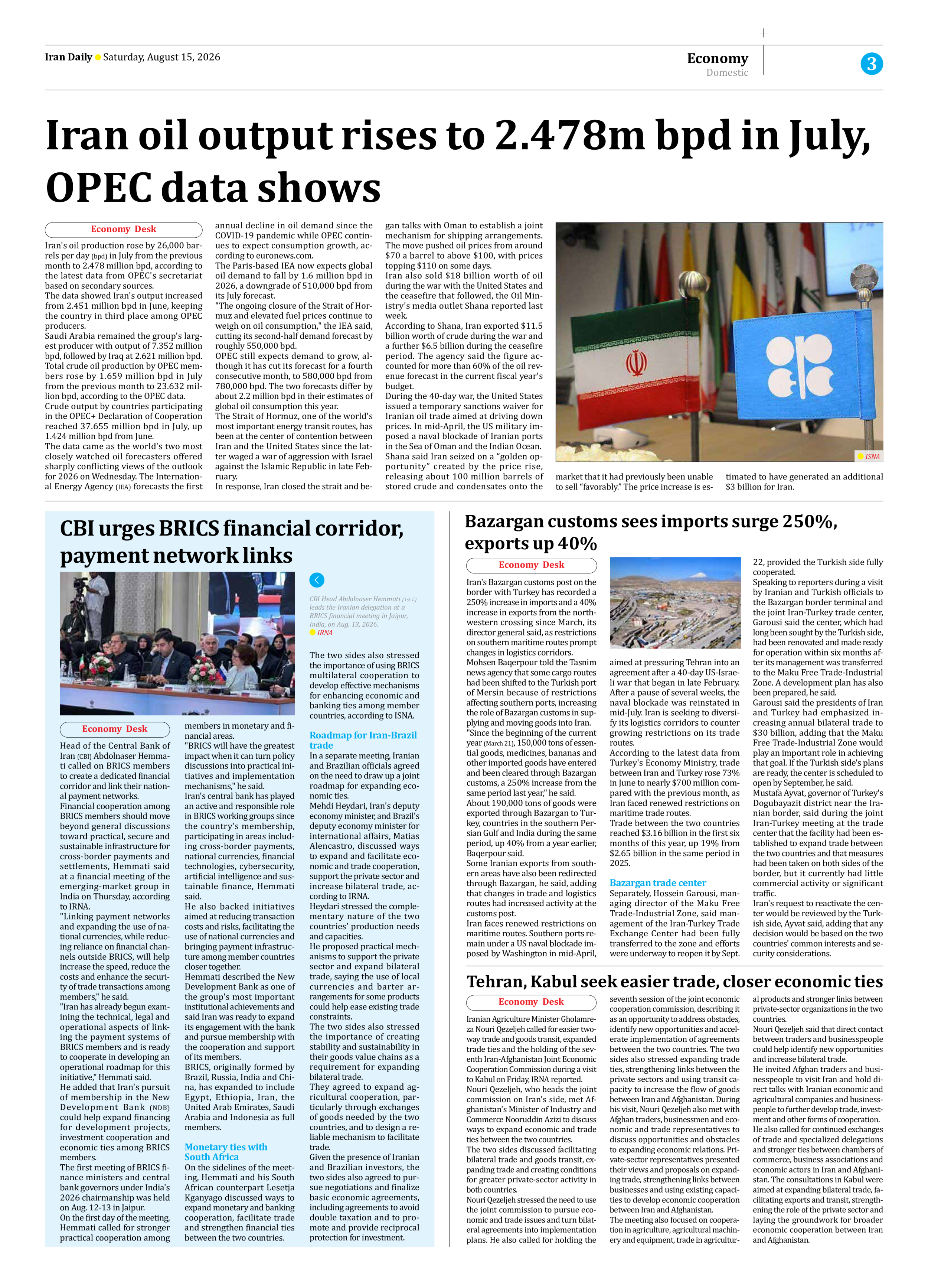
Head of the Central Bank of Iran (CBI) Abdolnaser Hemmati called on BRICS members to create a dedicated financial corridor and link their national payment networks.
Financial cooperation among BRICS members should move beyond general discussions toward practical, secure and sustainable infrastructure for cross-border payments and settlements, Hemmati said at a financial meeting of the emerging-market group in India on Thursday, according to IRNA.
"Linking payment networks and expanding the use of national currencies, while reducing reliance on financial channels outside BRICS, will help increase the speed, reduce the costs and enhance the security of trade transactions among members," he said.
"Iran has already begun examining the technical, legal and operational aspects of linking the payment systems of BRICS members and is ready to cooperate in developing an operational roadmap for this initiative," Hemmati said.
He added that Iran's pursuit of membership in the New Development Bank (NDB) could help expand financing for development projects, investment cooperation and economic ties among BRICS members.
The first meeting of BRICS finance ministers and central bank governors under India's 2026 chairmanship was held on Aug. 12-13 in Jaipur.
On the first day of the meeting, Hemmati called for stronger practical cooperation among members in monetary and financial areas.
"BRICS will have the greatest impact when it can turn policy discussions into practical initiatives and implementation mechanisms," he said.
Iran's central bank has played an active and responsible role in BRICS working groups since the country's membership, participating in areas including cross-border payments, national currencies, financial technologies, cybersecurity, artificial intelligence and sustainable finance, Hemmati said.
He also backed initiatives aimed at reducing transaction costs and risks, facilitating the use of national currencies and bringing payment infrastructure among member countries closer together.
Hemmati described the New Development Bank as one of the group's most important institutional achievements and said Iran was ready to expand its engagement with the bank and pursue membership with the cooperation and support of its members.
BRICS, originally formed by Brazil, Russia, India and China, has expanded to include Egypt, Ethiopia, Iran, the United Arab Emirates, Saudi Arabia and Indonesia as full members.
Monetary ties with South Africa
On the sidelines of the meeting, Hemmati and his South African counterpart Lesetja Kganyago discussed ways to expand monetary and banking cooperation, facilitate trade and strengthen financial ties between the two countries.
The two sides also stressed the importance of using BRICS multilateral cooperation to develop effective mechanisms for enhancing economic and banking ties among member countries, according to ISNA.
Roadmap for Iran-Brazil trade
In a separate meeting, Iranian and Brazilian officials agreed on the need to draw up a joint roadmap for expanding economic ties.
Mehdi Heydari, Iran's deputy economy minister, and Brazil's deputy economy minister for international affairs, Matias Alencastro, discussed ways to expand and facilitate economic and trade cooperation, support the private sector and increase bilateral trade, according to IRNA.
Heydari stressed the complementary nature of the two countries' production needs and capacities.
He proposed practical mechanisms to support the private sector and expand bilateral trade, saying the use of local currencies and barter arrangements for some products could help ease existing trade constraints.
The two sides also stressed the importance of creating stability and sustainability in their goods value chains as a requirement for expanding bilateral trade.
They agreed to expand agricultural cooperation, particularly through exchanges of goods needed by the two countries, and to design a reliable mechanism to facilitate trade.
Given the presence of Iranian and Brazilian investors, the two sides also agreed to pursue negotiations and finalize basic economic agreements, including agreements to avoid double taxation and to promote and provide reciprocal protection for investment.