





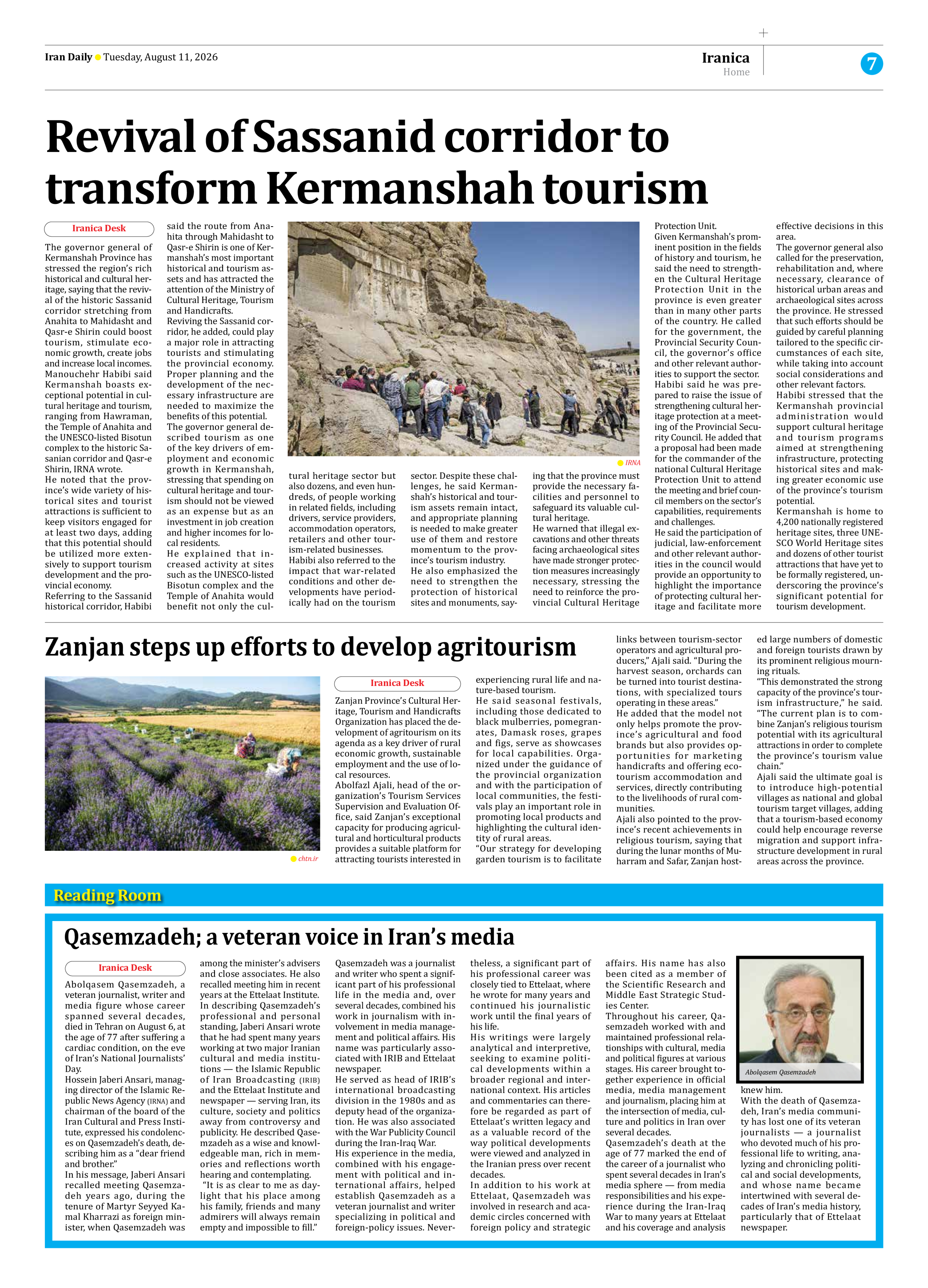


Qasemzadeh; a veteran voice in Iran’s media
Abolqasem Qasemzadeh, a veteran journalist, writer and media figure whose career spanned several decades, died in Tehran on August 6, at the age of 77 after suffering a cardiac condition, on the eve of Iran’s National Journalists’ Day.
Hossein Jaberi Ansari, managing director of the Islamic Republic News Agency (IRNA) and chairman of the board of the Iran Cultural and Press Institute, expressed his condolences on Qasemzadeh’s death, describing him as a “dear friend and brother.”
In his message, Jaberi Ansari recalled meeting Qasemzadeh years ago, during the tenure of Martyr Seyyed Kamal Kharrazi as foreign minister, when Qasemzadeh was among the minister’s advisers and close associates. He also recalled meeting him in recent years at the Ettelaat Institute.
In describing Qasemzadeh’s professional and personal standing, Jaberi Ansari wrote that he had spent many years working at two major Iranian cultural and media institutions — the Islamic Republic of Iran Broadcasting (IRIB) and the Ettelaat Institute and newspaper — serving Iran, its culture, society and politics away from controversy and publicity. He described Qasemzadeh as a wise and knowledgeable man, rich in memories and reflections worth hearing and contemplating.
“It is as clear to me as daylight that his place among his family, friends and many admirers will always remain empty and impossible to fill.”
Qasemzadeh was a journalist and writer who spent a significant part of his professional life in the media and, over several decades, combined his work in journalism with involvement in media management and political affairs. His name was particularly associated with IRIB and Ettelaat newspaper.
He served as head of IRIB’s international broadcasting division in the 1980s and as deputy head of the organization. He was also associated with the War Publicity Council during the Iran-Iraq War.
His experience in the media, combined with his engagement with political and international affairs, helped establish Qasemzadeh as a veteran journalist and writer specializing in political and foreign-policy issues. Nevertheless, a significant part of his professional career was closely tied to Ettelaat, where he wrote for many years and continued his journalistic work until the final years of his life.
His writings were largely analytical and interpretive, seeking to examine political developments within a broader regional and international context. His articles and commentaries can therefore be regarded as part of Ettelaat’s written legacy and as a valuable record of the way political developments were viewed and analyzed in the Iranian press over recent decades.
In addition to his work at Ettelaat, Qasemzadeh was involved in research and academic circles concerned with foreign policy and strategic affairs. His name has also been cited as a member of the Scientific Research and Middle East Strategic Studies Center.
Throughout his career, Qasemzadeh worked with and maintained professional relationships with cultural, media and political figures at various stages. His career brought together experience in official media, media management and journalism, placing him at the intersection of media, culture and politics in Iran over several decades.
Qasemzadeh’s death at the age of 77 marked the end of the career of a journalist who spent several decades in Iran’s media sphere — from media responsibilities and his experience during the Iran-Iraq War to many years at Ettelaat and his coverage and analysis of political and international affairs.
For readers of Ettelaat, Qasemzadeh was a familiar figure whose name had become associated with the newspaper over many years. For his friends and colleagues, he was a knowledgeable and eloquent man whose gatherings and conversations would remain in the memories of those who knew him.
With the death of Qasemzadeh, Iran’s media community has lost one of its veteran journalists — a journalist who devoted much of his professional life to writing, analyzing and chronicling political and social developments, and whose name became intertwined with several decades of Iran’s media history, particularly that of Ettelaat newspaper.