







Revival of Sassanid corridor to transform Kermanshah tourism
The governor general of Kermanshah Province has stressed the region’s rich historical and cultural heritage, saying that the revival of the historic Sassanid corridor stretching from Anahita to Mahidasht and Qasr-e Shirin could boost tourism, stimulate economic growth, create jobs and increase local incomes.
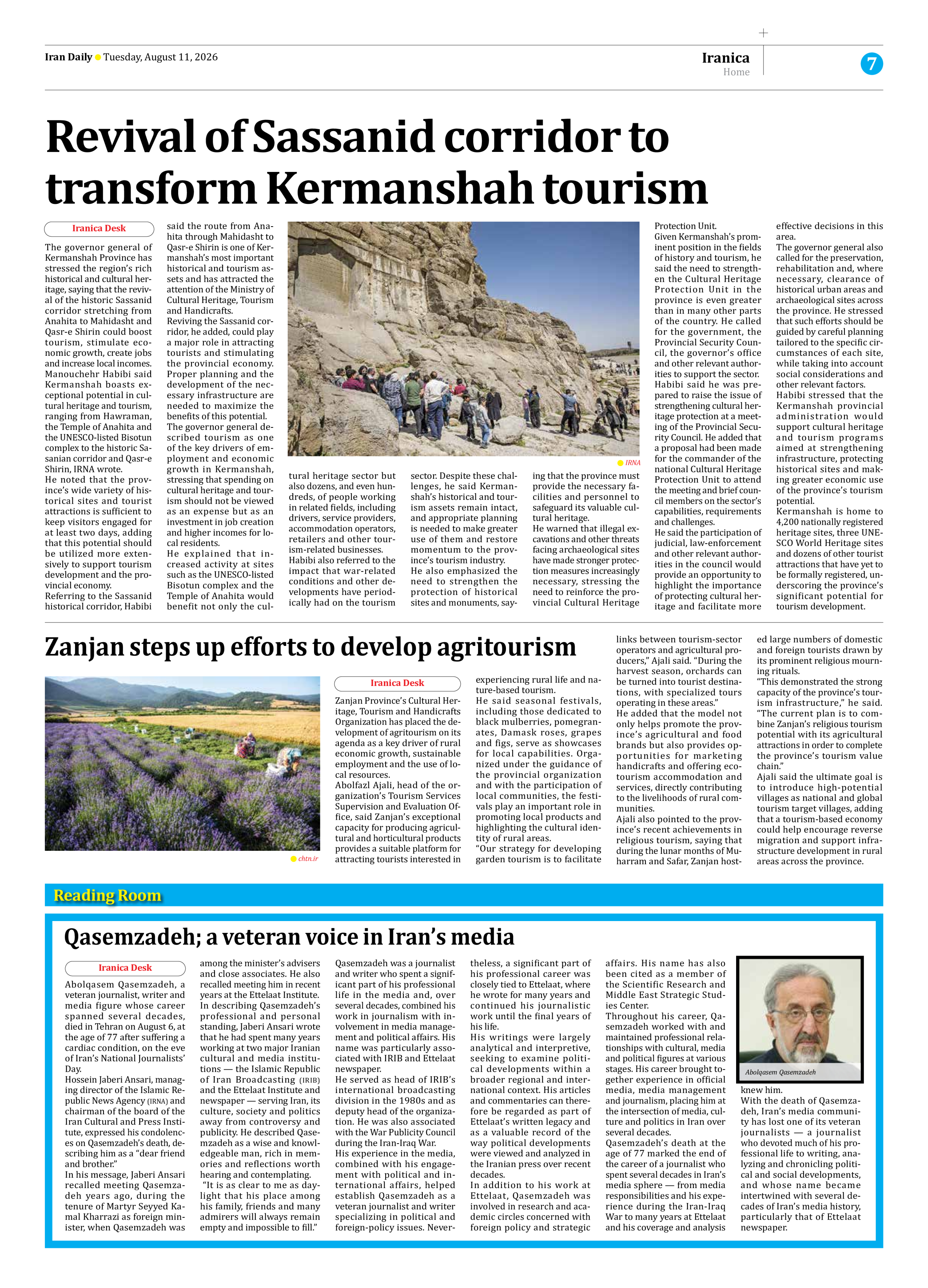
Manouchehr Habibi said Kermanshah boasts exceptional potential in cultural heritage and tourism, ranging from Hawraman, the Temple of Anahita and the UNESCO-listed Bisotun complex to the historic Sasanian corridor and Qasr-e Shirin, IRNA wrote.
He noted that the province’s wide variety of historical sites and tourist attractions is sufficient to keep visitors engaged for at least two days, adding that this potential should be utilized more extensively to support tourism development and the provincial economy.
Referring to the Sassanid historical corridor, Habibi said the route from Anahita through Mahidasht to Qasr-e Shirin is one of Kermanshah’s most important historical and tourism assets and has attracted the attention of the Ministry of Cultural Heritage, Tourism and Handicrafts.
Reviving the Sassanid corridor, he added, could play a major role in attracting tourists and stimulating the provincial economy. Proper planning and the development of the necessary infrastructure are needed to maximize the benefits of this potential.
The governor general described tourism as one of the key drivers of employment and economic growth in Kermanshah, stressing that spending on cultural heritage and tourism should not be viewed as an expense but as an investment in job creation and higher incomes for local residents.
He explained that increased activity at sites such as the UNESCO-listed Bisotun complex and the Temple of Anahita would benefit not only the cultural heritage sector but also dozens, and even hundreds, of people working in related fields, including drivers, service providers, accommodation operators, retailers and other tourism-related businesses.
Habibi also referred to the impact that war-related conditions and other developments have periodically had on the tourism sector. Despite these challenges, he said Kermanshah’s historical and tourism assets remain intact, and appropriate planning is needed to make greater use of them and restore momentum to the province’s tourism industry.
He also emphasized the need to strengthen the protection of historical sites and monuments, saying that the province must provide the necessary facilities and personnel to safeguard its valuable cultural heritage.
He warned that illegal excavations and other threats facing archaeological sites have made stronger protection measures increasingly necessary, stressing the need to reinforce the provincial Cultural Heritage Protection Unit.
Given Kermanshah’s prominent position in the fields of history and tourism, he said the need to strengthen the Cultural Heritage Protection Unit in the province is even greater than in many other parts of the country. He called for the government, the Provincial Security Council, the governor’s office and other relevant authorities to support the sector.
Habibi said he was prepared to raise the issue of strengthening cultural heritage protection at a meeting of the Provincial Security Council. He added that a proposal had been made for the commander of the national Cultural Heritage Protection Unit to attend the meeting and brief council members on the sector’s capabilities, requirements and challenges.
He said the participation of judicial, law-enforcement and other relevant authorities in the council would provide an opportunity to highlight the importance of protecting cultural heritage and facilitate more effective decisions in this area.
The governor general also called for the preservation, rehabilitation and, where necessary, clearance of historical urban areas and archaeological sites across the province. He stressed that such efforts should be guided by careful planning tailored to the specific circumstances of each site, while taking into account social considerations and other relevant factors.
Habibi stressed that the Kermanshah provincial administration would support cultural heritage and tourism programs aimed at strengthening infrastructure, protecting historical sites and making greater economic use of the province’s tourism potential.
Kermanshah is home to 4,200 nationally registered heritage sites, three UNESCO World Heritage sites and dozens of other tourist attractions that have yet to be formally registered, underscoring the province’s significant potential for tourism development.