







Taleqan rural museum set to preserve region’s heritage
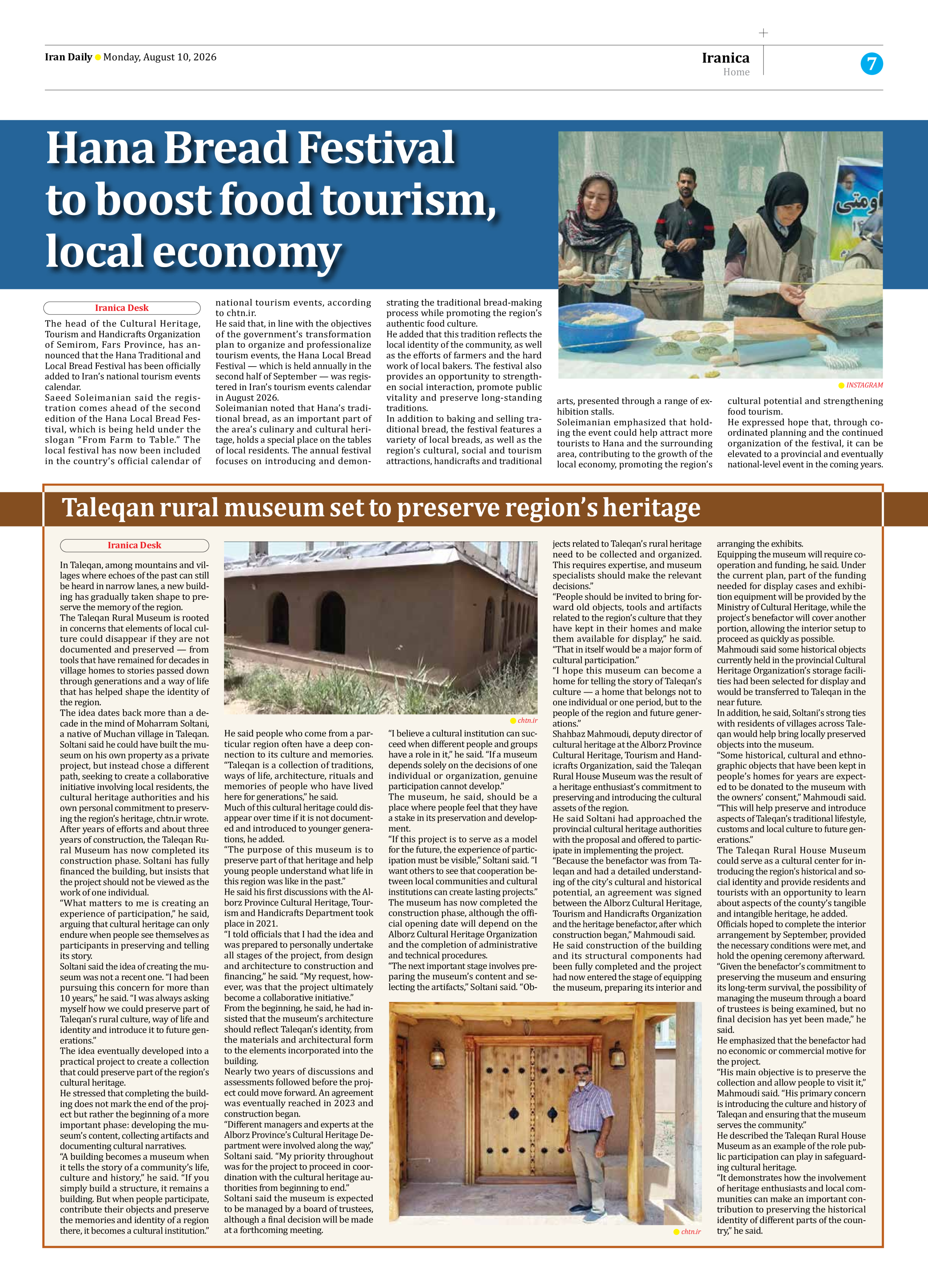
In Taleqan, among mountains and villages where echoes of the past can still be heard in narrow lanes, a new building has gradually taken shape to preserve the memory of the region.
The Taleqan Rural Museum is rooted in concerns that elements of local culture could disappear if they are not documented and preserved — from tools that have remained for decades in village homes to stories passed down through generations and a way of life that has helped shape the identity of the region.
The idea dates back more than a decade in the mind of Moharram Soltani, a native of Muchan village in Taleqan. Soltani said he could have built the museum on his own property as a private project, but instead chose a different path, seeking to create a collaborative initiative involving local residents, the cultural heritage authorities and his own personal commitment to preserving the region’s heritage, chtn.ir wrote.
After years of efforts and about three years of construction, the Taleqan Rural Museum has now completed its construction phase. Soltani has fully financed the building, but insists that the project should not be viewed as the work of one individual.
“What matters to me is creating an experience of participation,” he said, arguing that cultural heritage can only endure when people see themselves as participants in preserving and telling its story.
Soltani said the idea of creating the museum was not a recent one. “I had been pursuing this concern for more than 10 years,” he said. “I was always asking myself how we could preserve part of Taleqan’s rural culture, way of life and identity and introduce it to future generations.”
The idea eventually developed into a practical project to create a collection that could preserve part of the region’s cultural heritage.
He stressed that completing the building does not mark the end of the project but rather the beginning of a more important phase: developing the museum’s content, collecting artifacts and documenting cultural narratives.
“A building becomes a museum when it tells the story of a community’s life, culture and history,” he said. “If you simply build a structure, it remains a building. But when people participate, contribute their objects and preserve the memories and identity of a region there, it becomes a cultural institution.”
He said people who come from a particular region often have a deep connection to its culture and memories. “Taleqan is a collection of traditions, ways of life, architecture, rituals and memories of people who have lived here for generations,” he said.
Much of this cultural heritage could disappear over time if it is not documented and introduced to younger generations, he added.
“The purpose of this museum is to preserve part of that heritage and help young people understand what life in this region was like in the past.”
He said his first discussions with the Alborz Province Cultural Heritage, Tourism and Handicrafts Department took place in 2021.
“I told officials that I had the idea and was prepared to personally undertake all stages of the project, from design and architecture to construction and financing,” he said. “My request, however, was that the project ultimately become a collaborative initiative.”
From the beginning, he said, he had insisted that the museum’s architecture should reflect Taleqan’s identity, from the materials and architectural form to the elements incorporated into the building.
Nearly two years of discussions and assessments followed before the project could move forward. An agreement was eventually reached in 2023 and construction began.
“Different managers and experts at the Alborz Province’s Cultural Heritage Department were involved along the way,” Soltani said. “My priority throughout was for the project to proceed in coordination with the cultural heritage authorities from beginning to end.”
Soltani said the museum is expected to be managed by a board of trustees, although a final decision will be made at a forthcoming meeting.
“I believe a cultural institution can succeed when different people and groups have a role in it,” he said. “If a museum depends solely on the decisions of one individual or organization, genuine participation cannot develop.”
The museum, he said, should be a place where people feel that they have a stake in its preservation and development.
“If this project is to serve as a model for the future, the experience of participation must be visible,” Soltani said. “I want others to see that cooperation between local communities and cultural institutions can create lasting projects.”
The museum has now completed the construction phase, although the official opening date will depend on the Alborz Cultural Heritage Organization and the completion of administrative and technical procedures.
“The next important stage involves preparing the museum’s content and selecting the artifacts,” Soltani said. “Objects related to Taleqan’s rural heritage need to be collected and organized. This requires expertise, and museum specialists should make the relevant decisions.”
“People should be invited to bring forward old objects, tools and artifacts related to the region’s culture that they have kept in their homes and make them available for display,” he said. “That in itself would be a major form of cultural participation.”
“I hope this museum can become a home for telling the story of Taleqan’s culture — a home that belongs not to one individual or one period, but to the people of the region and future generations.”
Shahbaz Mahmoudi, deputy director of cultural heritage at the Alborz Province Cultural Heritage, Tourism and Handicrafts Organization, said the Taleqan Rural House Museum was the result of a heritage enthusiast’s commitment to preserving and introducing the cultural assets of the region.
He said Soltani had approached the provincial cultural heritage authorities with the proposal and offered to participate in implementing the project.
“Because the benefactor was from Taleqan and had a detailed understanding of the city’s cultural and historical potential, an agreement was signed between the Alborz Cultural Heritage, Tourism and Handicrafts Organization and the heritage benefactor, after which construction began,” Mahmoudi said.
He said construction of the building and its structural components had been fully completed and the project had now entered the stage of equipping the museum, preparing its interior and arranging the exhibits.
Equipping the museum will require cooperation and funding, he said. Under the current plan, part of the funding needed for display cases and exhibition equipment will be provided by the Ministry of Cultural Heritage, while the project’s benefactor will cover another portion, allowing the interior setup to proceed as quickly as possible.
Mahmoudi said some historical objects currently held in the provincial Cultural Heritage Organization’s storage facilities had been selected for display and would be transferred to Taleqan in the near future.
In addition, he said, Soltani’s strong ties with residents of villages across Taleqan would help bring locally preserved objects into the museum.
“Some historical, cultural and ethnographic objects that have been kept in people’s homes for years are expected to be donated to the museum with the owners’ consent,” Mahmoudi said. “This will help preserve and introduce aspects of Taleqan’s traditional lifestyle, customs and local culture to future generations.”
The Taleqan Rural House Museum could serve as a cultural center for introducing the region’s historical and social identity and provide residents and tourists with an opportunity to learn about aspects of the county’s tangible and intangible heritage, he added.
Officials hoped to complete the interior arrangement by September, provided the necessary conditions were met, and hold the opening ceremony afterward.
“Given the benefactor’s commitment to preserving the museum and ensuring its long-term survival, the possibility of managing the museum through a board of trustees is being examined, but no final decision has yet been made,” he said.
He emphasized that the benefactor had no economic or commercial motive for the project.
“His main objective is to preserve the collection and allow people to visit it,” Mahmoudi said. “His primary concern is introducing the culture and history of Taleqan and ensuring that the museum serves the community.”
He described the Taleqan Rural House Museum as an example of the role public participation can play in safeguarding cultural heritage.
“It demonstrates how the involvement of heritage enthusiasts and local communities can make an important contribution to preserving the historical identity of different parts of the country,” he said.