







Copy in clipboard...
Iran’s share of Caspian Sea not addressed in legal convention due to disputes: FM
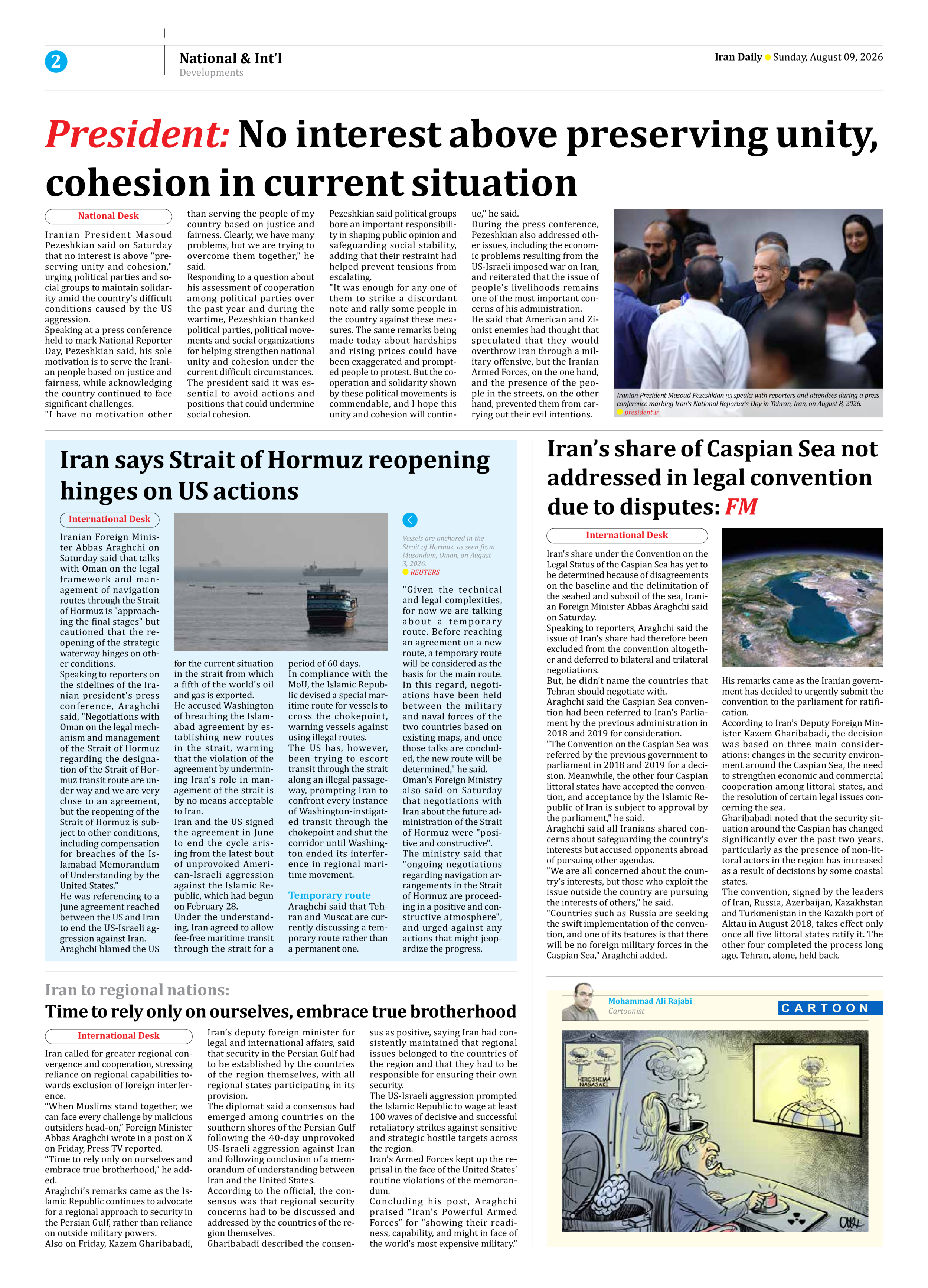
Iran's share under the Convention on the Legal Status of the Caspian Sea has yet to be determined because of disagreements on the baseline and the delimitation of the seabed and subsoil of the sea, Iranian Foreign Minister Abbas Araghchi said on Saturday.
Speaking to reporters, Araghchi said the issue of Iran's share had therefore been excluded from the convention altogether and deferred to bilateral and trilateral negotiations.
But, he didn’t name the countries that Tehran should negotiate with.
Araghchi said the Caspian Sea convention had been referred to Iran's Parliament by the previous administration in 2018 and 2019 for consideration.
"The Convention on the Caspian Sea was referred by the previous government to parliament in 2018 and 2019 for a decision. Meanwhile, the other four Caspian littoral states have accepted the convention, and acceptance by the Islamic Republic of Iran is subject to approval by the parliament," he said.
Araghchi said all Iranians shared concerns about safeguarding the country's interests but accused opponents abroad of pursuing other agendas.
"We are all concerned about the country's interests, but those who exploit the issue outside the country are pursuing the interests of others," he said.
"Countries such as Russia are seeking the swift implementation of the convention, and one of its features is that there will be no foreign military forces in the Caspian Sea," Araghchi added.
His remarks came as the Iranian government has decided to urgently submit the convention to the parliament for ratification.
According to Iran’s Deputy Foreign Minister Kazem Gharibabadi, the decision was based on three main considerations: changes in the security environment around the Caspian Sea, the need to strengthen economic and commercial cooperation among littoral states, and the resolution of certain legal issues concerning the sea.
Gharibabadi noted that the security situation around the Caspian has changed significantly over the past two years, particularly as the presence of non-littoral actors in the region has increased as a result of decisions by some coastal states.
The convention, signed by the leaders of Iran, Russia, Azerbaijan, Kazakhstan and Turkmenistan in the Kazakh port of Aktau in August 2018, takes effect only once all five littoral states ratify it. The other four completed the process long ago. Tehran, alone, held back.